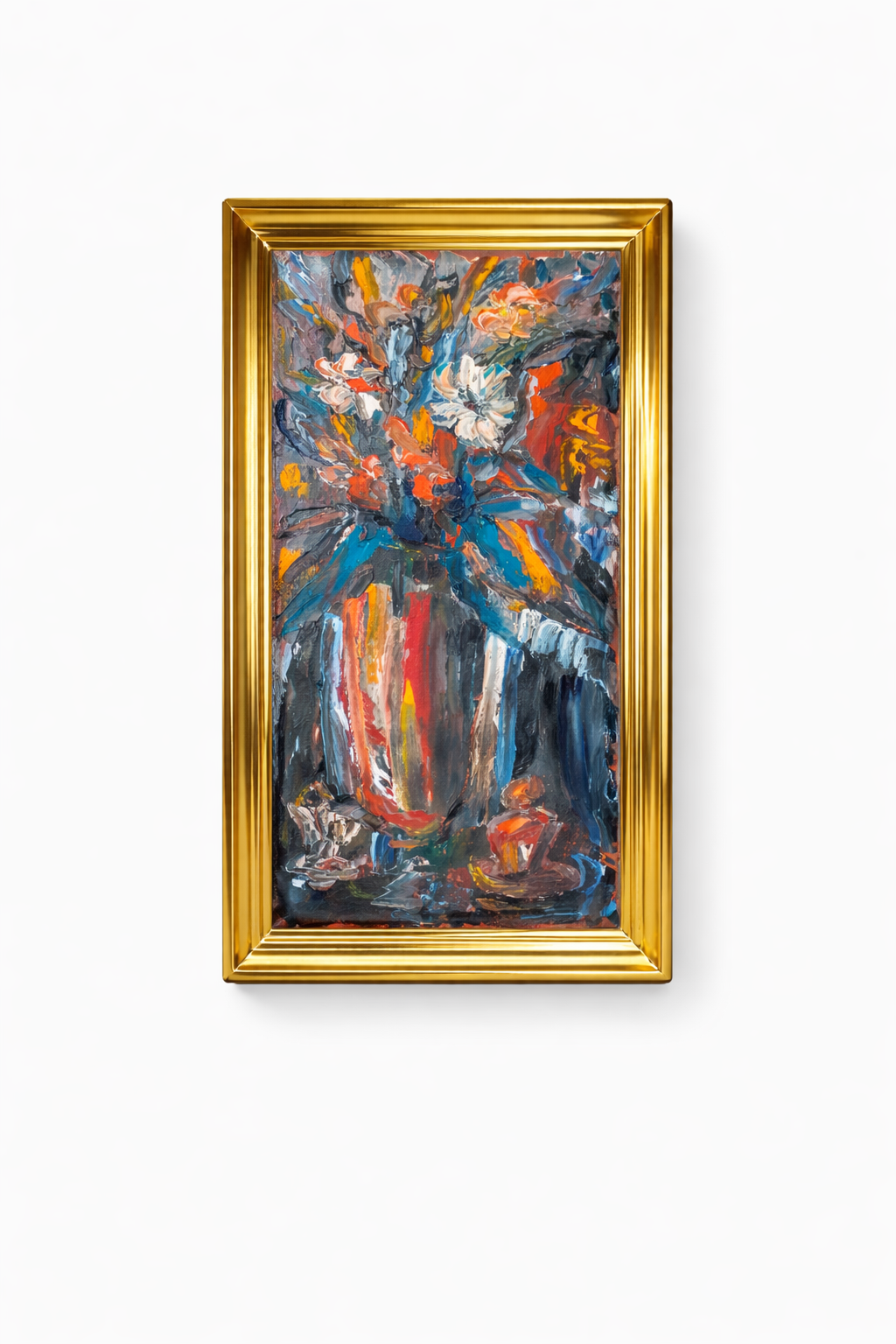
Picture Framing Basics: How a Frame Is Built, Chosen and Made to Last
The phrase picture framing sounds simple, but it covers a surprising amount of ground. A good frame has two jobs at once: it has to present a piece well, and it has to protect it for the long term. Get the first right and the artwork looks settled on the wall. Get the second right and it still looks that way in twenty years. I make frames and mirrors from raw moulding in my own workshop, and I gild them by hand, so most of what follows comes from the bench rather than from a catalogue. My aim here is to give you the whole picture in one place, then point you to the deeper guides where a single decision deserves more room.
What picture framing actually involves
At its core, framing is the craft of holding a piece securely while controlling everything around it: light, dust, moisture and physical knocks. The decorative side, the part most people notice first, is only half of it. The other half is quiet and structural, and it is the part that decides how well a work survives. I have written separately about how a frame protects artwork over time, so here I will keep it short: a frame is a small, sealed environment, and the better it is built, the more stable that environment stays.
The anatomy of a picture frame
It helps to know the parts before you make any decisions, because a frame is more than the strip of wood you see.
- The moulding is the shaped length of timber that forms the visible frame. Its width, depth and profile set the whole character of the piece, and I look at this more closely in my guide to frame colour and material.
- The rebate is the lip on the inside back edge that the artwork and glazing sit behind. Its depth decides what you can fit, which matters a great deal for a deep canvas or a boxed object.
- A mount, or passe-partout, is the card border between the work and the glass. It is decorative, but it also keeps the surface of the work off the glazing, which is important for anything on paper. I cover mounts and other finishing details in my article on decorative frame elements and additions.
- The glazing is the glass or acrylic that covers works under a mount. The choice between standard, anti-reflective and UV-filtering glass is one of the things that separates a shop frame from a made-to-measure one.
- The backing and seal close the frame from behind. Acid-free backing and a proper dust seal are exactly the sort of detail that adds cost and protects the work.
- The mounting is how the work is actually held: hinged, floated or pressure-fitted, depending on what it is. This is where most long-term damage is either prevented or caused.
Knowing these parts makes every later choice easier, because you can see what you are paying for and why.
Standard size, made to measure, or fully bespoke?
This is the question I am asked most often, and the honest answer is that it depends on the piece.
A standard, ready-made frame works when the artwork is a common size, has no real value beyond the decorative, and you simply want it on the wall. There is nothing wrong with that.
A made-to-measure frame becomes the better choice the moment the dimensions are unusual, the proportions need to be exact, or the work has thickness a shelf frame cannot take. Most of my clients come to me at this point, and you can see the range in my custom picture frames, where the width, profile, colour and finish are all chosen for the individual piece.
A fully bespoke frame is the right call for fine art, originals, or anything where the frame is meant to be part of the work rather than a container for it. That is the territory of my bespoke picture frames, where I design and build the moulding itself rather than adapting an existing one.
If you are weighing this up, the simplest test is value and fit: the more a piece is worth to you, and the further it sits from a standard size, the more a custom or bespoke frame earns its place.
Decorative framing versus conservation framing
Not every piece needs the same level of protection, and it is worth being clear about the difference.
Decorative framing is about presentation. The materials are chosen mainly for how they look, and that is perfectly appropriate for prints, posters and reproductions you can replace.
Conservation framing puts the survival of the work first. It uses acid-free, reversible materials throughout, UV-filtering glazing, and mounting methods that can be undone without harming the piece. I offer this as archival and museum framing, and it is the right approach for original art, works on paper, photographs, documents and anything with sentimental or financial value. The guiding principle is reversibility: in a hundred years, someone should be able to take the work out of the frame and find it exactly as it went in.
Different media also ask for different handling. Framing an oil painting, for instance, is not the same as framing a watercolour or a canvas print, and I treat each on its own terms in my work on framing oil paintings and framing canvas prints. If you are framing anything irreplaceable, conservation framing is not an upgrade, it is the baseline.
Choosing a frame that suits both the artwork and the room
A frame answers to two things at once: the work it holds and the room it hangs in. The work usually leads. A bold, modern piece can take a plain, deep profile; a delicate watercolour often wants a wide mount and a quiet frame. The room then decides the finish, whether that is a warm timber, a flat black, or gold. I go further into this in my guide to frame style and aesthetics, but the rule I keep coming back to is restraint: a frame should support a piece, not compete with it.
A word on finishes: paint, gesso and gold
Finish is where a frame stops being joinery and starts being craft. After a frame is built it can be painted, finished over traditional gesso, or gilded, and gilding is the part of the trade I care about most. I lay genuine gold leaf over a hand-prepared gesso and bole ground, the same way it has been done for centuries, which is what gives a real gilded frame its depth and warmth. Genuine gold leaf is not the same as the imitation metal leaf you will often see, so if you are weighing one against the other I explain the difference between gold leaf and Dutch metal in detail elsewhere. You can see the results across my gold gilded picture frames, including a hand-carved frame finished in 23-karat gold leaf, and I have written separately about choosing gold frames for paintings as well as the traditional water gilding method.
The same skills carry straight over to mirrors. A mirror's glass is neutral, so the frame is what gives it character, and I make and gild mirror frames exactly as I do picture frames. If that interests you, I cover it in my piece on mirror frame colours and finishes, and you can browse the range in my decorative mirrors. A frame and a mirror frame are, in the end, the same craft pointed at two different jobs.
How I make a frame, step by step
It may help to see how the parts come together in practice. When a piece arrives, I start with the work itself, not the frame.
First I measure carefully and assess what I am framing: paper, canvas or a three-dimensional object, because that decides everything that follows. Then I choose and cut the moulding, working from raw lengths rather than pre-made corners, and join the corners so they sit tight and square. For a gilded frame I prepare the surface with layers of gesso, sand it smooth, lay the bole, and only then apply the leaf and burnish it. After finishing, I fit the work using the right mounting for its medium, add the glazing and mount where needed, and close the back with acid-free backing and a clean dust seal. The last check is always the same: that the frame is square, sealed and stable, so it holds its geometry for years rather than months.
Working this way, alone and by hand, is slower than assembling a frame from stock parts. It is also the reason the result lasts, and the reason I can tailor every detail to the piece in front of me. You can read more about how I work on my about page.
Picture framing questions I am often asked
What does picture framing involve?
Picture framing involves choosing and building a frame that both presents a work and protects it. In practice that means selecting a moulding, deciding on a mount and glazing, mounting the piece securely, and sealing the back, so the artwork is held safely and shown at its best.
What is conservation framing?
Conservation framing is a method that puts a work's long-term survival first. It uses acid-free, reversible materials, UV-filtering glazing and mounting that can be undone without damage. It is the right choice for original art, works on paper, photographs and anything irreplaceable.
What is box framing?
Box framing, sometimes called a box frame, uses a deep frame with a spacer that holds the glazing away from the surface of the work. It suits canvases, textiles and three-dimensional objects that need room and should not touch the glass.
How do I frame an oil painting?
An oil painting on stretched canvas is usually framed without glazing, set into a frame deep enough to take the stretcher, often with a small gap or a slip between the canvas and the moulding. Because oils are sensitive to handling, a frame made to the exact size protects the edges best.
Do I need a custom frame, or will a standard size do?
A standard frame is fine for common sizes and replaceable prints. A custom or made-to-measure frame is worth it when the dimensions are unusual, the proportions must be exact, the work is deep, or the piece has real value to you.
What is a gesso frame?
A gesso frame is a timber frame coated in gesso, a traditional ground made from chalk and glue, which is sanded smooth to create the perfect surface for paint or gold leaf. It is the foundation of most hand-gilded and finely finished frames.
Why does professional framing cost more than a shop-bought frame?
Professional framing costs more because the materials and the work are different: made-to-measure moulding, conservation-grade backing and glazing, hand-joining and hand-finishing all take time and skill. I break the cost down in detail in my guide on why professional picture framing is so expensive.
If you have something waiting to be framed and you are not sure which approach it needs, that is exactly the kind of thing I help with every week. Whether it points towards a ready profile, a custom picture frame or a fully bespoke one, the starting point is always the piece itself. Feel free to tell me about it and I will talk you through the options.