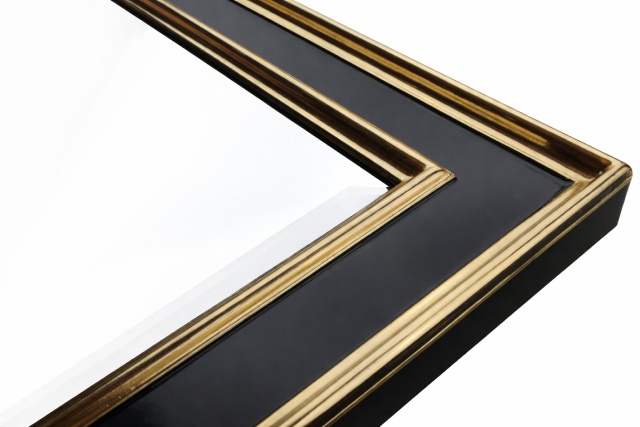
Black and Gold Framed Mirror — Classic Profile, Hand-Gilded with Real Gold Leaf
A black and gold framed mirror brings together two qualities that rarely meet in a single object: the discipline of a classic moulding profile and the living glow of genuine gold leaf. This is not a "glamour" mirror in the popular sense — there are no high-gloss lacquered surfaces competing for attention, no chrome finishes. Instead, you get a sculpted wooden moulding, deep lacquered black, and two gilded channels running along the profile, hand-gilded with 23-karat yellow gold. The result sits within the long tradition of classical framing while feeling at home in contemporary interiors where proportion and craft are valued.
This article looks at what makes a black and gold framed mirror distinctive, why a classic moulding is a different proposition from a glamour frame, and where this kind of mirror works best — from living rooms to hallways. It is written for anyone looking for a decorative wall mirror with presence, but without ostentation.
What distinguishes a black and gold framed mirror
Black and gold is an old combination in interiors — from 17th-century lacquered frames to Art Deco mirrors. Contemporary pieces in this palette draw on both traditions. Black stabilises the composition: it absorbs light, sharpens edges, and makes the mirror glass feel deeper. Gold does the opposite — it reflects and scatters light, creating a subtle halo around the frame.
In the model shown here, a classic profile is traced by two parallel gilded channels in yellow 23-karat gold leaf. One runs along the inner edge, directly beside the mirror glass; the other follows the outer edge of the profile. A flat lacquered black surface sits between them. The visual effect is one of a double-bordered setting — the mirror glass is framed twice by a thin gold line, which optically isolates it and gives the whole piece a sense of order.
Classic profile vs. glamour frame — not the same thing
The term "glamour mirror" usually refers to a frame with smooth, rounded edges and a uniform finish — often white gold, mirror-polished chrome, or a modern high-gloss surface. A classic moulding works differently. It has multiple tiers, hollows, and ridges that create a constant play of light and shadow. This is exactly why it pairs so naturally with gold leaf: the uneven surface means the gilding never reads as a flat field, and the slight wear in the recesses gives the frame depth.
For anyone torn between styles, this distinction matters. Glamour mirrors tend to land in clearly contemporary settings — minimalist, with polished surfaces and metallic accents. A classic black-and-gold frame has broader range: it sits comfortably in an eclectic scheme, but also in a more traditional living room with wooden furniture. It is a frame that does not dictate the style of the room — it adapts to it.
23-karat gold on black lacquer — the visual effect
Choosing 23-karat yellow gold is a design decision, not a cosmetic one. The higher gold content produces a deeper, warmer glow than imitation dutch metal or cooler 22-karat moon gold. In daylight, the gilded channels take on a rich, saturated tone; under warm evening lighting, they come alive — throwing small sparks of reflection even from a distance.
Against a black background, the effect is especially pronounced. Deep lacquered black dampens ambient reflections, so the gold channels become the dominant feature of the frame — they do not compete with the lacquer, they simply mark its boundaries. This is why these mirrors hold their presence even in bright, open interiors. Gold laid leaf by leaf, by hand, also has a quality that mass-production cannot replicate: slight irregularities and the faint trace of the gilder's tool at the edge of each leaf give the surface a character that reads as alive.
Where a black and gold framed mirror works best
A rectangular shape is the most versatile form among decorative mirrors. It works equally well vertically or horizontally — the choice of orientation depends on the wall and the neighbouring furniture. Because of its strong colour contrast, a black and gold framed mirror performs well in several types of rooms.
Living room
Above a sofa, over a fireplace, or as the focal point of an empty wall — a rectangular wall mirror in a black and gold frame brings order to a living-room composition. It works beautifully against cool greys, navy blue, deep bottle green, or a plain white wall, where the black reads as a graphic accent. In the rest of the room, pairing it with other gold details — a lamp, coffee-table legs, a candlestick — helps it feel intentional, without multiplying shine beyond the point of restraint.
Hallway
In a narrow hallway, a rectangular mirror plays both a practical and a decorative role. A black frame does not visually dissolve the way a white one does; instead, it creates a defined anchor that optically deepens the space. The gold channels then act as light — they catch the eye and lift the mirror away from the wall. This is especially useful where the hallway is modestly lit.
Getting shape, format, and hanging height right matters in a hallway — I cover this in more detail in the article on how to choose the right hallway mirror, along with practical notes on proportion and lighting. The full selection is available in the entrance mirrors category.
Dining area and console arrangements
Above a console in a corridor, over a sideboard in a dining room, or as the companion to a dressing table — a black and gold frame sits well next to wood, particularly in darker tones (walnut, stained oak, wenge). Placed above a buffet, it can serve as a classic decorative element that holds the character of the room for years, regardless of how the surrounding accessories change.
Details of craftsmanship
The quality of a classic black and gold framed mirror comes from decisions made at every stage. The moulding is made from solid, high-quality wood — not laminated — and shaped so the profile has a clear rhythm of light and shadow. Corners are joined with wooden dowels, which gives the construction stability and resistance to warping over years of use.
The black is built up through multiple coats of lacquer, each smoothed before the next is applied, until the surface gains an even, saturated depth. Only then is gold leaf laid down. Gilding the two channels — the inner one beside the mirror glass and the outer one at the edge — is the most demanding stage: each leaf has to be fitted to the curve of the profile without creases or gaps. Traditional craft techniques give every piece its durability and finished feel.
The mirror glass is SGG Miralite® Pure Diamant 4 mm, OptiWhite — neutral in tone, without the greenish cast typical of standard mirrors. For commissions where the mirror plays the leading role in the interior, a ground bevel up to 20 mm wide is available. The bevel adds a quiet crystalline sparkle to the glass, without drawing attention away from the frame.
All decorative mirrors are made to measure. The dimensions given cover the full mirror including the frame; the width and depth of the moulding are fixed for the chosen profile — only the overall format varies.
Made to measure
Each mirror is produced as a single piece, to the customer's exact dimensions. That matters in practice: mass-market wall mirrors come in a handful of standard formats, which rarely match the real dimension of a wall. A made-to-measure commission removes this problem — the mirror is built to the format agreed, and it sits in its setting exactly as the client or interior designer intended.
Beyond the standard black-and-gold version, several variations are possible: a deeper or softer black, other gold tones (22-karat moon gold for a cooler reading), or — on request — a different lacquer colour on the panel. This kind of personalisation matters especially when the mirror needs to work with a specific piece of furniture or fabric in the room.
In short
A black and gold framed mirror is a piece for people who value classic character but do not want to give up a strong presence in the room. A shaped moulding, lacquered black, and two channels hand-gilded with 23-karat gold leaf produce an effect that cannot be reached through mass production — every piece carries the mark of the maker's hand. It is a decorative wall mirror that works as a graphic accent in contemporary interiors, and as an anchor of character in more traditional ones.
If this is the aesthetic you are looking for, see our bespoke mirror in a black frame gilded with real gold leaf — an example of how a classic profile meets hand gilding.