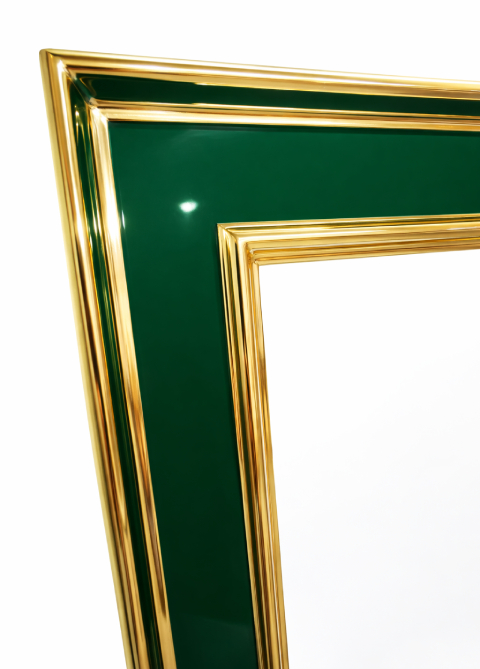
Mirror Frame Colours and Finishes: Choosing Gold, Silver, Black and Mirrored Frames
A mirror does two jobs at once. It reflects light and space, and it decorates a wall. The glass itself is neutral, so the part that decides the whole character of a mirror is the frame, and within the frame it is the colour and finish that do the work. The same mirror in warm hand-gilded gold, cool silver, sharp black or a high-shine mirrored frame will read as four completely different pieces. Get the finish right and a mirror stops being a functional object and becomes the focal point of the room.
I make every mirror frame from raw timber in my own workshop and finish each one by hand, including gilding with real gold leaf. Below I explain the finishes I offer, what each one does to a room, and how I help clients choose. I have given the gold tones the most space, because the difference between carats is the question I am asked most often and the one least understood, and it is exactly what gives a glamour mirror its mood.
Why the frame finish decides the character of a mirror
Because the glass is the same in every mirror, the frame is where all the personality lives. A finish does three things: it sets the mood, it controls how the mirror interacts with light, and it ties the piece to the rest of the room. A reflective gold or mirrored frame throws daylight back into a space and makes it feel brighter and larger; a matte black frame contains and grounds; a soft silver lightens. This is why I never treat finish as an afterthought. Before I build a mirror I want to know where it will hang, what the wall colour is, and how the room is lit, because daylight and warm lamplight pull very different tones out of a gilded or painted surface.
Gold mirror frames: the carat tones I gild by hand
All of my gold finishes are real gold leaf, laid by hand using traditional water gilding over a coloured clay base called bole, then sealed with a protective lacquer. The carat number tells you the purity of the leaf, and that purity changes both the colour and the way the frame reflects light. It is not a marketing distinction. Stand two gilded mirrors side by side and the difference is obvious, which is why I offer the full range across my glamour mirrors. Here is how each tone behaves.
6-carat gold: pale, cool and contemporary
Six-carat leaf is the palest gold I use. It leans towards a soft, almost silvery warmth and reads as light and modern rather than opulent. I reach for it when a client wants the presence of gilding without the richness, for example in a minimalist bedroom or a pale, contemporary living room where a deep gold would feel heavy. It sits beautifully against white and grey walls.
12-carat gold: a balanced, classic gold
Twelve-carat is the middle ground, a true and even gold that is neither cool nor heavily warm. That makes it the most versatile of the tones and a safe choice when a room mixes styles. It gives a mirror a classic gold presence without committing to a strongly period look, and it pairs well with both warm and cool interiors.
22-carat moon gold: bright and light-reflecting
Twenty-two-carat moon gold is the most luminous finish on my bench. It has a bright, clean reflectivity that catches and throws daylight, so a mirror framed in moon gold genuinely lifts the light in a room. I often choose it for a glamour mirror that needs to feel elevated and gallery-like without tipping into heaviness, and it is especially effective in a darker room that needs lifting.
23-carat ducat gold: warm, deep and regal
Twenty-three-carat ducat gold is the richest, warmest tone I offer. It has a deep, saturated colour that reads as genuinely luxurious and is the gold most people picture for an art déco or grand interior. I use it where the brief calls for warmth and presence: a statement mirror over a fireplace, a dining room, or a bedroom dressed in a glamour style. If you want to see the warmth of a gilded frame on a finished piece, I have written about a gold framed mirror in detail. The same leaf and method go into my gilded picture frames, so a mirror and its surrounding frames can be matched exactly.
Silver and cool-toned mirror frames
Silver is the choice for lightness and subtlety. A cool, silvered frame brings freshness to a room and pairs beautifully with pastels, pale wood and marble. It reads as clean and contemporary, and because cool tones recede slightly it can make a wall feel more open. Silver works equally well in a minimalist scheme and in a classic interior, and it is often the right answer when a gold frame would feel too warm against the existing palette. You will find these lighter, cooler styles across my decorative mirrors and my classic mirrors.
Black mirror frames: contrast and drama
A black frame is for people who want a strong, confident accent. Its depth creates contrast that draws the eye, and it looks striking against a light or white wall. The finish matters as much as the colour: a flat matte black feels architectural and modern, while a black with a little sheen, or a black paired with metallic detail, feels more glamorous. A black-framed mirror anchors a room and works particularly well in a larger, open space where it can hold its own. I have written more about the look in a mirror in a black frame.
Black and gold mirror frames
One of the most requested combinations is black with a gilded edge or gilded detail. It brings together the drama of black and the warmth of gold, and it suits both classic and contemporary interiors depending on the profile. The gilded element keeps the piece from feeling too severe, while the black grounds the gold so it never reads as fussy. I covered the pairing in detail in a black and gold framed mirror.
Mirrored and high-gloss frames: maximising light
For the brightest, most spacious effect, a mirrored or high-gloss frame reflects the room back into itself. This is the finish to choose when the goal is to open up a space: the frame and the glass together bounce light around and make a small room feel noticeably larger. These finishes are perfect in the rooms where light is at a premium, which is why they work so well in hallways, bathrooms and dressing rooms. They also add a modern, eye-catching detail that a plain frame cannot.
Matching a mirror finish to the room
The right finish depends as much on the room as on personal taste, so this is how I think it through with clients.
In a living room or a formal reception space, a warm 12 or 23-carat gold or a bold black-and-gold mirror makes a confident statement above a fireplace or sofa. In a bedroom, the choice often comes down to mood: warm ducat gold for a rich, glamorous feel, or pale 6-carat gold and silver for something softer and calmer. In a hallway, where space and light are usually tight, a mirrored, silver or bright moon-gold frame opens the area up and brightens it. And in a bathroom, a lacquered gold or mirrored frame brings warmth and light to a room that is often cool and functional, provided the finish is well sealed for the conditions.
There is rarely a single correct answer, but these questions usually narrow it to two finishes, and seeing samples settles it. Because every mirror is made to order, the finish is genuinely yours to choose rather than whatever a standard range happens to stock. You can see the full made-to-measure range under mirrors in frames.
How I protect a gilded mirror frame
A finish is only as good as its durability, and this is where hand work earns its keep. After gilding, I seal the surface with a high-quality protective lacquer that guards the leaf against oxidation, handling and the gradual loss of shine. Done properly, a gilded mirror keeps its lustre for many years rather than dulling within a season. Painted and silvered finishes are built up and sealed in the same careful way, so the colour stays true and the surface stands up to everyday use, including in the damper conditions of a bathroom when the right protection is applied.
Commissioning a made-to-measure mirror in your chosen finish
If you have a wall that deserves the right mirror, the process is simple. Tell me about the room and the look you are after, and I will recommend a tone and finish, prepare samples where it helps, and build the mirror to measure in any size and shape. Whether you want a hand-gilded gold glamour mirror, a soft silver frame, a sharp black profile or a high-shine mirrored frame, I make each one individually rather than from stock. You can browse the styles across my mirrors in frames and decorative mirrors, and I am always happy to talk a choice through before anything is made.
Frequently asked questions about mirror frame colours and finishes
Are gold mirrors still in style?
Yes, and a hand-gilded gold mirror stays in style precisely because it is timeless rather than trend-led. What changes is the tone and the profile. A bright moon-gold or a slim, restrained gilded frame reads as contemporary, while a deep ducat gold on an ornate profile reads as classic and glamorous. Choosing the carat to suit your interior is what keeps a gold mirror current.
What is the difference between 22-carat and 23-carat gold leaf?
The difference is tone. Twenty-two-carat moon gold is brighter, cooler and more reflective, so it lifts light and feels contemporary. Twenty-three-carat ducat gold is warmer, deeper and more saturated, giving the rich, glamorous look most people associate with a classic gold mirror. Both are real gold; the choice is about the mood you want in the room.
What colour mirror frame suits a small room?
For a small or dark room, choose a finish that reflects light: a mirrored or high-gloss frame, a cool silver, or a bright 22-carat moon gold. All three bounce light around and make the space feel larger and airier. I would avoid a heavy matte black in a genuinely small room, as it can close the space down.
Black or gold mirror frame for a modern interior?
Both can be modern; it depends on the profile and the wall. A flat matte black on a clean, simple profile is strongly contemporary and sharp against a light wall. A pale 6-carat gold or a slim moon-gold frame is modern in a warmer way. If you want the best of both, a black-and-gold frame bridges the two.
What is water gilding?
Water gilding is the traditional method of applying genuine gold leaf over a smoothed coat of bole, a fine clay, which is then burnished to a deep shine. It is more demanding than other methods but gives the richest, most luminous result and allows the warm bole to show at the edges. I explain the craft in full on my water gilding page.
Will a gilded mirror frame tarnish or fade over time?
Genuine gold leaf does not tarnish the way base metals do, and once I seal the surface with a protective lacquer it is well guarded against oxidation, handling and loss of shine. With normal care a properly finished gilded mirror holds its appearance for many years.