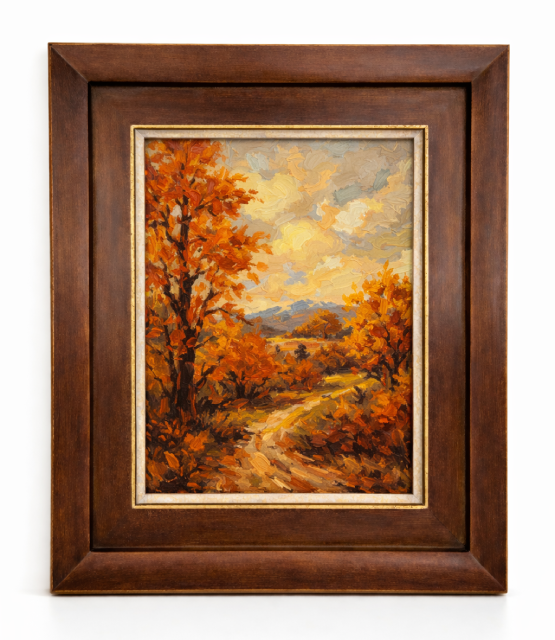
Picture Frame Styles and Types: A Maker's Guide to Choosing the Right Frame
Choosing a frame is rarely a single decision. Before colour or size comes a more basic question: which family of picture frame styles suits the work, and which physical type of frame will hold it. The two are easy to confuse, but they answer different needs. Style is about character, whether a piece looks at home in a period drawing room or a pared-back modern flat. Type is about construction: the shape of the profile, the depth of the rebate, and the way the frame sits around the artwork.
I work alone and cut, join and finish every frame by hand, so I weigh both at once for each commission. This guide sets out the main styles, the construction types behind them, and the finishes that bring them to life, with the practical reasoning I use whenever a client is undecided.
Style versus type: two decisions, not one
Frame style is the aesthetic language of the frame: classic, modern, rustic, glamour, and so on. It is what most people mean when they ask which frame "goes with" a painting. Frame type is the build: a standard rebated moulding, a reverse or Dutch profile, a floating or box frame, a deep or wide section. A single style can be produced in several types, and the same type can be finished in several styles. Getting both right is what makes a frame feel inevitable rather than simply added on.
The three main picture frame styles
Most of the frames I am asked for fall into three broad families. They are not rigid categories, and the most interesting commissions often borrow from more than one, but they are a useful place to start.
Classic and traditional frames
Classic frames carry ornament with confidence: carved profiles, swept corners, and warm gilded surfaces. They suit oil portraits, landscapes, sacred works, and anything with a historical or romantic character. The scale matters as much as the decoration; a generous profile gives a small painting presence, while an over-busy moulding can crowd a delicate work. Most of the classic frames I build are gilded by hand, which is why a true gold surface reads so differently from a printed gold-effect finish. If this is the direction you are drawn to, my classical-style picture frames and the gold gilded picture frames in the shop show the range, and there is more on the look in my note on classic picture framing.
Modern and minimalist frames
Modern frames do the opposite: clean lines, slim profiles, and quiet colours that let the work breathe. A thin section in black, graphite or white is often enough to set a clear boundary without competing for attention. This family suits prints, photographs, abstracts and contemporary painting, and it is the one clients most often underestimate, assuming a plain frame is a non-decision when in fact the proportion of a narrow profile is just as considered. For ideas on this look, see modern style picture frames, along with the black picture frames and white picture frames in the shop.
Eclectic and statement frames
Between the two sit the eclectic styles: rustic frames with visible grain and honest tool marks, industrial finishes, vintage profiles, and glamour frames built for shine. These reward a confident eye and a clear interior. A rustic frame anchors a still life or a landscape; a glamour finish turns a frame into the focal point of the wall. If you are matching a frame to a particular room rather than a particular painting, my guide to frames chosen by interior style and the piece on stylish frames in interior design are good starting points.
Picture frame types: the profile does the work
Once the style is settled, the construction decides how the frame behaves around the artwork. These are the types I build most often, and the differences are practical, not just visual.
Standard rebated moulding
The familiar shape: an L-section with a rebate that holds glass, mount and artwork from the front, with the work secured from behind. It is the most versatile type and can be made in any style, from a plain modern profile to a richly carved classic one. For most paintings, drawings and photographs, this is the sensible default.
Reverse and Dutch profiles
A reverse profile slopes so that its lowest point sits at the outer edge and its highest at the sight edge, drawing the eye inward toward the painting. The Dutch frame, the dark ebonised moulding with a fine inner gilded lip associated with the Golden Age, is the best-known example, and its restraint is deliberate: the frame supports the work rather than overshadowing it. I explain both at length in Dutch frames uncovered and in my comparison of reverse and coved profiles.
Floating and box frames
In a floating frame the canvas sits within the moulding with a narrow shadow gap around it, so the work appears to hover rather than to be enclosed. The American box frame is the classic version of this idea and suits contemporary, abstract and large-format paintings where the edge of the canvas is part of the composition. Box framing extends the same principle to objects, holding medals, textiles or memorabilia in a deeper space behind glass. There is a full account in my article on the American box frame for a painting.
Deep and wide frames
Depth and width are types in their own right. A deep rebate is needed for thick stretcher bars, three-dimensional pieces, or any work that needs space between the artwork and the glass. A wide profile gives presence to large paintings and helps a modest work hold a big wall. For canvases in particular, the rebate has to match the depth of the stretcher exactly, which is one of the clearest reasons to work to measure rather than to a standard size. I cover this in the wide wooden frame and in my guide to frame types for canvas paintings.
Finish and material: where a style becomes tangible
Style and type set the form; finish is what you actually see. I build in solid wood, then prepare each frame with a gesso ground (the smooth chalk-and-glue base that takes gilding or paint). On a gilded frame, that ground is followed by bole, a fine coloured clay, and then genuine gold leaf laid by hand. The carat and the colour of the leaf change the mood completely, from cool, pale gilding through to deep, warm ducat gold, with moon gold, white gold, palladium and silver leaf as alternatives. A painted or patinated finish gives a different character again. If you are weighing the options, my guide to frame colour and material is the place to start, the difference between genuine gold leaf and Dutch metal is worth understanding before you commit, and the gilded and partially painted frames show how the two can be combined on one profile.
Matching style and type to the artwork and the room
The frame has two jobs at once: it has to fit the artwork and it has to fit the room. A gilded classic profile that looks perfect on a portrait can feel heavy in a minimalist flat; a slim modern frame that suits a print can look thin around an oil. I usually start from the work, choose the style family that reflects its character, then adjust the proportion and finish so the frame settles into the interior rather than fighting it. People often ask whether gold frames are out of style, and the honest answer is no: a well-chosen gold frame is timeless, and it reads as dated only when the proportion or the finish is wrong for the piece. For the full reasoning, see my guide to frame style and aesthetics and the practical walkthrough on how to match a frame to your interior and artwork.
Ready-made or made to measure
A ready-made frame is the right call when the artwork fits a standard size, the work is not especially valuable, and you want it framed quickly. Made to measure earns its place when the piece is an unusual format, when the proportion has to be exact, when the frame becomes part of the composition, or when the work deserves archival care. In practice, anything stretched on a non-standard bar, anything on canvas with depth, and anything you intend to keep tends to do better in a frame built for it. I set out the trade-off in when to choose a custom frame; you can read more about the service on my bespoke picture frames page, and browse the range of made-to-measure picture frames in the shop. If you would like the full picture, my overview of the frame types, styles and customisation options I offer brings the choices together in one place.
The same language applies to mirror frames
A framed mirror is, at heart, a frame built around glass, so the same styles and types apply. The classic and modern families carry straight across: an ornate gilded surround turns a mirror into a decorative centrepiece, while a slim or near-invisible profile suits a minimalist room and answers the popular ask for a modern, almost frameless look. Glamour mirrors take the eclectic, high-shine end of the spectrum and make the most of it. I make every mirror frame to measure in exactly the same way as a picture frame, which is why the choice of finish carries the same weight. The mirrors in frames, decorative mirrors and glamour mirrors categories show the range, and my guide to mirror frame colours and finishes walks through the options.
How I make each frame
Whatever the style or type, the process in my workshop is the same. I start with solid timber, cut and join the profile with traditional corner joints, then prepare the surface with gesso before any finish goes on. Gilded frames are then sized, boled and leafed by hand, a method known as water gilding with genuine gold leaf; painted and patinated frames are built up in layers and worked back by hand. Because I make each piece individually rather than to a catalogue, the size, profile, finish and corner detail are all yours to decide. That is the real meaning of a frame made to measure: not a standard moulding cut to length, but a frame designed around one specific work.
Frequently asked questions
What is frame style?
Frame style is the aesthetic character of a frame, the design language that decides how it looks and what it suits. The main styles are classic (ornamented and often gilded), modern (slim, plain and minimal), and eclectic (rustic, industrial, vintage or glamour). Style is separate from frame type, which describes the construction rather than the look.
What are the main types of picture frames?
The most common types are the standard rebated moulding, the reverse or Dutch profile, the floating or American box frame, and deep or wide frames. The type is chosen for how the frame holds and presents the work, while the style is chosen for its appearance. Many frames combine a single type with one of several possible styles.
What is the difference between a classic and a modern frame?
A classic frame is ornamented, often carved and gilded, and is designed to add richness and a sense of tradition. A modern frame is plain and slim, designed to set a clean boundary and let the work speak for itself. Classic frames suit oils, portraits and period interiors; modern frames suit prints, photographs and contemporary rooms.
What is box framing?
Box framing holds the artwork or object in a deeper space behind the glass, with room between the front of the work and the glazing. It is used for canvases that need to float, and for three-dimensional items such as medals, textiles and memorabilia, where a flat frame would press against the piece.
Are gold picture frames out of style?
No. A well-made gold frame is a timeless choice and works in both classic and modern interiors. It only looks dated when the proportion is wrong for the artwork or when the gold is a printed effect rather than a genuine gilded surface. Chosen carefully, a gold frame adds warmth and presence without overwhelming the work.
Should I choose a ready-made or a bespoke frame?
Choose ready-made when the artwork fits a standard size and you want a quick, economical option. Choose bespoke when the format is unusual, the proportion has to be exact, the frame is part of the composition, or the work needs archival protection. Anything on a non-standard canvas, or anything you plan to keep, is usually better in a frame built to measure.