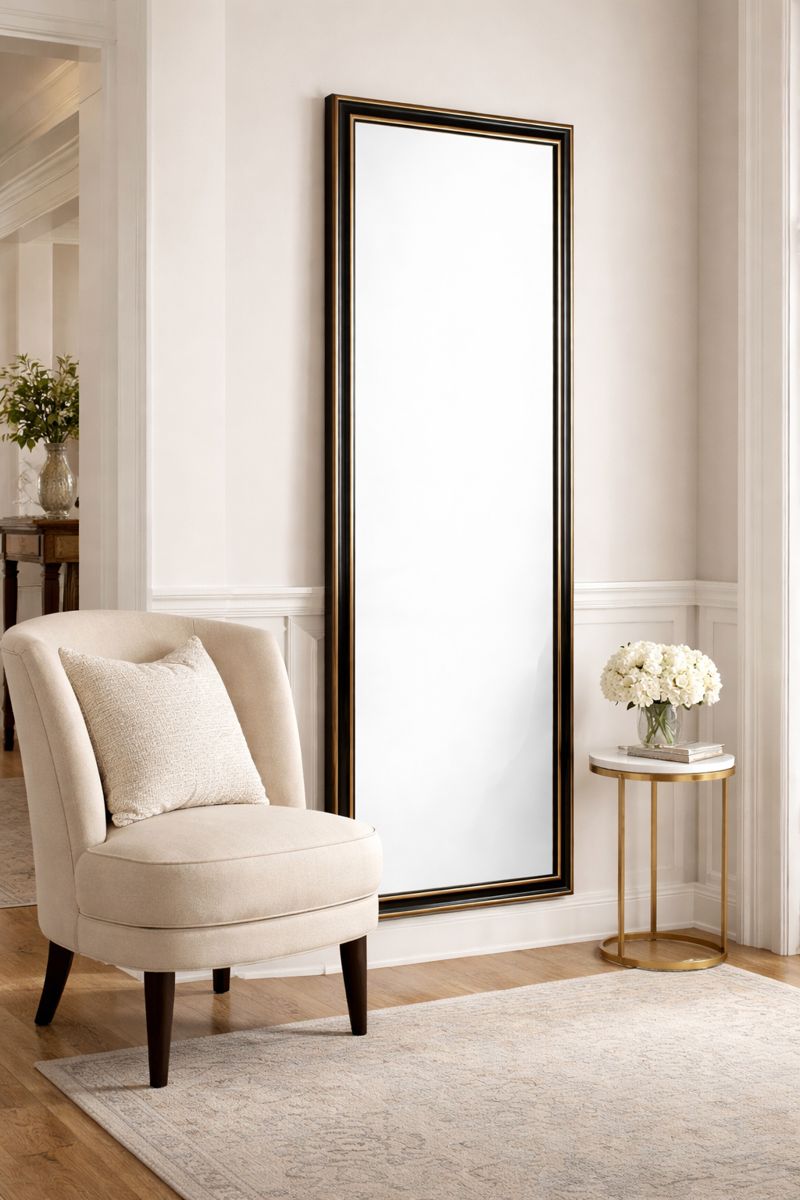
Mirror Sizes and Shapes: How to Choose the Right Format for Your Space
Two decisions settle whether a mirror belongs in a room or simply hangs on the wall: its size and its shape. Get the mirror sizes and shapes right and the piece looks as though the room was built around it. Get them wrong, and even a beautiful frame feels borrowed from somewhere else. In my workshop I build every mirror to measure, so before I cut a single length of moulding I work through the same questions with each client: how large should it be, which format suits the wall, and what shape carries the style of the room.
This guide walks through how I approach those choices, room by room, so you can arrive at a size and shape with confidence and then have the mirror made to fit.
Why size and shape decide whether a mirror works
Ready-made mirrors come in a narrow band of standard formats, and those formats rarely match the real dimensions of a wall. A mirror that is a few centimetres too short over a sideboard, or a touch too wide beside a doorway, reads as an afterthought. Building to measure removes the problem: the mirror is made to the exact format agreed, and it sits in its setting the way you or your designer intended. That is the whole point of my made-to-measure mirrors, where the size, profile, colour and finish are all chosen for one specific place.
Because each piece is produced individually, the format is genuinely open. I have built slim mirrors for the tightest hallways and tall panels well over a metre and a half in height. If you already know the space, a custom mirror in a gilded frame can be sized to the centimetre rather than approximated from a catalogue.
How I work out the right mirror size
Most rooms give you a clear anchor to size against. Over a piece of furniture, a reliable starting point is a mirror surface that spans roughly two thirds to seventy per cent of the width of the console, sideboard or vanity beneath it. That keeps the mirror dominant enough to matter without crowding the wall. For hanging height, I centre a mirror at eye level, which usually falls around 150 to 160 cm (about 59 to 63 in) from the floor, adjusted for the household.
A full-length mirror follows a different rule: it needs to capture a head-to-toe reflection with a little margin, so I plan the glass height from the tallest regular user rather than from a fixed number. I have covered these proportions in more depth in my guide on how to choose the right hallway mirror, and the same logic transfers to living rooms and bedrooms.
The practical difference with a made-to-measure piece is that I calculate from the wall, not from stock. You tell me the width and height available and where it will hang, and the mirror is built to those figures.
Portrait, landscape or square: choosing the format
Format, meaning the orientation and proportion of the mirror, does as much work as raw size. A tall, portrait format draws the eye upward and is the natural choice for a narrow wall or a room where you want to suggest height. A landscape format does the opposite, visually widening a wall and working well above a long sideboard or a bath. A square sits between the two and reads as a quiet, contemporary accent.
Some designs are deliberately flexible. The Nero Glam 23K, for instance, can be hung either vertically or horizontally, so the same mirror adapts to the wall you have. When a format is not fixed in advance, I recommend deciding it against the specific space rather than in the abstract.
Mirror shapes: rectangular, round, oval, arched and irregular
Shape is where a mirror shows its character. A rectangular mirror is the most versatile and suits classic and modern interiors alike, which is why it remains the most common request. A round mirror softens the hard geometry of a hallway or a gallery wall and sits beautifully above a console. An oval carries a more traditional, elegant note, while an arched top adds an architectural feel that flatters period rooms. Irregular and organic outlines are the boldest option, drawing attention through form alone and breaking up strictly geometric arrangements.
Because I build the moulding by hand, shape is not limited to what a supplier happens to stock. My decorative mirrors span these outlines in a range of proportions, and any of them can be adjusted to the size your wall calls for.
Choosing a mirror size by room
Every room asks a slightly different question of a mirror, and the right size and shape follow from how the space is used.
Hallways and entrances. The hallway is usually the smallest room in the home and the first anyone sees. Narrow corridors work best with tall, vertical formats that add light and a sense of height without stealing width, while a larger entrance can carry an oversized mirror as a focal point beside a console. My hallway mirrors are built with exactly these proportions in mind, and I set out the process in my note on ordering a made-to-measure mirror for a tight space.
Living rooms. Here a mirror can be a statement. A large format over a sofa or fireplace bounces daylight through the room and becomes a centrepiece in its own right. Richly profiled glamour formats suit this role, and a piece such as a black and gold framed mirror holds the character of the room for years. The full range of statement pieces sits in my glamour mirrors collection.
Bathrooms. Above a vanity, the format usually follows the basin and cabinetry, with a little breathing room on each side. What matters most is that the glass and finish are made for a humid environment. My bathroom mirrors use moisture-resistant lacquers and glass suited to the room.
Bedrooms and dressing areas. A full-length mirror is the priority here, sized for a complete reflection and often placed where daylight can reach it.
How each mirror is built to your dimensions
Once the size and shape are settled, the making follows. I build the frame from solid timber and mill the moulding profile to the depth and width the design calls for, so the outline is shaped in solid wood rather than pressed from moulded compo. Corners are usually joined with biscuit joints for a clean, stable mitre. From there the frame is either hand-painted and lacquered or given a traditional gesso ground and water gilded with genuine gold leaf, in carats from 6-karat white gold through to 23.75-karat yellow, depending on the tone you want.
For the glass I use high-clarity mirror, and for the brightest, most neutral reflection I can specify SGG Miralite Pure Diamant. Where a mirror shares a wall with framed artwork, museum-grade glazing with UV and anti-reflective coatings is available. I agree every finish from photographs of previous work, so you can see exactly how a colour and a carat behave before I begin. I ship internationally, and a made-to-measure mirror typically takes around four to eight weeks depending on the finish.
These are the same materials and techniques I use for framing, which is why some clients order a mirror and their picture frames in matching finishes so a whole room reads as one composition. I explain that side of the work in my guide to custom gilded picture frames.
How to order a mirror in the size and shape you need
The simplest way to start is to send me the width and height available on your wall, along with a photograph of the space. From there I suggest a suitable format and shape, prepare an individual design, and quote the piece, with pricing worked out from the perimeter and the finish. Whether you know your dimensions to the centimetre or only have a rough idea of the wall, I can guide you to a size and shape that fits the room and then build the mirror to match.
Frequently asked questions
What size mirror should I hang above a console table?
As a guide, choose a mirror that spans about two thirds to seventy per cent of the width of the console, centred at eye level, roughly 150 to 160 cm from the floor. Because I build to measure, I can size the mirror precisely to your console rather than to the nearest standard format.
Should a mirror be portrait or landscape?
A portrait format adds height and suits narrow walls; a landscape format widens a wall and works above long furniture. If you are unsure, I help you decide against the specific space, and several of my designs can be hung either way.
What shape of mirror works best in a small room?
A tall rectangular or a round mirror usually works best in a small room, as both add light and a sense of space without dominating. A round shape in particular softens a tight hallway or corner.
Can I order a mirror in a non-standard size?
Yes. Every mirror I make is built to measure, so non-standard widths, heights and formats are the norm rather than the exception. You give me the dimensions and I build to them.
How high should a mirror be hung?
Centre the mirror at eye level, which usually falls around 150 to 160 cm from the floor. Over furniture, leave a small gap above the surface so the mirror and the piece below read as a pair.