Gold Framed Mirror Shapes: Round, Oval, Arched and Irregular
The shape of a mirror does as much work as its finish. When I make a gold framed mirror, the outline decides where the eye settles, how light travels across the wall and whether the piece reads as classical, contemporary or somewhere in between. This guide walks through the gold framed mirror shapes I make most often, from round and oval to arched, rectangular and fully irregular forms, and explains which shape tends to suit which space. Every frame here is built from solid timber in my workshop and water gilded by hand with genuine gold leaf, so the shape and the gold are chosen together rather than picked off a shelf.
Why the shape matters as much as the gold
A gilded edge catches light, so whatever the shape is doing, the gold amplifies it. A circle softens a room full of straight lines. A tall rectangle grounds a wall and adds a sense of order. An arch introduces a little architecture and lifts the eye upward. Before I gild anything, I think about the shape in the actual room: what hangs near it, how much wall it has to itself and where the daylight comes from. If you want the fuller case for choosing gold in the first place, I set out why a gold framed mirror works so well in a separate piece. The shapes below are the ones I return to most across my range of decorative mirrors.
Round gold framed mirrors
A round mirror is the most forgiving shape in a room. It has no corners to fight with the furniture, it draws the eye to a single point and it softens hard, boxy interiors. In gold it becomes a warm focal point, a little like a sunburst above a console table, a basin or a fireplace. Because a circle has no corners, I do not mitre or biscuit-joint it the way I would a rectangular frame. Instead I build the ring from shaped sections, true up the curve, lay the chalk gesso ground and gild the finished profile so the gold runs unbroken around the whole circle. Round works especially well in a hallway, where it greets people and bounces light back down a narrow space. My round glamour mirror shows the effect in a fully gilded finish.
Oval gold framed mirrors
An oval keeps the softness of a circle but adds direction. Stood upright it elongates a wall and flatters the face, which is why it sits so naturally above a dressing table or in a bedroom. Laid on its side it widens a space. An oval gilded frame feels a touch more traditional than a plain circle, and it is a good choice when you want something decorative without the full formality of an ornate rectangle. As with round frames, I shape the curve rather than joining corners, then gild the continuous profile.
Rectangular and square gold framed mirrors
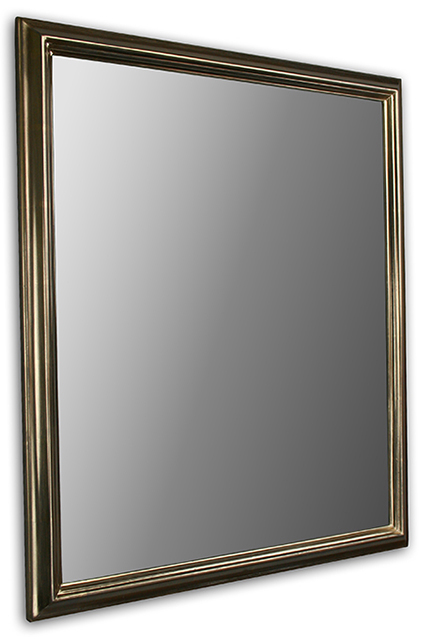
The rectangle is the workhorse, and a clean gilded rectangle suits classic and modern rooms equally. Portrait proportions add height to a wall; landscape proportions stretch it wider and work well above a sideboard or mantelpiece. This is the shape where my joinery shows its worth. I cut the lengths, mitre the corners and usually join them with biscuit joints, so the frame stays square and stable for decades rather than opening up at the corners. The profile itself is milled to the depth and moulding you want, and the rebate that holds the glass is milled to fit. A simple, well proportioned gilded rectangle is often the right answer among my classic mirrors, and a bolder finish such as a black and gold framed mirror reads as more contemporary. If your wall wants presence without bulk, a slim mirror in a narrow gold frame keeps the footprint tight.
Arched and cathedral-top gold framed mirrors
An arched mirror is having a real moment, and for good reason. The curved top lends a room a sense of height and a hint of architecture, whether it is a soft, shallow arch or a taller cathedral top. It looks wonderful in an entrance, above a fireplace or leaning full length against a bedroom wall. I make arched and semicircular frames as bespoke pieces, shaping the curved section and joining it to the straight sides, then gilding the whole outline. In gold, an arch manages to feel both current and timeless at once.
Irregular and organic mirror shapes
Irregular, asymmetric and organic pebble shapes are the boldest option, and they make outstanding focal points precisely because the eye cannot predict the outline. One irregular gold mirror on an otherwise plain wall does more than three ordinary ones. These shapes suit a modern interior that already has clean lines and wants a single sculptural moment. I explore this in more depth in my guide to irregular shaped mirrors. Gilding an organic shape by hand is slow work, because the gold has to follow every curve of the profile, but the result is genuinely one of a kind.
Matching the shape to the room
Shape and room go hand in hand. In a hallway I usually suggest a round or arched mirror to open the space and reflect light. In a living room a large rectangle over the sofa, or a generous round above the fireplace, tends to anchor the whole scheme; you can see the format options among my living room mirrors. For a bathroom, a round or arched mirror above the basin looks elegant, but a gold frame in a damp room needs the right glass and a properly sealed, well chosen gilded finish so it lasts. I use SGG Miralite Pure Diamant mirror glass for its clarity and edge stability, and I am happy to advise on the safest gilding choice for a bathroom mirror. Where a room calls for shine and depth of colour, a piece from my glamour mirrors in a gold or gold-and-black frame is often the answer, like my green and gold glamour mirror.
Which gold, and how I gild each shape
Not all gold is the same, and the tone changes the whole character of a mirror. I water gild onto a chalk gesso ground using genuine gold leaf, from a deep 6ct through 22ct and 23.75ct, as well as cooler white golds and moon golds. The colour of the bole under the leaf shifts the warmth: a red clay base gives a rich, glowing gold, while a grey or ochre base reads cooler and more silvery. Straight-sided frames are milled, mitred and usually biscuit-jointed; curved shapes are built from shaped sections; and every profile is gessoed and burnished before the leaf goes on. It is the same craft I bring to my gold gilded picture frames, and if you want to understand the process itself, I explain hand-gilding with gold leaf in detail. Choosing genuine leaf over a gold-effect paint is the difference between a warm, living surface and a flat imitation.
A few of my pieces show how much the base changes things. A cream and gold mirror in 23 carat leaf over a warm bole glows softly and suits a lighter room; a green frame with 23 carat gold reads richer and more jewel-like against the coloured ground; and a deep 23 carat gold mirror in a Tuscan profile is about as opulent as a mirror gets.
Made to measure: your shape, your gold
Almost everything above is made to order, which means you are not limited to a stock size or a fixed outline. Tell me the shape you want and the space it has to fill, and I build the frame to those exact dimensions, whether that is a plain gilded rectangle or a made-to-measure gold glamour mirror. I agree the finish with you from photographs of my previous work, so you can see how a given gold and bole actually look on a finished piece before I start. Lead time is typically 4 to 8 weeks, and I can specify museum, UV-filtering or anti-reflective glazing where it is needed.
You will find the full picture in my mirrors in frames range and in my guide to made-to-measure framed mirrors; a recent piece is my cream frame gilded with gold leaf. The simplest way to start is to send me your measurements and a photo of the wall.
Frequently asked questions about gold framed mirror shapes
Are gold framed mirrors still in style?
Yes. Gold framed mirrors move in and out of fashion at the edges, but a genuinely gilded mirror has stayed desirable for centuries because real gold reflects warm light in a way no other finish matches. Round and arched shapes feel especially current right now, as a modern gold framed mirror in 23 carat leaf shows, while a classic gilded rectangle never really dates.
Should I choose a round or a rectangular gold mirror?
Choose round to soften a room, create a single focal point or reflect light down a hallway. Choose rectangular to add height or width to a wall, or to sit neatly above a piece of furniture. If your interior is very square and modern, a round or organic shape gives welcome contrast; if it is more traditional, a proportioned rectangle usually feels right.
Is the gold real?
On the mirrors I make, yes. I use genuine gold leaf ranging from 6ct to 23.75ct, applied by hand over a gesso and bole ground. That is quite different from a gold-coloured spray or foil, both in how it looks and in how it ages.
Are irregular mirrors good for a focal point?
They are one of the strongest focal points you can hang. Because an irregular outline is unpredictable, the eye is drawn straight to it, so a single asymmetric gold mirror can carry an entire wall on its own. They work best against plain, uncluttered backgrounds.
Can I have a gold framed mirror in a bathroom?
Yes, with the right build. I use stable, high-clarity mirror glass and choose a gilded finish suited to humidity, so the frame copes with a damp room. Round and arched shapes look particularly good above a basin.