Glamour Mirrors: Decorative Finishes and Bespoke Detail
A glamour mirror is one of those pieces that changes a room the moment it goes up, and what sets it apart is rarely the glass on its own. It is the decorative finish of the frame: the depth of hand-applied gold leaf, the carved or moulded profile, the colour worked in underneath the gilding, and the way the edge of the glass catches the light. In my workshop I build these mirrors one at a time, so every finish is a deliberate choice rather than a factory specification. Below I explain the decorative finishes I use most often on glamour mirrors, what each one does for a space, and how I decide between them for a particular commission.
What makes a mirror a glamour mirror?
A glamour mirror is a decorative wall mirror built around an ornamental, usually gilded frame, made to act as a focal point rather than a purely functional surface. The style leans on luxurious materials and refined finishing: genuine gold or white gold leaf, hand-painted colour, a polished or softly antiqued sheen, and clean, high-clarity glass. The common thread is that the frame does the talking.
People often ask me whether gold-framed mirrors are still in fashion. In my experience they have never really left. A well-made gilded mirror reads as timeless rather than trend-led, which is exactly why I treat the frame as the heart of the piece. If you want to see the full range of styles side by side, my glamour mirrors collection sits alongside a broader decorative mirrors category, and I have written a separate overview of glamour, vintage, classic and modern decorative mirrors for anyone deciding on a direction.
The hand-gilded frame is where the glamour comes from
Almost all of the character in a glamour mirror is built into the frame, and the technique I rely on most is traditional water gilding. I start with a solid wood moulding, join it in the raw, then build up layers of gesso and coloured clay, known as bole. Genuine gold leaf is laid onto that clay, and the surface can then be burnished to a bright shine or left with a softer, satin glow. It is slow, hands-on work, and it is increasingly rare, which is part of why a water-gilded mirror looks so different from a sprayed or foil-finished one. If you want the full picture of the method, I describe it in detail on my water gilding page.
The gold finishes I work with
The shade and behaviour of the gold change the whole mood of a mirror, so this is usually the first decision I take with a client. The finishes I use most often are:
- Yellow gold, 23.5 carat: a rich, warm, genuinely metallic shine, left bright rather than antiqued. This is the classic glamour look.
- Moon gold, 22 carat on grey clay: a cooler, paler gold, gently antiqued for a refined, warm glow that is less showy than yellow gold.
- White gold on grey clay: softly antiqued for a delicate, satin, almost platinum effect.
- White gold, not antiqued: a cool, mirror-like surface reminiscent of polished chrome, which suits very contemporary rooms.
- Palladium and silver leaf: for a silver-toned, often artistically aged finish when gold would be too warm.
Because each piece is gilded by hand, these are starting points rather than fixed options. A made-to-measure slim gilded mirror can carry any of these golds against a glossy black, bottle green, blue or white edge, and a wider statement piece such as my glamour mirror in a gold gilded frame shows what 23.5 carat gold does at scale.
Black and gold, and other colour-and-gold combinations
The single most requested glamour finish in my workshop is black and gold. The discipline of a deep black profile against the warmth of real gold leaf is hard to beat, and it works in both classic and modern interiors. The detail that separates a bespoke piece from a mass-produced one is the corner: I gild the frame so the leaf runs seamlessly around the mitre, with no visible join. My Nero Glam 23K mirror is the clearest example, with the frame partly painted in deep black and partly gilded in 23 carat gold, then sealed with a protective lacquer.
The same approach extends to other colour pairings: white gold on black bole, burgundy and gold, cream and gold, or silver over a dark ground for a more antique feel. For colder, more graphic schemes I also make a black frame gilded with white gold. If black and gold is the look you are chasing, I have written a dedicated guide to the black and gold framed mirror that goes further into profiles and proportions.
Ornate and carved frame profiles
A good number of the people who contact me are specifically looking for decorative mirrors with ornate frames, and this is where the moulding profile matters. An ornate frame is one with sculpted, three-dimensional detail rather than a flat or plain border: beading, scotia and ogee curves, leaf and shell carving, or decorative corners. Worked under gold leaf, that relief is what makes the surface shift as you move past it.
I can produce richly carved and moulded profiles, frames with traditional Flemish corners, and even gilded frames divided by muntins for a window-pane effect. If your taste runs to bolder, more decorative pieces, the decorative mirrors category is the right starting point, while the full set of mounted options lives under mirrors in frames. A plainer, narrower profile is always an option too, since an ornate look is a choice rather than a requirement.
Bevelled edges and the glass itself
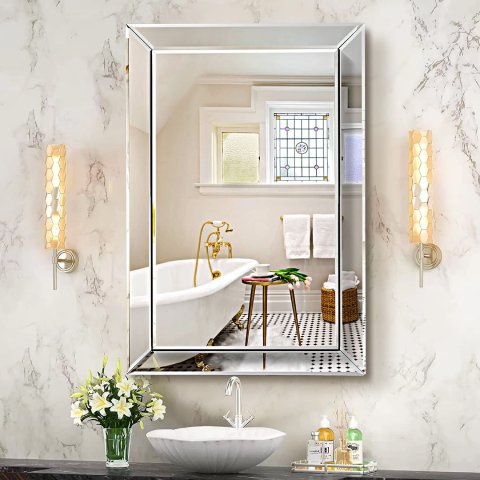
The frame carries most of the glamour, but the glass is not an afterthought. A bevelled edge, where the perimeter of the mirror is ground and polished at a shallow angle, adds a band of subtle refraction around the reflection and gives the piece a more finished, jewellery-like quality. I offer bevelled glass as standard on most pieces.
Clarity matters just as much. I use premium SGG Miralite Pure Diamant glass, an ultra-clear mirror that reflects without the slight green tint you see in ordinary float glass. That high-clarity, almost crystal sheen is the honest source of the sparkle people associate with glamour mirrors. For rooms with moisture I specify a moisture-resistant build and seal the frame appropriately, which is what makes a gilded mirror suitable as a bathroom mirror rather than a risk in a damp space.
Shape and proportion
Glamour is as much about proportion as decoration. I make mirrors in rectangular, square, round, oval and arched formats, and because each one is built to order, the size is set to your wall rather than approximated from a standard range. A tall, slim rectangle suits a hallway or a narrow pier between windows, a generous round mirror softens a square room, and an oval reads as the most classically elegant of the shapes. Getting the dimensions right is usually the difference between a mirror that fits the room and one that merely hangs in it.
Choosing a glamour mirror room by room
The right finish depends a great deal on where the mirror will live:
- Living room: this is where a statement piece earns its place above a console or fireplace. Warm yellow or moon gold over an ornate profile gives the most impact. My living room mirrors are made for exactly this role.
- Bedroom: softer, antiqued white gold or a cream-and-gold finish keeps things elegant without overpowering a restful space.
- Hallway: a slim, vertical glamour mirror brightens a narrow entrance and bounces light back into the room. The hallway mirrors category is set up around this.
- Bathroom: a sealed, moisture-resistant gilded mirror brings real warmth to a tiled room, which is why my bathroom mirrors are built specifically for humid conditions.
Why I make every glamour mirror to measure
I do not hold a fixed catalogue of finished mirrors waiting to be shipped. Every glamour mirror is made to order, from the dimensions and shape through to the profile, the colour of the bole, the type of gold and the glass. That is the only way to match a piece to a specific wall, a particular light, and the rest of a room. It is also why I always recommend talking through a commission before ordering: the gilding finish, the edge colour and the size can all be adjusted, and the price reflects the materials and the hours of hand-work involved rather than a mass-production cost.
If you are weighing up a piece, the glamour mirrors collection is the best place to see current models and finishes. For anything outside what is shown, the same craft sits behind my bespoke framing work, and you are welcome to contact me with sizes and a sense of the look you want so I can advise on the most suitable finish.
Frequently asked questions
Where can I buy a decorative mirror with an ornate frame?
I make decorative mirrors with ornate, hand-gilded frames to order and ship them internationally. You can see the current range in my glamour mirrors and decorative mirrors categories, and any profile, size or finish can be adapted to your room.
How much does a glamour mirror cost?
The price depends on the size, the profile, the type of gold leaf and the glass. Because each mirror is hand-built and water-gilded rather than mass-produced, the cost reflects the materials and the hours of work involved. Every model in the glamour mirrors collection shows its own price, and I can quote bespoke sizes on request.
Are gold-framed mirrors still in style?
Yes. A genuine gold-leaf mirror reads as timeless rather than trend-led, which is why it stays relevant across changing interior fashions. Warm yellow gold suits classic and glamour rooms, while a cooler white gold or palladium finish works in more contemporary spaces.
Can a glamour mirror go in a bathroom?
It can, provided it is built for the conditions. I use moisture-resistant glass and seal the gilded frame with lacquer so it can handle the humidity of a bathroom while keeping the look of a decorative piece.
What is the difference between a glamour mirror and an ordinary decorative mirror?
A glamour mirror is a type of decorative mirror defined by its luxurious finish, typically a gilded or ornate frame and high-clarity glass, made to act as a focal point. A decorative mirror is the broader category, which also includes simpler, vintage or minimalist styles.
Is the frame finished with real gold?
On my gilded mirrors, yes. I use genuine gold leaf, including 23.5 carat yellow gold, 22 carat moon gold and white gold, applied by hand using traditional water gilding rather than gold-effect paint or foil.