Handmade Wooden Picture Frames: Solid Wood, Trends and a Sustainable Approach
Why solid wood is still the best material for a picture frame
Walk into most framing shops and much of what you see is not really wood at all: it is MDF or foamed plastic wrapped in a printed foil that imitates grain. Those mouldings are cheap to produce, but they cannot be sanded, repaired or refinished, and they rarely survive a house move without chipping at the corners. Every frame I make starts differently, from solid timber boards, because solid wood is the only material that gives a frame real structural strength, clean joinery and a surface that improves rather than degrades with age.
Solid wood also matters for the finish. Traditional gesso grounds, genuine gold leaf and natural paints all need a stable, breathing substrate to bond to. A gilded finish laid over chalk gesso on solid timber can last for generations and can be renewed; the same finish on foil-wrapped MDF cannot. That is why all of my custom picture frames are built from timber, whatever the style, size or budget. If you are still weighing up finishes and colours in general, my frame colour and material guide compares the options in more detail.
How I make a wooden picture frame by hand
I work alone in my workshop, and every frame follows the same sequence. First I select and acclimatise the timber: boards are checked for straight grain, dried to the right moisture content and set aside to settle before any machining. Rushing this stage is the most common reason cheap frames twist on the wall a year later.
Then I mill the profile. The shape of the moulding, every cove, bead and flat, is routed from the solid board, and the rebate that will hold the artwork is milled to the exact depth the piece needs. Only after the profile exists do I reach for the saw: I cut the lengths and saw the mitres at precisely 45 degrees, then join and glue the corners so the frame is rigid and square.
What happens next depends on the finish. For painted and gilded frames I apply traditional gesso grounds, layer after layer of chalk and glue, sanded back until the surface is perfectly smooth. Gold finishes are laid on by hand with genuine gold leaf; where the commission calls for the deepest, burnishable shine I use water gilding, the same historic technique used on museum frames. Natural wood finishes get oil, wax or shellac instead, so the grain stays visible. This is the process behind every commission described on my bespoke picture frames page: one maker, one frame at a time, from raw board to finished corner.
Choosing the timber: pine, lime, oak and ash
There is no single best wood for a picture frame; there is the right wood for a given finish and format. In my workshop four species do most of the work.
Pine is my standard choice under gesso, paint and gilding. It is dimensionally stable, light enough for large formats and takes chalk grounds beautifully. Lime, known as linden or basswood, is the classic carver's wood: when a frame calls for hand-carved ornament, lime holds crisp detail like no other species. Oak and ash come into play when the grain itself is the decoration; both are dense, strong hardwoods that look superb under clear oil or wax, though their open grain makes them a poorer base for fine gilding. For a heavy oil painting in a wide profile, the weight of the timber also matters: a large ash frame needs stronger fixings than the same profile in pine.
What a sustainable approach means in my workshop
Ecology in framing is often reduced to a certificate logo. Certified, responsibly forested timber is the starting point, and I buy sawn boards from sources I trust, but in practice a sustainable frame is defined by three further things.
First, longevity. The most sustainable frame is the one you never throw away. A solid wood frame can be re-joined, re-gessoed, repainted or regilded decades from now; it is a repairable object, not a disposable one. Second, natural finishes. I finish frames with materials that predate the plastics industry: chalk gesso, shellac, plant-based waxes, casein and mineral pigments, and genuine gold leaf, which needs no lacquer and does not off-gas. Third, nothing conservation-grade is compromised: the boards, tapes and barriers that touch the artwork are acid-free, the same standard I apply in archival and museum framing, so protecting the environment never comes at the cost of protecting the art.
Hand production at this standard does cost more than a foil-wrapped moulding from a chain store, and I think buyers deserve to know exactly where the money goes. I break the numbers down honestly in what professional framing costs.
Wooden picture frame trends I see in commissions
Trends reach a one-man workshop through the commissions that arrive, and a few clear directions have dominated recent years.
Raw and natural wood is the strongest of them. Pale timber under nothing more than clear wax or oil suits Scandinavian and japandi interiors, and it lets the mitre joints and grain do the talking. Painted wooden frames remain the most versatile choice: deep matt black picture frames anchor graphic art and photography, while white picture frames keep watercolours and airy interiors light.
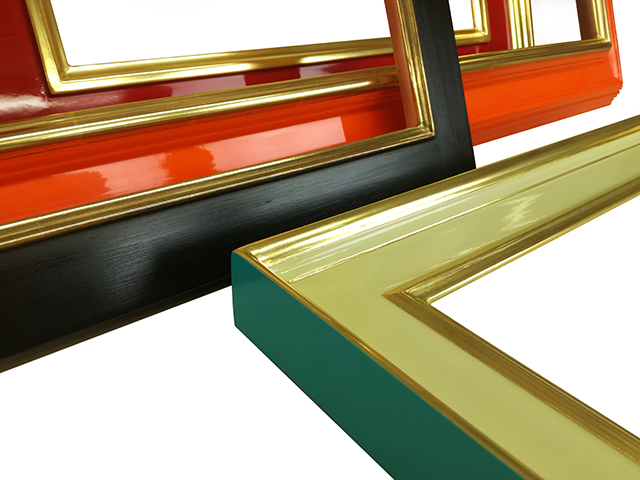
At the other end of the spectrum, giltwood is firmly back. Clients who a decade ago would have asked for plain oak now commission gold gilded picture frames for both classical and contemporary paintings. The most requested variation in my workshop is the two-tone frame, a painted profile with hand-gilded channels, which you can see across my gilded and partially painted picture frames. And for interiors with a rustic or vintage character, distressed and patinated wood finishes, waxed edges and softened colour give a new frame the presence of an old one.
Wooden frames are not only for paintings: mirrors
Everything above applies just as well to mirrors. The profiles I mill for paintings carry mirror glass equally happily, and a mirror is often the largest framed object in a home, so the quality of the timber and joinery matters even more. In hallways and living rooms a wooden framed mirror brings warmth that metal and frameless glass cannot; in bathrooms I seal the timber with moisture-resistant finishes so the frame shrugs off humidity. Every piece in my mirrors in frames collection is built to measure on exactly the same benches, from the same boards, as my picture frames.
Ordering a wooden picture frame made to measure
Commissioning a frame from my workshop is simpler than most people expect. You send me the exact dimensions of the artwork or mirror glass, tell me what the piece is (a canvas, a work on paper, a photograph), and I help you choose a profile and finish that suit the piece. For paintings in oil I also check the stretcher depth and edge condition, which is covered in more detail on my framing oil paintings page.
The finish is agreed before production begins, based on photographs of previous frames and colour variants from my workshop, so you know precisely what will arrive. Then I build the frame from scratch: milling, joining, gesso, finish and fittings, and ship it securely packed to the UK, the US and across Europe. One craftsman is responsible for every stage, which is exactly why the result fits both the artwork and the room it hangs in.
Frequently asked questions about wooden picture frames
Why are wooden picture frames so expensive?
A handmade solid wood frame carries the cost of real timber, hours of milling, joinery and finishing, and materials such as gesso and gold leaf. Unlike foil-wrapped mouldings it can be repaired and refinished, so the price buys decades of use. A full cost breakdown is in my article on what professional framing costs.
What is the best wood for a picture frame?
Pine for painted and gilded finishes, lime for hand-carved ornament, and oak or ash where the natural grain is meant to show. The best choice depends on the finish, the size of the artwork and the weight the wall can take.
Are wooden picture frames an eco-friendly choice?
Yes, provided the timber comes from certified sources and the finishes are natural. A solid wood frame finished with gesso, wax, shellac or genuine gold leaf is repairable and long-lived, which makes it far more sustainable than a disposable plastic or MDF moulding.
Can an old wooden frame be repaired or regilded?
Usually yes. Solid timber frames can be re-glued, filled, re-gessoed and gilded again, which is one of their greatest advantages. If you have an older frame you would like to bring back to life, contact me with photographs and I will tell you honestly what is possible.
Do wooden frames work for mirrors as well as paintings?
Yes. I build mirrors and picture frames from the same solid timber profiles. For bathrooms I use sealed, moisture-resistant finishes; for hallways and living rooms any finish that suits the interior, from raw waxed wood to full gilding.