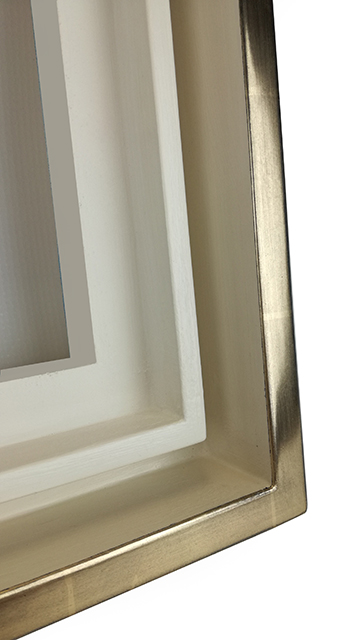
Guggenheim frame
What is a Guggenheim frame?
A Guggenheim frame is a minimalist, museum-style picture frame built on a single idea: the frame should give a work of art a clean visual boundary and then step out of the way. The name comes from the great museums of modern and contemporary art, among them the Solomon R. Guggenheim Museum in New York, where mid-twentieth-century curators moved away from ornate gilded mouldings toward plain, wide profiles that let the picture speak for itself. In practice, then, a Guggenheim frame is not a single catalogue design. It is a whole family of quiet, well-proportioned frames that share a flat face, a recessed rebate and a soft shadow around the artwork.
I build frames in this tradition constantly, and the question I hear most often is simply how to tell one apart from an ordinary frame, or from an American Box frame. The short answer is that a Guggenheim frame is defined by restraint: no carving, no heavy ornament, just proportion, a broad flat profile and the shadow line that separates the work from the moulding.
Where the Guggenheim frame came from
The idea took shape in the museums of modern art in the middle of the last century. Before that, a serious painting almost always meant an ornate, gilded frame. As modern and abstract painting moved to the centre of the collection, that language stopped fitting the work, because an elaborate gold surround around a Rothko or a Pollock fought the picture rather than serving it. The response was a plain, wide frame whose only job was to mark the edge of the work and bring order to the wall. Because that approach became so closely associated with institutions like the Guggenheim, the style picked up the museum's name, and it has kept it ever since among collectors, designers and framers.
The many names for one idea
Part of the confusion around the Guggenheim frame is that the same essential object travels under several names, each used in a slightly different setting. All of them are correct, and it helps to know how they relate.
Museum frame
This is the most neutral term, used in galleries and public collections. A museum frame has a plain, flat profile and a subtly recessed rebate that casts a fine shadow around the work. Its purpose is calm and balance, and it is usually the closest match to what people mean by a Guggenheim frame.
Gallery frame
The same form, seen more often in interiors and private collections, with greater freedom in the finish: matt or satin, black, white, graphite or natural wood. The discipline of the profile stays; the palette opens up.
Modernist frame
A more historical label, tied to the design of the 1950s and 1960s and to the way modern painters framed their own work, typically in plain black or natural oiled wood. Today it simply means a picture frame in a modern, minimalist idiom, the kind I describe in my guide to modern and minimalist picture frames.
Shadow box and flat frame
These are the technical descriptions. A shadow box frame leaves a deliberate gap between the work and the inner edge of the moulding, so a narrow line of shadow separates the two and gives the piece lightness and depth. A flat frame, sometimes catalogued as an American flat profile, is a wide, plain, flat-faced moulding used for larger paintings and canvases. Both terms describe the construction of a Guggenheim frame more than its style.
How to recognise a Guggenheim frame
When a client sends me a photograph and asks whether they are looking at a Guggenheim or museum frame, I look for four things:
- A plain, wide, flat face. No carving, no ornament, no sweeping profile. The moulding reads as a clean band around the work.
- A recessed rebate. The work sits slightly back inside the frame rather than tight against the front edge, which is what creates the sense of depth.
- A shadow line. A fine, even gap around the artwork, so a soft shadow separates picture from moulding on all four sides.
- Restraint in the finish. Matt or satin black, white, graphite or natural oak, occasionally a fine gilded inner edge, but never a busy or decorative surface.
If a frame has those four qualities, it belongs to the Guggenheim family, whatever a catalogue happens to call it.
Guggenheim frame and the American Box frame: same family, different construction
The question I am asked more than any other is whether a Guggenheim frame is the same thing as an American Box frame. They belong to the same minimalist family, but they are built differently, and the difference is worth understanding before you commission one.
In a Guggenheim frame, the work sits inside the moulding. The picture is set into the recessed rebate and the profile gently surrounds it, with a small distance, usually a few millimetres, between the edge of the work and the inside of the frame. That gap reads as a quiet shadow, and the picture feels calmly settled within the frame. It suits works on paper, prints and paintings of a delicate character.
In an American Box frame, the canvas does not sit inside the moulding at all. It is fixed from behind so that it stands slightly away from the frame, and a clear gap, the floating gap, opens up all the way round. The work appears to hover in the opening, which is why it is also called a floating frame. The effect is more spatial and more overtly contemporary, and it is the natural choice for deep-edged canvases where the artist has painted round the sides. I cover that construction in full in my guide to the American Box frame for a painting.
Put simply, a Guggenheim frame closes gently around the work, while an American Box frame lets it breathe in open space. In my workshop I often combine the two, building a frame that reads as a museum profile from the front but is constructed as a box behind, so the canvas hangs with a shadow and a little distance. One frame I make in exactly this way is a floating American Box frame gilded in 23ct gold leaf, where the flat museum face carries real leaf and the canvas floats behind it. Both are made from solid wood, and both are built to measure.
UK and US terms: float frame, tray frame and box frame
If you are searching for this kind of frame in the UK or the US, you will meet a slightly different vocabulary. A float frame or floating frame is the same idea as the American Box: the work is mounted so that it appears to float within an open surround. Tray frame and box frame are the terms most framers use here, especially for stretched canvases. An L-frame refers to the plain L-section profile that sits proud of the canvas edge. All of these describe the same underlying approach that the art world calls a Guggenheim or museum frame, and I build every one of them to order. If you want to see how the different constructions compare across canvas work, my guide to the types of frames for canvas paintings sets them side by side.
Which artworks suit a Guggenheim or museum frame?
The great strength of this style is how widely it works. Because the frame does not impose a period or a mood, it sits comfortably with almost any kind of art: oils and acrylics on canvas, works on paper, prints, photography and large-format abstract pieces. It is especially effective with big formats, where a broad flat profile becomes a kind of architecture for the picture rather than a decoration on it. For contemporary painting, a plain black or natural oak museum frame usually reads better than anything ornate; for photography and graphic work, a fine white or graphite profile keeps everything crisp. If your piece is an oil on canvas, my notes on framing oil paintings explain how I approach profile, depth and finish for that medium in particular.
Finishes: black, white, natural oak and gilded museum frames
Within this quiet style there is still a real choice of finish, and it changes the character of the frame completely. Black is the classic museum choice, and I build it up by hand in layers rather than spraying it in a single pass, so the surface has genuine depth; you can see the full range in my black picture frames, which include black box and floating profiles. White and pale profiles keep a modern interior light and open, and sit in my white picture frames; a good example is the plain white box frame I build to measure. Natural oak, oiled rather than stained, keeps the warmth of the timber and suits Scandinavian and contemporary rooms. And for anyone who wants the restraint of a museum frame with a little warmth, I gild a fine inner edge in genuine gold leaf; my gilded and partly painted frames show how a narrow band of real leaf lifts an otherwise plain profile without turning it decorative.
How I build museum and box frames to measure
Every frame in this style leaves my workshop made to measure, built from solid wood, most often oak, ash or pine chosen for the weight and depth the work needs. I mill the profile myself rather than buying in a ready-made moulding, which lets me set the exact width of the face, the depth of the rebate and the size of the shadow gap for a particular picture. The mitres are sawn and the corners joined with mortise-and-tenon joinery rather than simple pins, because a wide flat frame has to stay true across a long edge and hold its line for years. Only then does the frame go to finishing, where the black, white, oak or gilded surface is built up by hand. This is the difference between a museum frame built the way a conservation studio would build it and a factory profile simply cut to length: the proportion is chosen for the work, and the construction is made to last. You can see the wider range of what I make to order in my custom picture frames.
Commissioning a Guggenheim-style frame
If you have a particular painting, canvas or photograph in mind, commissioning a museum or box frame is straightforward. Send me the dimensions of the work, measured to the nearest millimetre, along with a photograph, and tell me the setting it will hang in. From there I agree the profile, the depth and the finish with you before I begin, working from photographs of frames I have already made and from colour variants, so you can see how a finish will look before a single length is milled. Whether you need a plain museum frame, a floating box frame for a deep canvas, or a bespoke picture frame for a collection, each one is designed around the work rather than approximated to it. If you are weighing up whether a piece justifies a made-to-measure frame at all, my guide to specialist and collector's frames may help, and for the highest level of protection I offer full archival and museum framing.
Frequently asked questions
What is a Guggenheim frame?
A Guggenheim frame is a plain, wide, minimalist frame designed so that it defines the edge of an artwork without competing with it. The name comes from the modern art museums that popularised the style, and it usually describes a flat-profiled museum frame with a recessed rebate and a soft shadow around the work.
Is a Guggenheim frame the same as a box frame?
They are closely related but built differently. A Guggenheim or museum frame sets the work inside the moulding with a small shadow gap, while a box or floating frame mounts the work from behind so that it appears to hover in an open surround. Many box frames read as Guggenheim frames from the front.
What is the difference between a box frame and a flat frame?
A flat frame is a wide, plain, flat-faced profile that surrounds the work closely. A box frame leaves an open floating gap around the work so that it stands away from the moulding. A flat frame emphasises calm and a clean boundary; a box frame emphasises depth and space.
Do Guggenheim frames use glass?
They can. Works on paper and photographs are usually glazed, and for those I fit conservation or museum glass. Stretched canvases and many contemporary oils are framed without glass, so the surface of the paint stays open, which is common in the box and floating versions of this style.
What sizes can a museum frame be made in?
Because I make each frame to measure, there is no fixed size. I build these frames from small works on paper up to large-format canvases, milling the profile and setting the depth to suit the scale and weight of the individual piece.