


American Box Frame: Gold Floating Picture Frame Made to Measure
- Add feedback:
- Code: 293
- Manufacturer: Karol Milewski
-
Availability:
 Exists
Delivery time: 20 - 30 working days
Exists
Delivery time: 20 - 30 working days
- pcs.
- €238.89
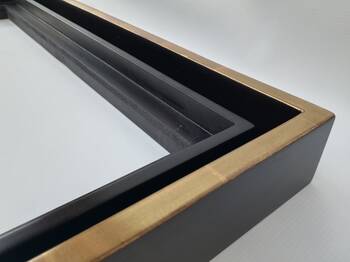
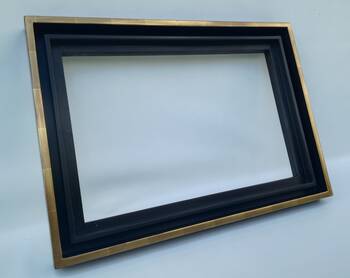
An American box frame built from two mouldings: the painting is seated in an inner frame and separated from the gilded outer frame by an open channel 20 mm wide. I make each one to the size of the individual canvas, with a 15 mm front laid in gold leaf by water gilding, four shades of gold and nine bole colours to choose from.
The American box is a frame in which the painting is not covered by a moulding but surrounded by air. The construction uses two separate frames: an inner one that holds the canvas, and an outer one gilded with leaf across its front. Between them runs an open channel, so the painting reads as though it were suspended inside the frame. This is a gold floating picture frame made to the measurements of one specific work, built in a one-person workshop in north-eastern Poland.
Profile and construction
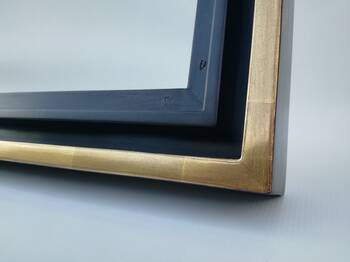
At the artwork sits the inner frame, with a front face 10 mm wide. In this model the painting is loaded from the front of the frame: the stretcher drops into the inner frame, which closes tightly against its sides, so the work is held at the edges rather than covered from above. The inner frame stands slightly proud of the channel floor, which lifts the canvas and presents it above the opening. Beyond the inner frame the face drops into the open channel, 20 mm wide, which separates the painting from the outer frame and creates the visible gap. I finish the channel with the same care as the outer surfaces, because it is looked into directly whenever the frame is seen from an angle. The last element of the face is the front of the outer frame, 15 mm wide, gilded with leaf over bole in the chosen colour. The flanks of the outer frame are painted; in the photographs they are black, which lifts the contrast against the gold and deepens the sense of space.
Specification
- Type: American box floating frame, two-part construction
- Front of the outer frame: 15 mm, gilded with gold leaf
- Channel between the frames: 20 mm
- Front of the inner frame: 10 mm
- Total depth of the frame: 60 mm
- Seat depth: 20 mm as standard, built for a stretcher of that thickness; other depths made to order
- Seating of the artwork: from the front of the frame, into the inner frame closing against the sides of the stretcher
- Timber: seasoned, low in tannin, of the kind used in museum work and art conservation
- Corner joinery: mitred at 45 degrees, reinforced with wooden splines
- Gilding: gold leaf, water gilding; 23-karat yellow gold, 22-karat moon gold, 12-karat white gold, 6-karat white gold
- Bole: nine colours, chosen separately from the shade of gold
- Finish: shellac and natural waxes, satin sheen, the grain of the wood visible on the painted surfaces
- Mounting of the artwork: screws into the inner frame
- Hanging: picture wire fitted, vertical or horizontal orientation to choose
- Suitable for: oil and acrylic paintings on stretchers
The dimension to order: give the size of the painting itself, not the outer size you would like the frame to be. The finished frame is larger by the front of the inner frame, the channel and the front of the outer frame, that is by roughly 4.5 cm on each side.
Which paintings and interiors it suits
The American box was developed for painting on canvas and that remains its natural use: oils and acrylics on stretchers, where the edge of the canvas belongs to the work and should not disappear under a moulding. It suits paintings with a strong worked surface, impasto, and any composition that runs to the very edge, where a conventional rabbet would cut a strip of it away. It is equally at home with contemporary abstraction and with a small, densely painted study that gains from being given room. Where a painting calls for a closed profile instead, the workshop pages on framing oil paintings set out the alternative.
In an interior the frame behaves quite differently from a classical moulding. The open channel reads as a shadow line, the gilded front closes the composition with a narrow band of metal, and the painted flanks keep the whole thing quiet. That combination sits well on a plain wall in a modern room, and it works just as convincingly in a room full of older furniture, where the gold ties the frame to brass, oak and warm light. Other frames built on the same logic of paint and partial gilding are gathered among the gold gilded and partially painted picture frames.
How it is made and finished
Both mouldings are milled from seasoned timber low in tannin, the material used in museum work and art conservation for its dimensional stability. I cut the lengths at 45 degrees and join the corners with wooden splines before any ground goes on, so each corner works as a single piece and does not open with the years.
The gilded front then follows the traditional route. I build up gesso and rub it back to a smooth surface, lay bole over the areas to be gilded, and transfer the leaf onto the wetted bole, sheet beside sheet with an overlap of about a millimetre. That is one layer of gold, not several; the multiple layers belong to the ground beneath it. The bole shows faintly through the metal and sets its temperature, so red gives the warmest, deepest reading and the cooler boles hold the gold back. The techniques and the differences between the shades of gold are described on the page about water gilding.
The remaining surfaces are painted by hand in successive layers, with the grain of the wood left legible rather than filled and levelled, and the whole frame is sealed with shellac and natural waxes to a satin sheen. The sheen matters here: a lacquered flank would catch lamps in points of light and compete with the painting across the open channel.
Personalisation. The order menu carries two separate choices, the shade of gold and the colour of the bole, and they are chosen independently of each other. The menu opens set to 23-karat yellow gold on red bole, the combination shown in the photographs. Alongside it there are 22-karat moon gold, paler and cooler, and white gold in 12 karat and 6 karat, the last of these almost chrome-like in its reflection. Nine bole colours are available, from red and black through brown, plum and Victorian grey to olive green and light blue. If you are unsure which pairing suits your painting, write to me with an image of the work and I will suggest one.
How it differs from a factory frame
A ready-made floater is usually an extruded profile in MDF or aluminium, wrapped in a metallic foil or sprayed, cut to a standard size and stapled at the corners. The gold on that kind of frame is a coating, and it dulls and darkens as it ages. Here the front carries real leaf laid over gesso and bole, applied by hand and by the same method used on antique frames, and it ages as metal rather than as a finish.
The second difference is the fit. I do not select the nearest standard size and pack out the gap: the inner frame is built to close on the sides of your stretcher, and the seat is cut to its thickness. On a floating frame that precision is visible, because the gap around the painting is the design and an uneven gap is the first thing the eye finds. More on the construction and on when this type of mounting is the right choice is set out in the guide to floating picture frames for canvas art.
Mounting and hanging
The painting is fixed to the inner frame with screws driven through the stretcher bars. You can do this yourself when the frame arrives, or send the work to the workshop and I will mount it and return it framed. Every frame leaves with picture wire already fitted and set for the orientation chosen in the order menu, vertical or horizontal. A single D-ring hanger can be fitted instead on request. The frame is supplied without glass: an American box is an open construction and takes no glazing or mounting board.
Ordering made to measure
The base price shown on the page is the price per running metre of moulding. The perimeter of the painting is not the whole length of moulding a frame needs, because corners cut at 45 degrees consume additional length, and the wider the moulding the more they take. The calculator accounts for the full consumption of moulding including the corners and the options selected, and it handles paintings up to 120 x 80 cm; larger formats are made to individual order.
The standard seat is built 20 mm deep, for a stretcher of that thickness. If your canvas is stretched on thicker or thinner bars, give me the thickness with the order and I will build the seat to fit it. Lead time is 20 to 30 working days.