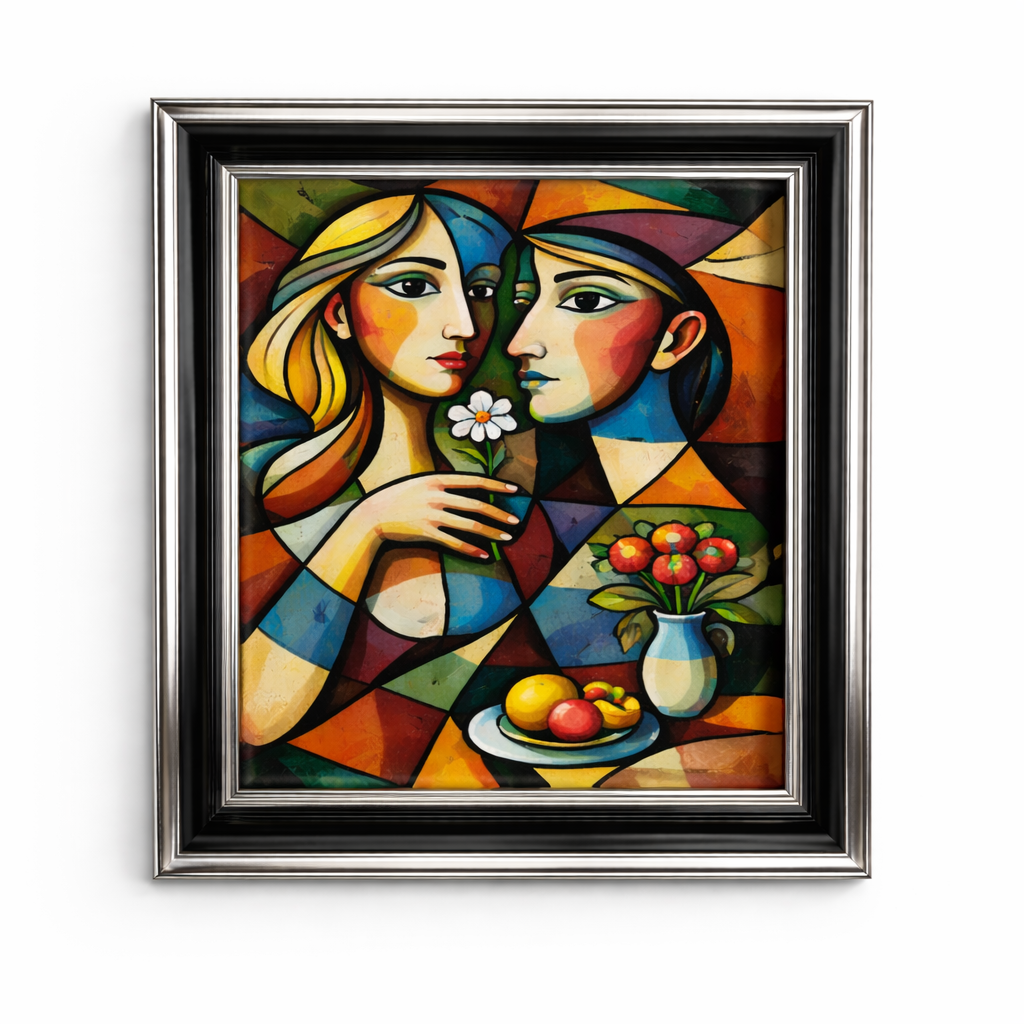
Fine Art Framing: How the Right Frame Protects and Elevates a Work of Art
When someone brings me a painting, the first thing we talk about is rarely the moulding. It is the work itself: what it is, where it will hang, and what it means to the person who owns it. Fine art framing begins there, because the frame's job is to serve the work, not to compete with it. A frame chosen well disappears into the experience of looking. A frame chosen badly is the first thing you notice and the last thing you can ignore.
A frame for a painting does two jobs at once. It shapes how the work is seen, and it protects the work for the years it will hang on a wall. Get either one wrong and the piece suffers. Get both right and the painting looks as though it was always meant to live exactly as it now does. Below I explain how I approach both, drawing on what I have learned building and gilding frames by hand in my workshop.
How the right frame changes the way a painting is seen
A frame draws a line around a composition and tells the eye where the work begins and the room ends. That sounds obvious, but it is the single most important thing a frame does for perception. Without that boundary, a painting bleeds into the wall behind it and loses force. With it, the eye settles, the colours read true, and details you might otherwise miss start to register.
The proportion and width of the moulding change the reading further. A wide, quiet profile gives a small work room to breathe and a sense of importance, while a narrow profile keeps the focus tight on a busy composition. The colour of the frame matters just as much: a warm tone can lift the warmth already in the paint, whereas a cool or dark frame makes colours sit back and feel more reserved. I have watched the same painting change character entirely between two frames, and so has every client who has seen options held side by side in the workshop.
If you want to go deeper on the visual side of these decisions, I have written separately about picture frame style and how it shapes a work and about choosing frame colour and material.
Match the frame to the work, not to the wall
A frame should answer to the painting first and the room second. The most common mistake I see is a frame chosen to match a sofa or a wall colour, with the work itself treated as an afterthought. A good frame can sit beautifully in its surroundings, but it has to earn its place by serving the piece. When the painting and the frame are right for each other, they tend to look right in almost any considered interior.
There is real craft in reading a work for this. The period and style of the piece, its palette, the medium, and the weight of the brushwork all point in a direction. A contemporary abstract rarely wants the same treatment as a nineteenth-century oil. I go into how to balance the work and the space in my guide on matching a frame to your interior and the artwork.
Gilded frames for paintings: why real gold leaf still matters
For oil paintings, sacred art, and traditional work, nothing carries a piece like a hand-gilded gold frame. This is the part of my craft I care about most. I gild with real gold leaf using the water gilding method, the same technique used in museum-quality framing for centuries. Beneath the leaf sits a built-up ground of gesso and bole, a coloured clay that decides the final tone of the gold. After the leaf is laid I burnish it with an agate stone, and that is where the deep, mirror-like sheen comes from.
This matters because most so-called gold frames sold today are not gold at all. They are painted with metallic paint or wrapped in foil. They look convincing in a shop photograph, then go matte and yellow within a few years and lose all their depth. A hand-laid sheet of real gold does not oxidise. It holds its sheen for decades, and if it ages it does so evenly, which adds character rather than wear. The difference is the same kind as between an oil painting and a print.
I work with several shades of leaf, from warm 23-karat yellow gold through cooler 22-karat moon gold and white gold, so the tone of the frame can be tuned to the work. You can see the range in my hand-gilded gold leaf frames for paintings, read more about gold picture frames and the styles they suit, or look at how water gilding is actually done. The same gilding I use on frames is what I use on my bespoke framed mirrors, if you are furnishing a room as a whole.
Protecting the work: glazing, mats and conservation framing
The second job of a frame is protection, and for anything of real or sentimental value this is not optional. Light, dust, humidity, and handling all degrade a work over time. Works on paper, watercolours, drawings, prints, and photographs are especially vulnerable and almost always need glazing and a mat.
For these I build in archival materials: acid-free mat board and backing, conservation tapes, and anti-reflective glass with a UV filter. The mat does more than look considered. It holds the surface of the work away from the glass, so the piece cannot stick to the glazing as the years pass. Done properly, this creates a stable environment around the work, which is exactly what archival and museum framing is for.
Oil paintings on canvas are framed differently again, usually without glass, because the surface needs to breathe. A great deal of the real cost of good framing lives in this protective layer, which is why I have written a full breakdown of why professional framing costs what it does. If you want the short version of how a frame guards a piece, I cover it in how a frame protects a painting.
Frames for different kinds of art
No single frame suits everything. Different media want different treatment, and matching the two is most of the work.
Oil and acrylic on stretched canvas can be framed traditionally with a rabbet, or set in a floater frame that leaves a shadow gap around the edge and shows the depth of the canvas. I go through the options in detail in the best frame for a canvas painting and on my dedicated page for framing oil paintings. To understand the range of profiles that suit canvas, I have laid them out in types of picture frames for canvas paintings.
Deeper, box-style frames suit canvases with painted edges, or works that benefit from a sense of space around them. I describe one such build in the American box frame for a painting. Canvas prints and photographs on canvas have their own requirements, which I handle on my page for framing canvas prints. And small finishing details, such as mats and fillets, can change a result completely: I cover them in decorative frame elements and additions.
Why I make every frame to measure
Everything above is the reason I do not keep stock. Every frame I make is built from scratch for one specific piece: cutting the moulding, gessoing, gilding or painting, and finishing, all by hand in my workshop. A made-to-measure frame is sized to the exact dimensions of a painting or stretched canvas, so the work sits correctly and the proportions are right for that piece rather than approximated to a standard size.
Working this way also means the decisions are made with you. Choosing the profile, the colour, and the gold becomes part of designing the frame, and in my experience that is the moment a painting feels finished. You can start from my range of custom picture frames, read about my approach to bespoke picture frames for fine art and collections, or learn a little about the workshop and how I work. For anything non-standard, an arched frame, an unusual format, or a museum-grade build, you are welcome to write to me for an individual quote, or to visit and see the frames in person.
Fine art framing: common questions
Does the frame really affect how a painting looks?
Yes, and more than most people expect. The frame sets the boundary that separates the work from the wall, controls how much space surrounds the composition, and through its colour and width can lift or calm the painting's palette. The same work in two different frames can read as two different pieces.
How do I choose a frame for a painting?
Start with the work, not the room. Consider the period, style, palette, and medium of the piece, then the proportion and colour of moulding that would serve it. Decide whether the work needs glazing for protection. Only after that, weigh how the framed piece will sit in its surroundings. If in doubt, I am happy to advise against the actual painting.
What frame is best for an oil painting?
Oil paintings on canvas are usually framed without glass so the surface can breathe, either with a traditional rabbet or in a floater frame that leaves a small gap around the canvas edge. A hand-gilded gold frame is the classic choice for traditional oils, while a clean, deep profile suits contemporary work.
Should artwork be framed with glass?
Works on paper, watercolours, drawings, prints, and photographs should be glazed and matted to protect them, ideally with anti-reflective UV glass and acid-free materials. Oil and acrylic paintings on canvas are normally framed without glass.
How long does a made-to-measure frame take?
In my workshop a bespoke frame usually takes four to eight weeks, depending on the complexity of the build, the gilding involved, and the current schedule.
Frame your work so it lasts and is seen properly
A frame is the one decision that touches both how a work is seen and how long it lasts. If you have a painting, a print, or a piece with meaning waiting to be framed properly, I would be glad to help. The best place to start is to get in touch and tell me about your piece, or to visit the workshop and see the frames in person.