Working With a Custom Framing Workshop
What a custom framing workshop actually is
A custom framing workshop is not a shop with a wall of ready-made frames. It is a place where each frame is designed and built to order, around one specific piece. I work alone, by hand, from raw moulding through to the final finish, so every frame that leaves my workshop has been cut, jointed, gessoed and finished for a single painting, print, photograph or mirror. Nothing is held in stock.
That distinction matters more than it sounds. A high-street frame shop, or an online configurator that drops your image into a stock profile, is solving a different problem to the one most collectors and artists actually have. When a work is valuable, unusually proportioned, or simply deserves better than a mass-produced moulding, working directly with a maker gives you control over every element: the profile, the width, the colour, the finish, the gilding, the glazing and the exact internal dimensions. You can explore the range in my custom picture frames collection, though what you see there is only a cross-section of what can be built.
How a commission begins: the brief and the first conversation
Every commission starts with the work itself, not the frame. Before I suggest anything, I want to know what I am framing: an oil on stretched canvas, a watercolour, a drawing, a print, a photograph, a textile, or a mirror for a particular wall. I ask for the exact dimensions, ideally measured to within a millimetre, and a photograph of the piece. For paintings on a stretcher I also need the depth, because that determines the rabbet, the recess where the work actually sits.
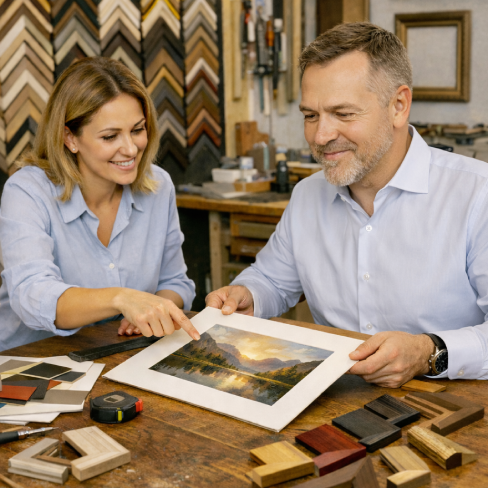
From there the conversation is genuinely collaborative. Some clients arrive with a clear idea and a reference image, others would rather I propose two or three directions. Both are welcome. If you are local you can visit the workshop and handle samples in daylight, which is always the best way to judge a gold tone or a paint colour. If you are not, and most of my clients are not, we do exactly the same thing remotely with photographs, measurements and detailed descriptions.
Designing the frame together: profile, colour, gilding and glazing
This is the part clients tend to enjoy most. Designing a bespoke frame means choosing from the workshop's full palette rather than a short catalogue: dozens of moulding profiles, from narrow finishing frames to wide cassetta and ornamental sections; over a hundred craft-grade paint colours, from clean whites and blacks to muted historic tones; and several shades of genuine gold leaf.
If the work calls for gold, I gild by hand using traditional water gilding, the only method that lets me burnish leaf to a deep, mirror-like sheen with an agate stone. I work most often in 23-karat yellow gold (the warmest, classic tone), 22-karat moon gold (cooler and subtly silvered), and white gold in 12 and 6 karat, alongside palladium and silver. Under the leaf sits a coloured bole, a fine clay ground in red, black, yellow, green, blue or grey, which shows softly through the gold and reveals itself under gentle wear. For a fully gilded result, see my gold gilded picture frames; for designs where leaf and painted colour work as equal partners, the gilded and partially painted frames show what is possible. If you prefer a painted finish, black and white frames are among the most versatile starting points.
For anything behind glass, we choose the glazing together: standard glass, conservation glass with a UV filter, or museum anti-reflective glass that all but disappears. The right choice depends entirely on the value and medium of the work.
Framing fine art, oil paintings and works on paper
Different media need different handling, and a workshop is where that knowledge lives. Framing oil paintings on stretched canvas usually means a deeper profile and a frame built around the stretcher rather than glazed. Works on paper need a mat, a spacer and conservation-grade materials to keep the surface off the glass. For collectors and galleries I build to museum standards: low-tannin timber that will not react with the work, acid-free mat board, backing and conservation tapes, and UV-filtering or anti-reflective glass, which together create a stable archival environment.
If you want to understand what genuinely goes into a museum-grade frame, and why it is priced the way it is, I have written a detailed breakdown of why professional picture framing costs what it does. For a fuller account of how I approach commissioned work for fine art, my bespoke picture frames page sets out the process in more depth.
Working with artists, galleries and collectors
A good deal of my work is for people who frame for a living, or who care for valuable collections. I trained as a wood carver and gilder, spent years restoring antique mirrors and making faithful reproductions of historic frames, and over time my work has gone to museums, to galleries from London to New York, and to private collectors. You can read more about my background on my about page.
In practice that experience means I can match an existing frame in a series, reproduce a historic profile for a period piece, or design something entirely contemporary, and I can talk through the conservation implications honestly rather than upselling glazing nobody needs. For an artist preparing a show, consistency across a whole body of work matters as much as any single frame, and that is exactly the kind of brief a workshop is built for.
Framing art within an interior
Framing decisions rarely happen in a vacuum. A frame has to sit in a real room, next to real walls, furniture and light, and it often has to relate to other pieces nearby. When I design with an interior in mind, I think about how the profile reads at a distance, whether a warm 23-karat gold or a cooler white gold suits the palette of the space, and how the frame holds its own without overpowering either the work or the room.
This is also where frames and mirrors start to talk to each other. A gilded mirror and a set of gilded frames in the same space can share a visual language, and clients often commission both together.
Bespoke mirrors, made the same way
The same workshop, the same hands and the same techniques also produce mirrors. A bespoke mirror in a handmade frame is built exactly as a picture frame is: solid wood, made to your dimensions, painted or water-gilded, finished by hand. If you are furnishing a particular space, I make glamour mirrors for statement walls, restrained classic mirrors for traditional interiors, and moisture-tolerant bathroom mirrors where an ordinary frame would not last. Commissioning a mirror follows the same path as a frame: dimensions, profile, finish, then a build to order.
Lead times, ordering remotely and what it costs
Honest expectations help everyone. Because every piece is made to order, production usually takes four to eight weeks, depending on the complexity of the build and the current workshop schedule. Gilded and carved work sits at the longer end, a simple painted profile is quicker.
Pricing works differently from a ready-made frame too. The base price you see on a product page is per running metre of moulding, not per frame, because a frame's cost depends on its perimeter, and mitred corners cut at 45 degrees use more moulding than the bare measurement suggests. Wider profiles use more again. The configurator on each product page accounts for full moulding usage, then adds any glazing, backing and hanging hardware you choose. One detail worth remembering when ordering against an existing canvas: the dimensions on a product page describe the outer frame, while the rabbet the work sits in is correspondingly smaller. If your piece is oversized, an unusual shape, or needs a museum-grade build, I prepare an individual quote rather than relying on the configurator.
How to start your commission
If you have a piece that deserves a frame built for it, the simplest first step is to send me its dimensions and a photograph, along with a sense of the interior it will live in. I will come back with a specification and a price, and we take it from there. Browse the custom picture frames collection for direction first, or simply get in touch and tell me what you have in mind.
Frequently asked questions about working with a framing workshop
Do I need to visit the workshop in person?
No. You are welcome to visit and see frames and samples in daylight, but most of my clients order remotely. With accurate measurements and a few photographs I can design, quote and build a frame for a client almost anywhere, then ship it safely.
How do I measure my artwork for a custom frame?
Measure the work itself as precisely as you can, ideally to a tenth of a centimetre, and for a stretched canvas measure the depth as well. Tell me whether you want the frame to sit over the edge of the work or around it, and I will allow the correct technical clearance so the piece fits properly.
How long does a bespoke frame take to make?
Typically four to eight weeks. The exact time depends on the profile, the finish, and how much hand-gilding or carving is involved, as well as the current schedule. I give you a realistic date when I confirm the order.
What is the difference between a workshop frame and a ready-made one?
A ready-made frame comes in fixed sizes and standard mouldings and is assembled in volume. A workshop frame is designed for one specific piece, built from raw wood to exact dimensions, jointed with traditional mortise-and-tenon corners rather than simple pinned mitres, and finished by hand. It costs more, and it looks and lasts like what it is.
Can you frame valuable or fragile works to conservation standards?
Yes. For valuable paintings, works on paper and photographs I use low-tannin timber, acid-free mounting materials and UV-filtering or museum glass, so the frame protects the work rather than slowly damaging it. I will always tell you honestly which level of protection a particular piece actually needs.