Picture Frame Styles and Constructions: Choosing the Best Frame for Your Painting
A picture frame does two jobs at the same time. It sets the mood around an image, and it physically holds and protects the work. When clients ask me which frame is best for a painting, the honest answer is that there is no single best frame, only the right pairing of style and construction for that particular piece. In this guide I compare the decorative styles I make, from ornate and gilded to minimalist, alongside the constructions I build in my workshop, so you can choose with confidence. If you want the full step by step rather than a comparison, I cover that separately in my notes on the fundamentals of framing artworks.
Picture frame styles compared: ornate, minimalist and the middle ground
The first decision is decorative. A frame can announce itself as part of the artwork, or it can disappear so the image carries the wall on its own. Most pieces sit somewhere between those two poles, and choosing well is mostly about reading the painting and the room together.
Ornate and decorative frames
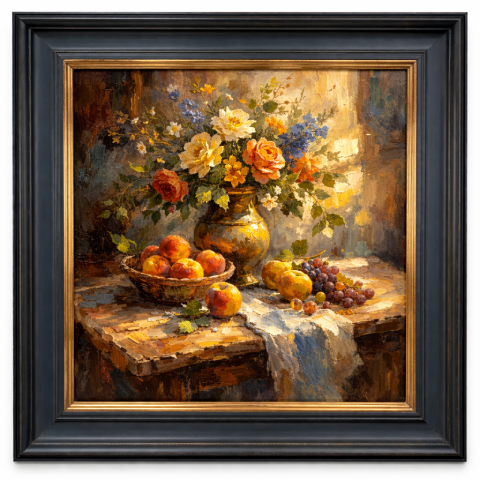
Ornate frames are full of detail: carved corners, beading, twisted rope mouldings and rich gilded surfaces. They suit classical paintings, oil portraits, religious works and anything that benefits from a sense of tradition and occasion. In my workshop I carve these profiles by hand and lay genuine gold leaf using the slow, traditional method of water gilding, which gives a depth of colour no printed or sprayed finish can match. If you are drawn to this look, my gold gilded picture frames are the natural place to start. For the decorative details themselves, the corner ornaments, crests and carved lines that give a frame its character, I have written a separate guide on decorative frame elements and additions.
Product slots (pending confirmation): hand-carved partially gilded frame · ornate black frame with carved corners · museum-style gilded frame with Flemish corners.
Minimalist and modern frames
Minimalist frames do the opposite. They are narrow, flat and quiet, and they let the work speak. A deep gloss black, a soft chalky white or a clean natural timber profile reads as contemporary and keeps all the attention on the image. These frames are ideal for modern and abstract art, photography and graphic prints. I make them as black picture frames and white picture frames, in matt, satin or high gloss finishes. If you are framing a modern piece and want to understand why restraint usually wins, I explain my reasoning in my article on modern picture frames.
Product slots (pending confirmation): high-gloss black profile · custom white moulding · deep black gesso frame.
The middle ground: subtle ornament and partial gilding
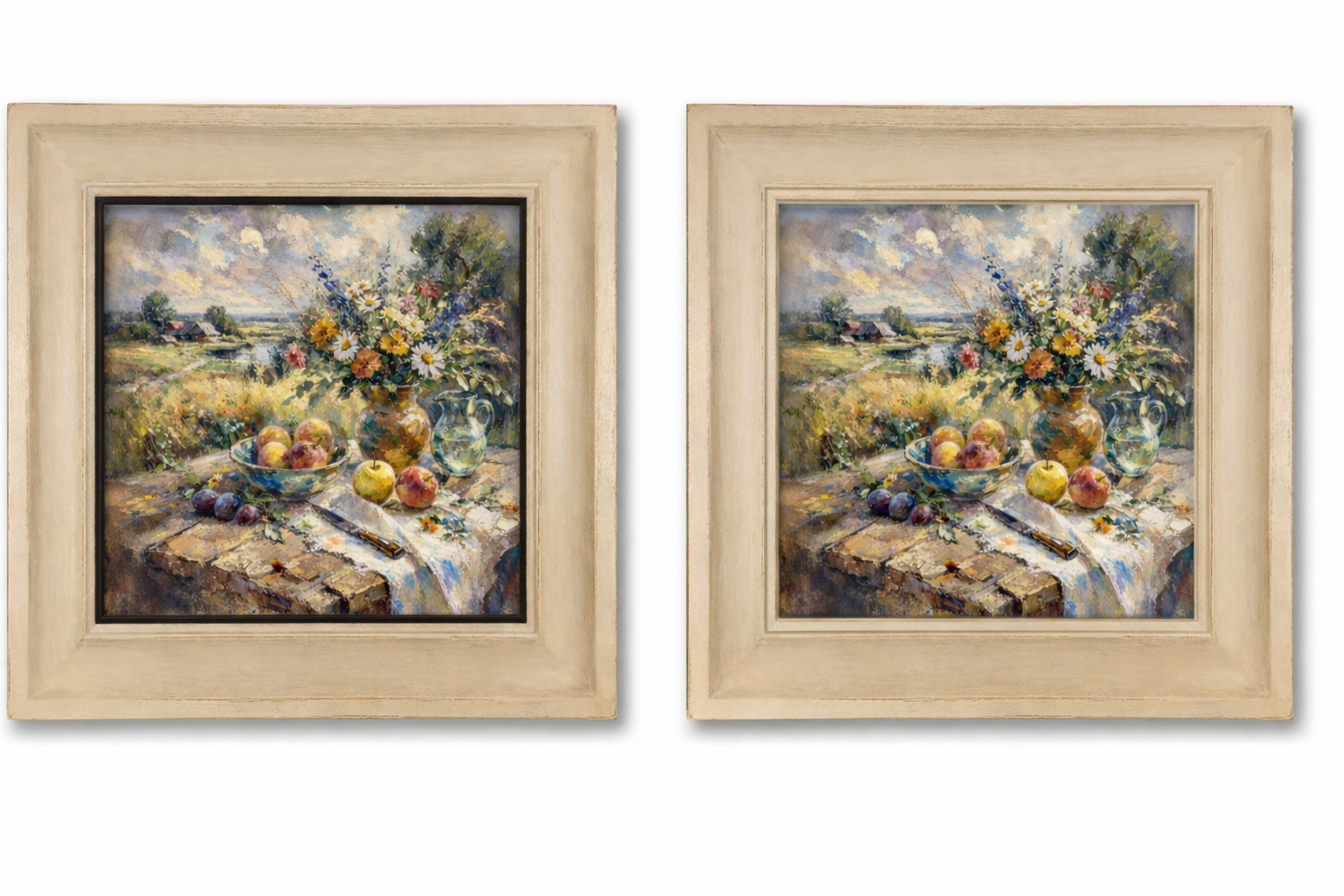
Between the two extremes sits the option most of my clients choose in the end: a frame that is calm overall but carries one piece of detail. That might be a painted profile with a single gilded lip, a fine carved line at the sight edge, or two raised mouldings picked out in white gold. It gives a painting a sense of quality without overpowering it, and it works in both traditional and modern interiors. I make these as gold gilded and partially painted picture frames, where colour and a touch of real gold leaf are combined on the same profile.
Product slots (pending confirmation): grey classical frame with 12-karat white gold · black frame with a gilded inner frame.
Frame constructions compared: standard, deep, spacer and box frames
The second decision is structural, and it matters just as much as the look. The right construction protects the work, suits its depth and decides how the piece sits on the wall. Two frames can share the same finish yet be built in completely different ways.
Standard rebate frames
A standard frame holds the work in a rebate (the step cut into the back of the moulding), with or without glass. This is the right answer for most paintings on canvas or board, where the surface is robust and no glazing is needed. The choice here is mainly about profile width and finish rather than special engineering.
Deep frames for canvas and three-dimensional work
Some works need extra depth. Thick gallery stretcher bars, heavily textured surfaces, collage and small three-dimensional pieces do not sit flat, so I build a deeper moulding or a tray and float construction that gives the work room and creates a clean shadow line around it. Floating frames in particular have become very popular for contemporary canvases because the painting appears to hover inside the frame. I explain how this construction works, and where it suits a painting, in my piece on the American box frame for a painting.
Product slots (pending confirmation): floating American box frame · deep floating frame built without a rebate · gilded tray frame.
Spacer frames for works on paper
Works on paper need different protection. A spacer holds the glazing a few millimetres off the surface so the paper never touches the glass, which prevents condensation, sticking and mould. Combined with archival mounts and backing, this is how I frame watercolours, drawings, etchings, prints and photographs that you want to keep for decades. For this kind of conservation work I would point you to my approach to archival and museum framing. For oils, where the priorities are slightly different, I cover the specifics in framing oil paintings.
Box and shadow frames for objects and keepsakes
Not everything you want to frame is flat. Medals, militaria, a christening gown, a sports shirt or other family keepsakes call for a box or shadow frame: a deep window box that gives the object space and presents it like an exhibit. I build these to measure around the item itself, so the depth and mount are made for that piece rather than forced into a stock size. This is one of the most rewarding parts of bespoke work, because the result turns a drawer of memories into something you can hang on the wall.
Product slot (pending confirmation): white box frame. Gap: no dedicated shadow box / display frame page exists yet (see notes).
Matching style to construction
The two decisions are not separate in practice; the best results come from combining them deliberately. A few pairings I return to often: a deep float in matt black for a contemporary canvas, an ornate gilded rebate for an oil portrait, a slim white moulding with a spacer for a botanical print, and a quiet painted profile with a single gold line for a piece that needs to sit calmly in a busy room. Because I make every frame to measure, you are not limited to stock profiles or proportions, which means the style and the construction can both be chosen for your specific work. You can browse the full range of custom picture frames or, if you already know roughly what you want, commission a bespoke frame directly. If the hardest part is judging what suits your room as well as your art, my guide on how to match a frame to your interior and artwork walks through it.
The same choices apply to mirrors
It is worth knowing that the same profiles, finishes and gilding I use on paintings also frame mirrors. An ornate gilded frame, a glamour finish or a clean minimalist moulding works just as well around glass as around a canvas, which is useful if you are styling a whole room rather than a single picture. You can see how these styles translate in my framed mirrors, and in the more elaborate decorative mirrors for hallways and living rooms.
How I make each frame
Every frame I sell is made by hand in my workshop near Bialystok, from start to finish. I begin with solid timber, cut and join the moulding, then build the surface in layers: gesso, coloured bole, and finally genuine gold or silver leaf laid by water gilding, or hand-applied paint and patina for the colour finishes. There is no production line and no outsourcing, so I can adjust width, depth, colour and the type of gold for each commission. That single-maker process is the reason a frame from my workshop fits a painting properly and ages well, and it is what I write about in more detail on the page about my workshop.
Frequently asked questions
What is a frame style?
A frame style is the overall look of the moulding: its profile shape, finish and level of decoration. The main styles are ornate (carved and gilded), minimalist (narrow, flat and plain) and a middle ground that combines a simple profile with one decorative detail such as a gilded edge.
What are the main types of picture frame?
By construction, the main types are standard rebate frames, deep frames, floating or tray frames, spacer frames for works on paper, and box or shadow frames for objects. By style, they range from ornate gilded frames through to plain minimalist mouldings. Most frames combine one construction with one style.
What is a box frame for a painting?
A box frame is a deep frame that gives the work space behind the front edge. For a canvas it can be built as a floating frame, so the painting appears to sit inside the frame with a shadow gap around it. For objects it becomes a shadow box that displays three-dimensional items behind glass.
Which frame is best for a canvas painting?
For a stretched canvas I usually recommend either a deep moulding that covers the edge or a floating frame that leaves a clean gap around it, since both suit the thickness of a canvas. The style then depends on the painting and the room. I go into the options in detail in my guide to the best frame for a canvas painting.
Do works on paper need a spacer frame?
Yes, in most cases. Paper should never touch the glass, so a spacer or a window mount holds the glazing off the surface and protects the work from condensation and sticking. For anything you want to preserve, I would pair a spacer with archival mounts and backing.
If you are weighing up a frame for a specific painting, drawing or object, tell me the dimensions and a little about the piece and I will recommend a style and construction, then make it to measure in my workshop.