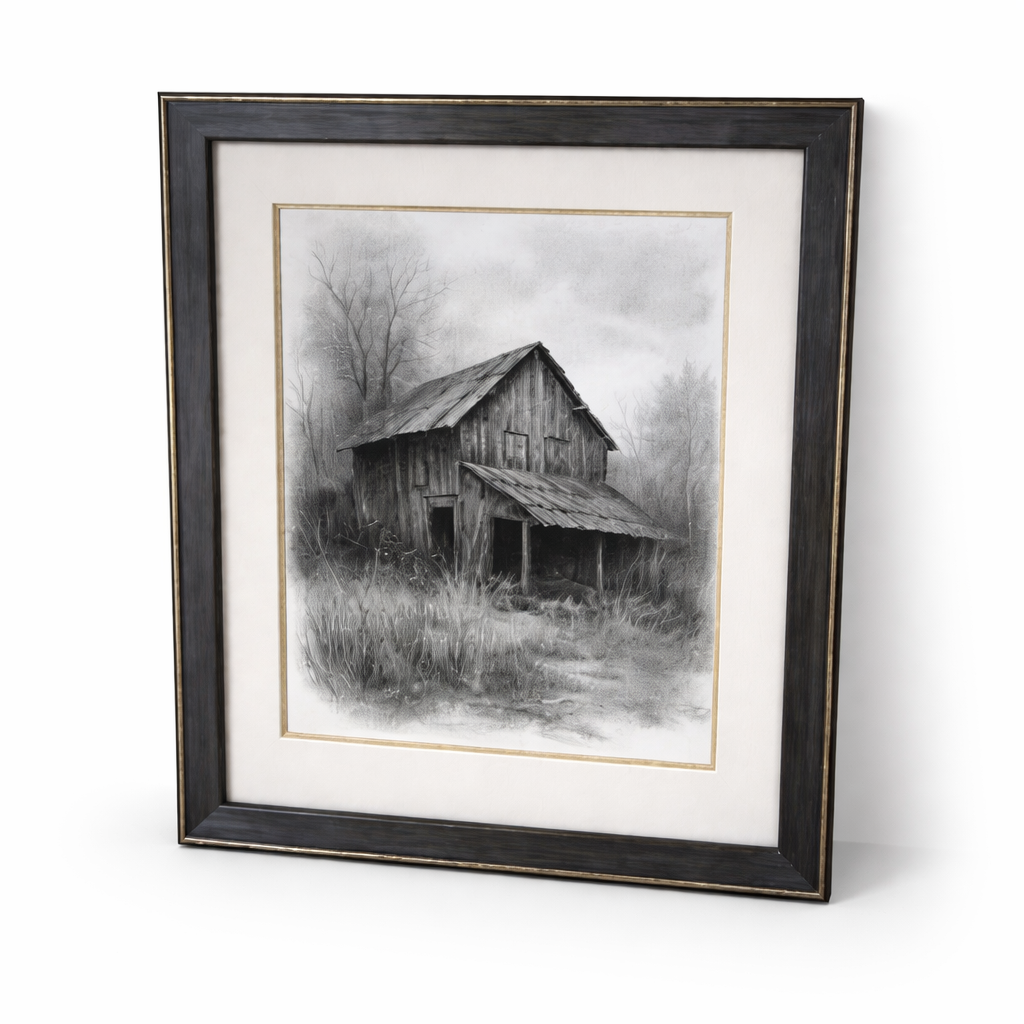
How to Choose the Right Frame for Different Types of Artwork
A frame does two jobs at once: it presents the work and it protects it. Get the presentation right and a painting reads as finished; get the protection right and it survives decades of light, handling and changing humidity. The difficulty is that no single frame does both jobs equally well for every kind of object. The choices that flatter a heavy oil on canvas are the wrong choices for a watercolour on paper, and neither has much in common with the deep, glazed case a medal needs. I build every frame to order in my workshop, from raw timber through to the final gilded or painted finish, so each of the decisions below is made for the specific piece in front of me rather than pulled from a shelf of stock sizes.
Start with the artwork, not the frame
Before I think about profiles or finishes, I ask two questions about the work itself. First, what is it: an oil on stretched canvas, a print on paper, a photograph, a textile, a document, or a three-dimensional object? Second, what does it need in order to survive: is it sensitive to light, to the acids in ordinary framing materials, to contact with glass, or to being held under tension? The answers point to the right construction long before taste comes into it. If you want the groundwork first, I cover the general principles in my notes on the fundamentals of framing artworks, and the practical side of commissioning a frame in how to choose custom picture frames. This guide takes the next step and works through each type of artwork in turn.
Framing oil and acrylic paintings on canvas
Oil and acrylic paintings are the most forgiving to frame in one respect: the paint surface is robust and rarely needs glass, which frees the decision to be largely about presentation and structure. As a rule, traditional and figurative oils, portraits, landscapes and still lifes sit best in a frame with some weight and depth to it, often a classical profile finished with genuine gold leaf, while contemporary and abstract work tends to want a quieter, more minimal profile that lets the painting carry the wall on its own.
The detail people most often overlook is the canvas itself. A stretched canvas has depth, sometimes a great deal of it on larger works, and the frame has to accommodate the stretcher bar without crushing it or hiding it. This is where the rabbet (the recess at the back of the moulding that receives the work) matters: it has to be deep enough for the stretcher. For paintings where the painted image continues around the sides, or where you simply want a clean, gallery look, a float or box frame is the better answer. In that construction the canvas sits inside the frame with a narrow gap all round, so the work appears to float and the edges stay visible. I write about the style in detail in my piece on the American box frame for a painting, and you can compare the approaches for stretched work in types of picture frames for canvas paintings and the best frame for a canvas painting.
For the finish, this is where the workshop side of what I do comes in. My fully gilded profiles are laid with real gold leaf over a coloured bole by the traditional water-gilding method, and you can browse them in my gold gilded picture frames category. Where a painting calls for something between gilt and paint, a hand-painted ground with a gilded edge or ornament, the pieces in gold-gilded and partially painted frames show what that combination looks like. If you want the full process for this medium in particular, including how I match style, colour and proportion to the painting, I set it out on my framing oil paintings page. One historical option worth knowing about is the Dutch reverse-profile frame, which suits oils especially well; I explain it in my article on Dutch frames.
Framing prints, drawings, watercolours and posters
Works on paper are the opposite of oils: the image is delicate, the support is acidic by nature, and light is the enemy. Framing here is mostly about protection, and the profile itself is often the simplest decision. Three things do the real work. The first is the glazing: I fit UV-filtering glass to slow the fading that ordinary glass does little to prevent. The second is an acid-free mount, the bevelled board (the passe-partout) that surrounds the image; as well as setting the work off visually, it lifts the paper away from the glass so the two never touch. The third is an acid-free backing, so that the materials behind the work are not slowly staining it from the rear.
Pastels, charcoal and other friable media need one extra step: the surface has to be kept clear of the glass altogether, which I do with spacers rather than a mount pressed against the work. This is also the honest answer to a question I am often asked, why a properly framed poster or print costs more than the off-the-shelf alternative. It is the conservation glass, the acid-free materials and the made-to-measure mount and frame that account for the difference, and I break the economics down in why professional framing costs what it does. The full set of glazing and mounting options I offer, including four classes of glass, is on my archival and museum framing page.
Framing photographs
Photographs share the sensitivities of works on paper and add one of their own: the emulsion can stick to glass where the two are in direct contact, especially as humidity changes. So a mount or a spacer here is not just decorative, it is doing a protective job. For colour photographs in particular, UV-filtering glazing is worth specifying, and where a print has real value I use a glass tested as safe for archival photography rather than one simply marketed as protective.
On the presentation side, photographs are versatile. A clean, narrow profile keeps the attention on the image, which is why much of my standard photo frames range is restrained in style. But a special photograph, a wedding portrait or a family group, often earns a more generous frame, and a gilded profile can lift a black-and-white image beautifully without overwhelming it. If that is the direction you have in mind, the gold gilded range is the place to look, with the protective specification described on the archival framing page above.
Framing textiles, embroidery and needlework
Textiles are framed quite differently from anything flat and rigid. The cardinal rule is that I do not glue or permanently fix the fabric: adhesives stain, and they make any later conservation impossible. Instead the piece is held under gentle, even tension on an acid-free support, so it keeps its shape without being stressed at any single point. As with paper, the textile should not press against the glass, so I set the glazing clear of the surface with spacers, which also lets the fabric breathe. Framed this way, a sampler or a piece of heirloom embroidery is both displayed and preserved, rather than slowly distorted behind a sheet of glass.
Framing certificates, diplomas and documents
A diploma or certificate is usually a representative object, so the frame should read as quiet and dignified rather than decorative: a restrained profile, often in a dark or natural finish, occasionally with a fine gilded edge for a more formal setting. The conservation thinking still applies, because these are works on paper and you will want them to look the same in twenty years as they do today, so I use acid-free mounting and, where the document will hang in daylight, UV-filtering glass. For an award or honour that deserves a little more presence, a gilded frame suits the occasion, built with the protective specification on my archival framing page.
Framing medals, coins and three-dimensional keepsakes
Three-dimensional objects cannot go in a flat frame at all; they need depth. The right answer is a deep box frame, sometimes called a shadow box or display case, built so that the object sits within the depth of the frame behind glass rather than being pressed against it. The object is held in place without permanent fixing wherever possible, so it can be removed or rearranged later, and the glazing keeps dust and handling away from it. A medal from an important occasion, a set of coins, a christening gift or a piece of memorabilia framed this way takes on an almost museum quality: protected, clearly seen from every angle, and given the standing it deserves. This kind of work overlaps closely with framing for collections, which I cover on my bespoke picture frames for fine art and collections page, and the box construction itself belongs to the same family as the floating frame I describe in the American box frame.
The decisions that apply to almost everything
A few choices cut across every type of work, and they are usually where a frame succeeds or fails.
Glazing: glass or acrylic, and when you need UV protection
Oils generally need no glazing; almost everything on paper does. Where glazing is called for, the questions are how much UV protection the work needs and how much reflection you can live with. I offer four classes, from a clear low-iron glass with no green tint, through anti-reflective UV glass, up to a museum acrylic that blocks over 99% of UV, all but eliminates reflection and is light enough to be safe on large pieces. I match the class to the work and its size, and explain the differences in full on my archival and museum framing page.
Mounts, mats and spacers
A mount (passe-partout) does three things: it gives the eye a margin of rest around the image, it sets a visual proportion, and it holds the work off the glass. A spacer does that last job invisibly where a mount is not wanted, for instance on a float-framed print or a pastel. Both should be acid-free, or in time they will mark the very work they are meant to protect.
Proportion, profile and colour
As a rough guide, the larger or busier the work, the more frame it can carry; a small, delicate piece is usually overwhelmed by a heavy profile. For colour, I take my lead from the work rather than the wall, picking up a tone already present in the image so that the frame feels inevitable rather than added. If you are weighing the frame against the room as well as the artwork, I go into that balance in choosing a frame for your interior.
Getting the size right
Because I make to measure, the fit is only as good as the measurements. I ask for the height, width and, for canvas or three-dimensional work, the depth, ideally to within a millimetre, since even a small error changes how the work sits in the rabbet. Send me those figures and a photograph and I can advise on profile, glazing and finish before anything is cut.
Made to measure: how I frame your work
Everything above is made by hand in my workshop rather than assembled from ready-made lengths. I cut and join the mouldings using mortise-and-tenon joinery rather than simple pinned mitres, because a gessoed and gilded frame has to stay stable under its own weight and through changes in humidity. Profiles are hand-shaped or hand-carved, gilding is laid as genuine leaf over bole by the traditional water-gilding method, and painted finishes are built up in layers. You can see the breadth of what that allows in my custom picture frames catalogue, read about the gilding itself on my water gilding page, and find out a little more about how I work on the about the workshop page. If you already have a piece that needs framing, the simplest next step is to send me the details and I will prepare a specification and a price.
The same craft, applied to mirrors
Much of this carries straight over to mirrors, which I also make to measure in the same workshop, with the same profiles and gilded finishes. If a frame can transform a painting, it can do as much for a mirror, and a hand-made frame turns a mirror from a fitting into a piece in its own right. You can see that range in my mirrors in frames and decorative mirrors collections.
Frequently asked questions
How do I choose a frame for an oil painting?
Start with the painting's character and size. Traditional and figurative oils generally suit a deeper, often gilded classical profile, while contemporary work suits a simpler one. Make sure the rabbet is deep enough for the stretcher bar, and remember that oils rarely need glass. My framing oil paintings page walks through it in detail.
Do oil paintings need glass?
Usually not. The paint surface is robust and benefits from a little air movement, so most oils are framed without glazing. Glass is only worth considering in unusual cases, such as heavy pollution, an unvarnished or fragile surface, or an exceptionally valuable work, and then a museum acrylic is the safer choice.
What frame is best for a canvas painting?
It depends on whether you want the canvas edges covered or visible. A traditional rabbeted frame encloses the edges; a float or box frame leaves a small gap so the canvas appears to float. I compare the options in types of picture frames for canvas paintings.
How do I frame a print or watercolour so it does not fade?
Use UV-filtering glazing, an acid-free mount that holds the work off the glass, and an acid-free backing, and keep the piece out of direct sunlight. These are the materials I describe on my archival framing page.
What is a passe-partout, and do I need one?
A passe-partout is the bevelled mount board that surrounds an image inside the frame. It gives the work visual breathing space and, just as importantly, keeps paper or photographs from touching the glass. It is recommended for almost all works on paper and photographs, and optional for canvas.
What frame do I use for medals, coins or a 3D keepsake?
A deep box frame or shadow box, which holds the object within the frame's depth behind glass. It protects the piece from dust and handling while letting it be seen clearly from every side. This sits alongside my work for collections.
Should all the picture frames in a room match?
They do not have to. A single consistent finish across a group reads as calm and deliberate, but a deliberately mixed set can work well too, provided something ties it together, a shared colour, metal or profile. The work itself should drive each individual choice.
Why does a custom frame cost more than a ready-made one?
Because it is made to your exact dimensions by hand, in your choice of profile, finish and glazing, with conservation-grade materials wherever the work needs them. I explain where the cost goes in why professional framing costs what it does.
Whatever you are framing, the principle is the same: let the object decide. Tell me what it is and what it needs, and I will build a frame that presents it well and keeps it safe. To start, send me the dimensions and a photograph and I will come back with a specification and a price.