Specialist and Conservation Framing Techniques
In fine art framing, the techniques that matter most are usually the ones you never see. Specialist and conservation framing techniques exist for one reason: to protect a work, whether on paper, canvas or board, from the slow damage caused by ultraviolet light, damp, airborne acidity and careless handling. A frame can look beautiful and still be quietly harming the piece inside it. Conservation framing is the discipline of making sure that never happens, while still presenting the work at its best.
I make every frame by hand, to order, in my workshop, and a large part of that work is invisible from the front: the choice of glass, the mounting system, the materials sitting against the artwork and the joinery holding everything stable. This guide walks through the three areas where these techniques matter most, conservation framing for valuable works, specialist framing for non-standard formats, and the restoration of old and antique frames, and explains when each one is worth the investment.
What conservation framing actually means
Conservation framing, archival framing and museum framing all describe the same thing: a way of framing designed to preserve a work rather than simply decorate it. The terms are used interchangeably across the trade. Whatever you call it, it rests on two principles.
The first is that every material touching the artwork must be chemically inert, so it cannot react with the surface, the paper or the pigments over time. The second is reversibility: the work must be removable from the frame in the future without any permanent intervention, no glue on the artwork, no trimming, no damage. If a frame meets both of those conditions, it is doing its job as a conservation frame. If it fails either, it is decoration that happens to surround something valuable.
The materials that protect a work of art
Most of the protective work in a conservation frame is done by a small number of carefully chosen components. None of them are dramatic on their own; together they decide what condition the work will be in for the next generation.
UV museum glass and anti-reflective glazing
Ordinary glass lets ultraviolet light pass straight through, and UV is what fades colours and weakens paper. Conservation glass carries a UV filter that blocks the great majority of it. The most advanced option, anti-reflective museum glass, goes further: it removes almost all surface reflection while still providing very high UV protection, so the glass seems to disappear and the work reads as if nothing were in front of it. For a signed, limited or irreplaceable piece, that protection is an investment rather than an expense. I explain how glazing sits within the wider cost of a frame in my breakdown of what goes into the cost of professional framing.
Acid-free mats, mounts and backing
Cheap framing relies on ordinary cardboard, which contains acids. Over the years those acids migrate into the artwork and cause the yellowing and brown spotting you often see on old prints and photographs. Conservation framing uses acid-free, pH-neutral materials throughout: cotton-rag or alpha-cellulose mat board, archival backing and acid-free mounting tapes. These stabilise the conditions around the work instead of slowly degrading it.
Spacers and the air gap
A work on paper should never sit pressed against the glass. Either a mat or a hidden spacer holds the surface away from the glazing, creating a small air gap. That gap stops the artwork sticking to the glass and protects it from condensation, which is exactly how mould and buckling begin.
Reversible mounting
This is the principle collectors care about most. The artwork is held with acid-free corners or paper hinges rather than glued down, so it can be lifted out cleanly at any point in the future. Reversible mounting protects both the piece and its value, and it is the clearest line between a conservation frame and a standard one. I bring all of these elements together in my archival and museum framing service, where the full system is specified for the individual work.
When does your artwork need conservation framing?
Not everything needs the full treatment, and I will always say so. A printed poster you may replace in a few years does not need museum glass. But for certain pieces, conservation framing is the difference between an heirloom and a ruined one. I recommend it for:
- original works on paper: watercolours, drawings, pastels and prints;
- signed, numbered or limited-edition prints, where condition directly affects value;
- photographs, especially baryta and other fibre-based prints;
- family heirlooms, documents and anything with sentimental rather than purely decorative worth;
- oil and acrylic paintings of real value, where the frame and mounting must support the work safely.
If you are framing a painting on canvas, the priorities shift slightly towards structure and presentation, which I cover in my guide to choosing the best frame for a canvas painting and in my framing oil paintings service.
Specialist framing for non-standard formats and materials
The other side of specialist framing has nothing to do with archival materials and everything to do with problem solving. Some works simply do not fit a standard frame, either literally, because of their shape or depth, or because they are made from unusual materials. These need a frame designed around the object rather than the object forced into a frame.
In practice that means building the moulding specifically for the piece, adjusting the rabbet depth and the mounting system to suit three-dimensional or deep work, and choosing materials that are stable and safe against the surface. A common solution is float or box mounting, where the work sits within the depth of the frame and appears to float, without the moulding ever covering its edges. It is the right approach for contemporary canvases, textile pieces, objects and anything where the edge is part of the work. I explain that construction in detail in my article on the American box frame for a painting.
This is the heart of bespoke picture framing: treating the frame as part of the composition, not an afterthought. If you have a piece that has never fitted anything off the shelf, a custom picture frame built to its exact dimensions is usually the only honest answer.
Frame restoration and regilding: bringing antique frames back to life
A good antique frame is worth saving. It is a piece of history in its own right, and often more characterful than anything currently made. Restoration is where craftsmanship and conservation knowledge meet, and the goal is never to make an old frame look brand new. It is to stabilise it and make its form legible again without erasing the patina that gives it age and authenticity.
What restoration involves
Depending on the frame, the work can include cleaning away dirt and old residues that weaken the surface, consolidating loose joints, filling losses in the wood, gesso or composition ornament, and rebuilding missing decorative detail by hand. Each step is done to match the original rather than to impose a modern finish.
Regilding with genuine gold leaf
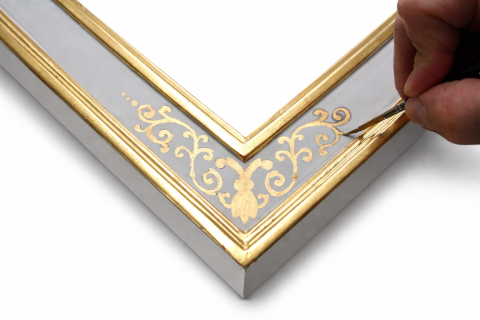
Where gilding has worn away, I restore it using traditional water gilding with real gold leaf, the same method used to make the frame in the first place. The leaf is laid by hand over a coloured bole ground, then burnished, exactly as it would have been historically. If you want to understand the technique itself, I describe the whole process on my water gilding page. The same skills sit behind every frame in my collections of hand-gilded gold leaf frames and gilded and partially painted frames, which are built to the same standards as the antique pieces they take their cue from.
Antique mirror frames
The same restoration and regilding work applies to the frames of old mirrors, which often survive long after the glass itself has aged. Reviving a carved, gilded mirror frame brings a genuine antique back into daily use, and it sits naturally alongside the made-to-measure pieces in my range of classic mirrors.
Why I build frames to conservation standards as standard
Even when a project does not call for full museum glazing, the construction underneath matters. I join my frames with traditional mortise-and-tenon corners rather than simple mitres held with pins, because that joint stays stable under the moisture cycling and weight of a gessoed and gilded surface. I cut mouldings from solid timber with low tannin levels, the kind used in museum framing and conservation, and I work to order so that every frame is sized and specified for one particular piece. Nothing is mass-produced, and nothing is built down to a price at the cost of the artwork's long-term safety. You can read more about my workshop and approach on my about the workshop page.
Frequently asked questions
What is conservation framing?
Conservation framing is a way of framing designed to preserve a work of art rather than just display it. It uses chemically inert, acid-free materials and reversible mounting, so the artwork is protected from light, damp and acidity and can be removed from the frame in the future without any damage.
What is the difference between archival, conservation and museum framing?
In practice there is none. Archival framing, conservation framing, preservation framing and museum framing all describe the same approach, using protective, reversible, acid-free materials and UV glazing. The different names tend to come from different parts of the trade rather than from any real difference in method.
Is museum glass worth the extra cost?
For a signed, limited or irreplaceable work, yes. Museum glass blocks the great majority of ultraviolet light, which is the main cause of fading, and the anti-reflective version removes almost all glare so the work reads clearly. For a poster or an easily replaced print, standard glazing is usually enough.
What does reversible mounting mean?
It means the artwork is held in place with acid-free corners or paper hinges instead of being glued or taped down permanently. The piece can be lifted out cleanly at any time, which protects both its condition and its value. Reversibility is one of the core principles of conservation framing.
Can an old or damaged frame be restored?
Usually, yes. Restoration can include cleaning, consolidating loose joints, filling losses, rebuilding missing ornament by hand and regilding worn areas with genuine gold leaf. The aim is to stabilise the frame and make its form whole again while keeping the patina that gives it age and character.
Does conservation framing change how the artwork looks?
It should not. Good conservation framing is discreet by design. Anti-reflective museum glass is almost invisible, acid-free mounting is hidden behind the mat, and the protective work happens out of sight. The viewer simply sees the artwork, presented at its best and safe for the long term.
If you have a piece you want framed to last, or an old frame worth saving, send me the dimensions and a photograph and I will prepare a specification and a price. You are also welcome to visit the workshop and see the work in person.