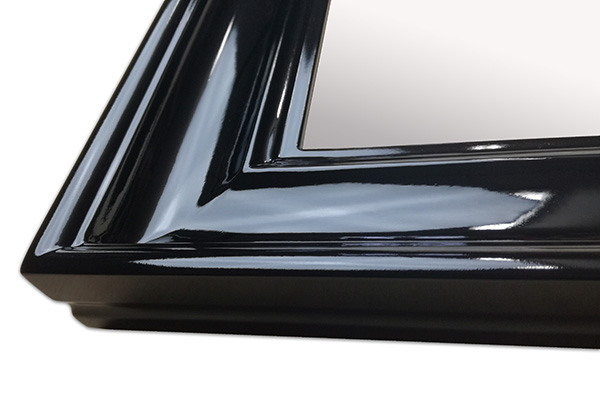
Stylish Black Framed Mirrors for Interiors
A black framed mirror works in almost every interior I have made frames for: minimalist flats, classic town houses, industrial lofts and glamour living rooms. Black gives the mirror a clear, graphic edge, so the reflection reads like a picture rather than a bare sheet of glass. In my workshop I build black framed mirrors to measure, from the solid timber profile through the ground and the finish to the glass itself, so every element can be matched to the room it will hang in.
Below I describe the black finishes I use most often, where each of them works best, and what to look at when choosing the width and profile of the frame.
Why a black frame suits almost any interior
Black is a neutral, but a decisive one. Against a pale wall a black frame draws a sharp outline around the reflection and gives the eye a place to rest. In rooms that already contain black accents, window joinery, door handles, lighting, a black framed mirror ties those elements together. And because the frame is dark, the reflection inside it appears brighter by contrast, which is useful in hallways and other rooms with little daylight. Many of the decorative mirrors I make in dark finishes go to rooms that need exactly this kind of visual anchor.
Matt, satin or high gloss: choosing the black finish
The finish changes the character of a black frame more than the profile does.
Matt black is soft and velvety. I paint it by hand over a chalk gesso ground, so the surface is even and deep rather than plasticky. Matt hides dust and small marks best and suits minimalist and industrial rooms.
Satin sits in the middle. It has a gentle sheen that responds to light without reflecting the whole room. If you are unsure, satin is the safest choice for a busy space.
High gloss black is the most demanding and the most spectacular. A gloss surface magnifies every flaw underneath it, so before the final coats I sand the gesso ground until it is completely smooth; only then will the lacquer build up a clean, piano-like shine. A black gloss mirror frame doubles reflections along its edge and suits glamour and modern interiors. It does show fingerprints, so it needs a little more regular care than matt. I compare more options in my guide to mirror frame colours and finishes.
Black and gold: gilded details on a black frame
A thin gilded line changes a plain black frame into something much more formal. I usually gild the inner lip or the outer edge with genuine gold leaf, using the traditional water gilding technique on a coloured bole, and leave the rest of the profile black. Warm 22ct or 23.75ct gold gives a classic, glamour effect; cooler white gold looks more contemporary against black. If this direction appeals to you, I have written separately about black and gold framed mirrors, and finished examples hang among my glamour mirrors.
Distressed black frames and shabby chic
Black does not have to be crisp. On distressed frames I rub the black coat back on the high points of the profile so the pale gesso or the timber shows through, then soften the whole surface with patination. The result is a frame that looks as if it had hung in the same house for decades. A black shabby chic mirror suits rustic and vintage rooms, and it forgives everyday knocks far better than any perfect gloss.
Black framed mirrors room by room
In the hallway a tall, narrow black framed mirror is the classic solution: it gives a full-length reflection before you leave the house, and its dark outline keeps a small space visually tidy. I have collected more layouts in my article on hallway mirror styles, and finished pieces are in the hallway mirrors category.
In the living room a black frame works over a sofa, a sideboard or a fireplace, especially where the room already plays with contrast: pale walls, dark furniture legs, black lamp fittings. You will find examples among my living room mirrors.
In the bathroom the finish matters more than anywhere else. I seal the frames of my bathroom mirrors carefully so that humidity does not lift the coating, and the mirror glass I use is made for damp rooms.
In the bedroom matt black is my usual recommendation: it frames the reflection calmly, without glare from bedside lamps.
Profile width, proportions and construction
I mill every profile from solid timber in my workshop; the saw only cuts lengths and mitres, the shape itself comes from the cutters. The corners are usually joined with biscuit joints, which keep the mitres tight for years. A narrow profile of two to three centimetres reads as a minimalist line. A wide, flat profile of eight centimetres or more gives the mirror a gallery presence. Deep, coved profiles suit classic rooms. For the glass I use SGG Miralite Pure Diamant, so the reflection stays clear and true to colour, without the green tint of ordinary mirror glass.
A black framed mirror made to measure
Most of the black framed mirrors that leave my workshop are built for a specific wall: a chimney breast, an alcove, the space between two windows. You send me the dimensions, I propose the profile and the finish, and the exact shade and sheen of black is agreed from photographs of my previous work. Then I make the frame from scratch: timber, ground, finish, glass and fittings. Lead time is typically four to eight weeks including international delivery. You will find made-to-measure pieces in the mirrors in frames category, and if you would like picture frames in the same finish to hang alongside, I make matching black picture frames as well.
Black framed mirrors: frequently asked questions
Does a black framed mirror suit a small room?
Yes. Choose a narrow profile and a matt or satin finish. The dark outline defines the reflection without taking up visual space, and the mirror itself adds depth to the room.
Is a high gloss black frame difficult to keep clean?
It needs more care than matt. Dust and fingerprints show sooner on gloss, so I recommend a dry microfibre cloth once a week. In busy hallways satin is the more practical choice.
Can a black frame have gold details?
Yes. The most frequent request I receive is a black profile with the inner lip gilded in genuine gold leaf. It adds warmth and formality without turning the mirror fully gold.
Which interior styles do black framed mirrors suit?
Minimalist, modern, industrial and glamour rooms first of all, but a distressed black frame also works in rustic and vintage interiors. Black is the most flexible frame colour after gold.