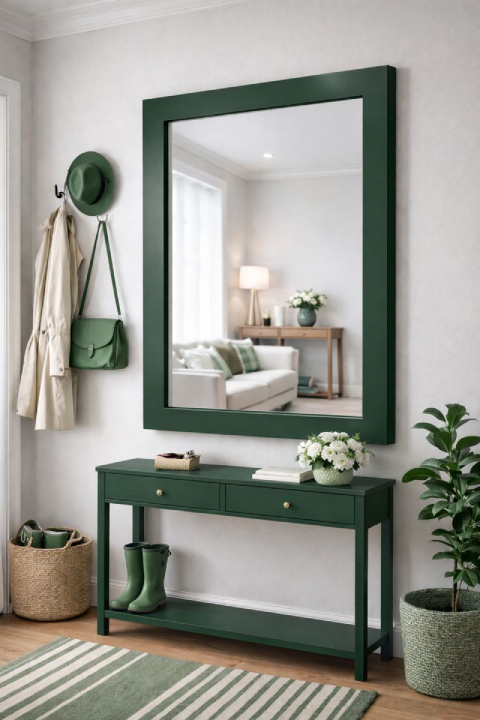
Bespoke Mirror Options: Bevelled Edges, Glass and Demisters
When I make a mirror to measure, the size is only the starting point. Every bespoke mirror I build carries a set of functional options that shape how it looks, how it performs in a particular room, and how long it stays looking its best. In this guide I walk through the main bespoke mirror options I offer, from the grade of glass and a ground bevel to moisture-resistant finishes and a bathroom demister, and I explain how I decide on each one in the workshop. The aim is simple: to help you specify a mirror that fits your wall, your interior, and the way you actually use the room.
Why a made-to-measure mirror puts the choices back in your hands
A ready-made mirror gives you a fixed size, a fixed shape, and whatever glass and finish the manufacturer happened to select. When I build a mirror to order, those decisions come back to you. I mill the moulding from solid timber, prepare the glass to your dimensions, and finish the frame by hand, so the specification is set around your room rather than a standard product line. That is the real value of a bespoke piece: the options are not extras bolted on afterwards, they are built into the mirror from the first cut. You can see the range of framed pieces I make in my mirrors in frames collection, which runs from quiet modern profiles to richly gilded classic mouldings. Two finished commissions show the span: my custom mirror in a gilded frame at the ornate end, and a lighter white frame mirror with a gilded edge for a calmer scheme.
The glass I use, and why it matters more than people expect
The single choice that affects a mirror most, and the one people think about least, is the glass itself. I use SGG Miralite Pure Diamant 4 mm, a low-iron OptiWhite mirror glass. Standard mirror glass carries a faint green cast that you notice most against white walls and on pale skin tones. Low-iron glass removes that tint, so the reflection reads neutral and true. On a decorative mirror where the frame is the point, clear glass keeps the whole piece looking considered rather than cheap. It is a small line on a specification and a large difference in the room.
A ground bevel: quiet sparkle at the edge
A bevel is a shallow angle ground into the perimeter of the glass. On my mirrors it can run up to 20 mm wide. It adds a soft, crystalline catch of light at the border of the reflection without pulling attention away from the frame, and it suits classic and glamour interiors especially well. Set inside a decorative frame it becomes a refined inner edge; you can see this handled on a piece like my black and gold framed mirror, where the bevel sits against a classic gilded moulding. A ground bevel of this kind reads at its best across my glamour mirrors range, where the play of light on the frame and the sparkle at the glass edge work together. A piece like my Nero Glam glamour mirror pairs a wide bevel with a bright gilded moulding. If you prefer the calmest possible look, a plain polished edge is the alternative.
Mirrors for bathrooms: moisture, safety glass and demisters
A bathroom asks more of a mirror than any other room. Steam, temperature swings and splashing all work against both the glass and the frame, so I treat bathroom commissions differently. For the frame, I choose finishes designed to cope with damp air and I seal the piece so it resists moisture. Safety glass is available where a larger mirror or a family bathroom makes it the sensible choice. The option people ask about most is a demister: a slim heating element fitted behind the glass that warms the surface just enough to stop condensation forming, so the mirror stays clear when you step out of the shower. I fit it on request, sized to the mirror. If you are planning a bathroom piece, my bathroom mirrors collection shows framed models built for exactly these conditions, among them my bathroom mirror in a white frame. It is worth deciding early whether you want a demister, because it is wired into the mirror during making rather than added later.
Shape, size and the frameless option
I make mirrors in rectangular, round, oval and custom shapes, cut to the exact width and height your wall needs. Getting the proportion right matters as much as the finish: a mirror that is a little too large overwhelms a narrow wall, while one that is too small looks lost above a wide console. When I quote a piece I ask for the wall dimensions and where it will hang, so the format is judged against the real space. For a fuller look at sizing a mirror to a specific room, my guide to made-to-measure mirrors for hallways applies just as well elsewhere in the home. Not every mirror needs a frame, either. A frameless mirror with a gentle bevel keeps the form minimal while still adding a polished detail, which works well in modern and compact interiors.
Frame finish as a functional choice, not only a decorative one
Finish is usually treated as decoration, but it also decides how a mirror behaves and where it belongs. I gild frames with genuine gold leaf in several karats, including 6, 12, 22-karat moon gold and 23-karat yellow gold, using traditional water gilding on a bole ground; for cooler tones I work with 6-karat white gold, palladium or genuine silver leaf, as on my bespoke mirror in a black frame gilded with white gold. Painted frames are built up in layers of gesso, smoothed, coloured and lacquered, and can be finished in high gloss or gently distressed for a vintage effect. On gilded pieces the corners are worked so the join disappears into a seamless closed-corner finish, which is a mark of a properly made frame rather than a mitred production one. The finish should answer the room: a high-gloss black or a bright gilded moulding for a glamour scheme, a softer painted or distressed frame for a traditional one. To see how these finishes read across styles, look through my decorative mirror finishes overview, and browse the full decorative mirrors collection for pieces where the frame is meant to be the focal point.
Where the mirror goes, and how it hangs
The room changes what the mirror needs to do. Over a living-room fireplace or a console, a larger decorative piece brings order to the wall and pulls extra daylight into the space; you can see how this plays out in my living room mirrors. A heavier gilded mirror needs a secure fixing rather than a single hook, so I finish larger pieces ready to mount safely on the wall, and I can advise on the fixing for the weight and size involved. In a bathroom or a hallway, the height at which the mirror sits and the light reaching it matter as much as the frame you choose.
Caring for a bespoke mirror
A hand-finished mirror asks for a little care and then rewards it for years. Clean the glass with a soft cloth and a gentle, ammonia-free glass cleaner. Wipe a gilded or painted frame with a dry, soft cloth only, and avoid letting water sit against the frame, even on a bathroom piece where the finish is already sealed against damp air. Treated this way, a frame gilded with real gold leaf can last for generations. It is a decorative object, but also something of an investment.
How I agree the options with you
Every choice above is settled together before I begin. Send me your wall dimensions and your preferences for style, colour and finish, and I will prepare an individual quote. I agree the exact specification with you from photographs of pieces I have already made, so you can see how a ground bevel, a particular gilded moulding or a bathroom demister actually looks before any work starts. Once the specification is settled, I make the mirror in the workshop and ship it safely to your address. If you would like to talk a commission through, you can reach me through my contact page.
Frequently asked questions
Can I have a bathroom mirror that does not fog up?
Yes. I fit a demister on request: a slim heating element placed behind the glass that gently warms the surface so condensation does not form. It is wired in while the mirror is being made and sized to the piece, which is why it is best specified at the quote stage rather than added later.
What is a bevelled mirror edge?
A bevel is a shallow angle ground around the perimeter of the glass. It catches the light at the edge of the reflection and gives the mirror a more finished, crystalline detail. On my mirrors the bevel can be up to 20 mm wide, and it suits classic and glamour interiors particularly well.
Do you make mirrors in custom sizes and shapes?
Yes. Every mirror is made to measure in rectangular, round, oval or custom shapes, cut to the width and height your wall requires. This is the reason to choose a bespoke piece: it is fitted to your space and, where needed, aligned with built-in furniture or a fireplace rather than approximated to it.
What glass do you use for your mirrors?
I use SGG Miralite Pure Diamant 4 mm, a low-iron OptiWhite mirror glass. It is neutral in tone and free of the greenish cast typical of standard mirror glass, so the reflection stays true. Safety glass is available where a larger or family-bathroom mirror makes it the sensible option.
How do I order a made-to-measure mirror?
Send me the dimensions of your wall and your preferences for style, colour and finish. I prepare an individual quote, agree the specification with you from photographs of my previous work, then make the mirror and ship it to your address. Deciding on the bevel, glass and any demister at this stage keeps the process straightforward.