White picture frame for canvas paintings, made to measure
- Add feedback:
- Code: 58
- Manufacturer: Karol Milewski
-
Availability:
 Exists
Delivery time: 20 - 30 working days
- pcs.
- €163.89
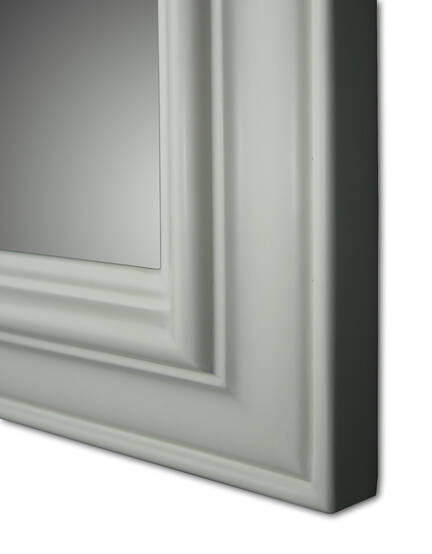
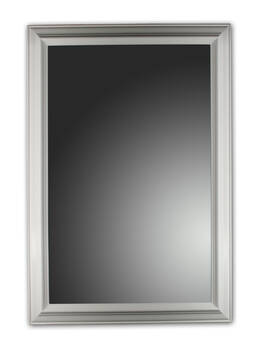
A white frame for paintings on stretched canvas, with a reverse profile that carries its highest point next to the picture and falls away towards the wall. The moulding is 67 mm wide and the rebate runs 20 mm deep, so it takes a thick stretcher without packing or alteration. I paint and finish each frame myself, to the measurements of one particular work.
This white picture frame is made for paintings on stretched canvas. The moulding is 67 mm wide and 32 mm thick, and the rebate runs 20 mm deep, so it takes a thick stretcher without packing or alteration. The section is a reverse one: the highest point runs next to the painting and the face falls away towards the wall, so an oil or acrylic on canvas is held in a broad, quiet band. Each frame is made to the measurements of one work.
Moulding profile
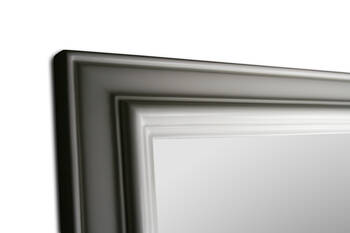
At the picture side the face rises through a concave hollow into a half round, the crest of the whole section. From there it descends across a long frieze that takes up the middle of the width, and closes with a small roll at the vertical outer edge. The crown of the moulding stands at the painting, not at the wall.
A reverse profile works differently from a classical one. The mass and the light gather at the work, and the descending frieze carries the eye inwards, so a 67 mm moulding of this shape does not overwhelm a painting. Where the shape comes from I set out in my guide to Dutch frames and the reverse profile.
Specification
- Style – reverse profile, softly drawn, without ornament
- Colour and finish – white, painted in several coats, satin sheen
- Moulding width – 67 mm
- Moulding thickness (face to back) – 32 mm
- Rebate – 7 mm wide, 20 mm deep, the maximum stretcher thickness
- Timber – low-tannin wood of the kind used in museum work and conservation
- Corner joints – mitred at 45°, reinforced with wooden splines
- Glazing, backing and mount – outside the calculator, priced individually
- Fixings and hanging – spring clips and picture wire, portrait or landscape orientation selected in the order menu
- Suitable for – oil and acrylic paintings on stretched canvas
A note on dimensions. The figures you enter in the calculator are the measurements of the artwork itself. I build the frame 2 to 3 mm larger, a clearance that lets the canvas seat without forcing, so the moulding overlaps the edge of the work by roughly 4 to 5 mm.
Which paintings and interiors it suits
I choose this section most often for oil and acrylic painting on canvas, for work with pronounced texture and strong colour. White acts as a pause between the painting and the wall: neutral, without a pull towards yellow or blue, so it does not compete with the palette. It suits landscape, still life and abstract work equally. The practical side of that choice I set out on my page about framing oil paintings.
On the wall a frame of this width behaves quietly. Against a pale wall it is the shadow under the half round that registers; against a dark wall the frame cuts a clean border. It belongs in modern, Scandinavian and gallery interiors, and the other frames of this kind are gathered in the white picture frames category.
Making and finishing
I work alone, one frame at a time. The moulding is cut at 45° and the corners are joined first, reinforced with wooden splines set into the line of the cut, so the corner exists before any finishing and the later coats run across the joint without a visible break.
Only then is the frame prepared for painting. The ground is built up in gesso and levelled back, and the white goes on in several coats, sanded between them, which gives a cover that one heavy coat cannot. The finish is wax, worked by hand, holding a satin sheen without warming the white.
How it differs from a mass produced frame
A frame made from ready-made moulding is cut from the metre and stapled together over a coating already on the timber, so the corner stays visible and the paint splits along it. Here the corner is joined and reinforced first, and the finish goes on to the assembled frame. The second difference is the measurement: I build around one particular work rather than fitting the painting to the nearest size on a shelf.
Functionality
As standard the frame is supplied without glazing, prepared for a painting on a stretcher. The 20 mm rebate is its most practical feature: it takes thick stretchers, including braced ones with keys, and hides the side of the stretcher completely. How deep a frame is depends on what can be closed inside it, on the rebate rather than the thickness of the moulding, and here that is a work up to 20 mm thick.
The same section can also be made without a rebate, as a floating frame in which the painting hangs inside with a visible gap around it; how that is built I show on the American Box floating frame.
Frequently asked questions
How thick a stretcher will this frame take?
Up to 20 mm, the depth of the rebate. A thinner canvas is packed from behind so that its face sits level with the lip.
What kind of frame suits a painting on canvas?
One with a rebate deep enough to hide the stretcher and a section quiet enough not to compete with the painting. A reverse profile does both.
Complete framing – additional options
Every frame I make can be completed with full archival and museum-quality framing: anti-reflective UV-filtering glass (four classes to choose from), acid-free museum mat board, spacers wrapped in acid-free paper and a Dibond backing. This kind of mounting protects the work from light, acids and distortion. I set out the full glass and material specification on a separate page: archival and museum framing for paintings and photographs. All components are available at extra cost, as an individual quote on request.
Mounting and hanging
Spring clips are fitted as standard, installed in the workshop and rotated aside to seat or swap the painting without dismantling the frame. Brass plates with screws are available on request, supplied loose with the screws included, for you to fit once the work is in place; this is the permanent retention used in exhibition mounting.
Hanging orientation, portrait or landscape, is selected from the order menu, and the frame is fitted only in the chosen orientation. Picture wire is standard; a single D-ring hanger is available on request.
Ordering to measure
Measure the width and height of the painting itself, to the nearest millimetre, and enter those two figures in the calculator on this page.
The base price shown on the page is the price per running metre of moulding. The perimeter of the artwork is not the whole length a frame needs: corners cut at 45° consume additional length, and the wider the moulding, the more each corner takes. The calculator accounts for the full consumption of moulding including the corners, together with the options you select.
The calculator accepts artwork up to a perimeter of 180 cm, the limit set for a moulding of this width; larger formats I make to individual order, so please write to me first. The calculator prices the frame alone, without glazing: glass, backing and mount are matched to the particular work, so please send me a message if you want the piece framed under glass. The lead time is 20 to 30 working days.