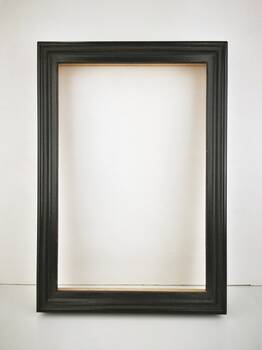
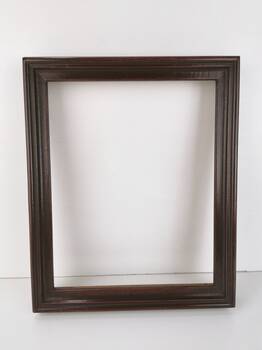
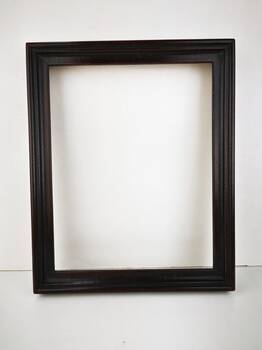
Hand-painted picture frame for oil paintings, made to measure
- Add feedback:
- Code: 312
- Manufacturer: Karol Milewski
-
Availability:
 Exists
Delivery time: 20 - 30 working days
- pcs.
- €116.67
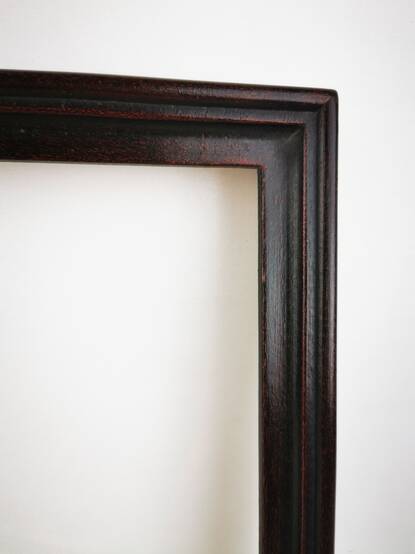
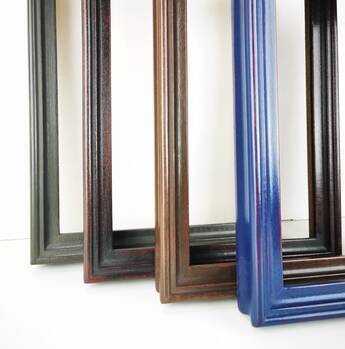
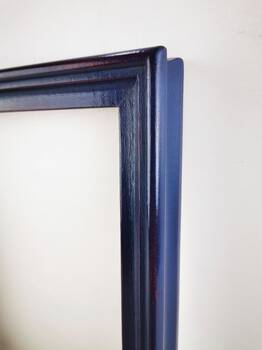
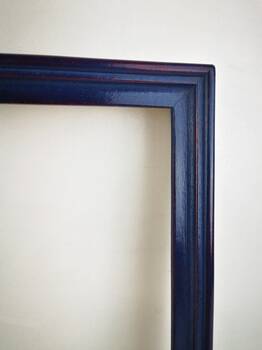
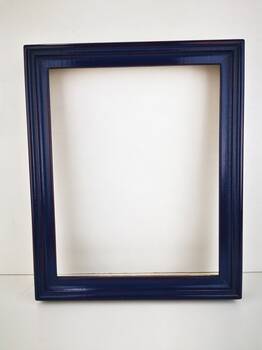
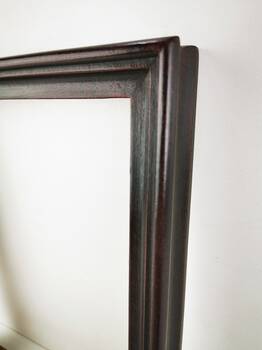
A picture frame I paint and finish by hand, one at a time, in four colours: black, dark brown, navy and grey. Under each colour there is a second, contrasting ground that reads through the patinated surface, so no two frames come out the same.
The face is a narrow 25 mm, the section a deep 30 mm, so a stretched canvas up to 20 mm thick sits straight in. Made to the size of your painting.
This is a hand-painted picture frame made to the size of your painting and finished by hand in my workshop. I lay a coloured ground first, then the top colour, and patinate the surface by hand so the ground reads through along the edges and across the face. The result is quiet rather than showy: a narrow moulding, but a properly worked one, with enough movement in the section to catch light along its length without competing with the painting. Because every frame is painted to order, the colour, the size and the rebate depth are all decided for one specific work.
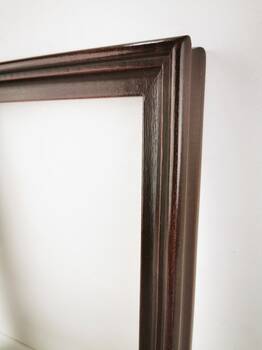
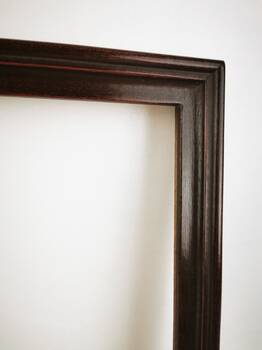
The moulding profile
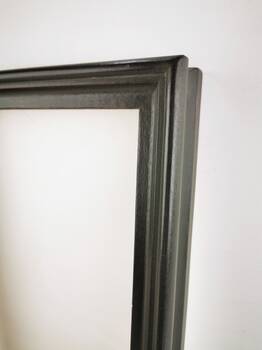
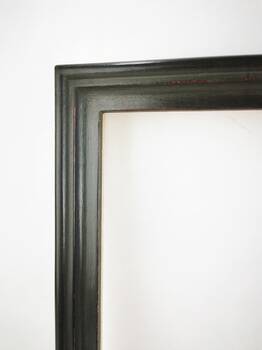
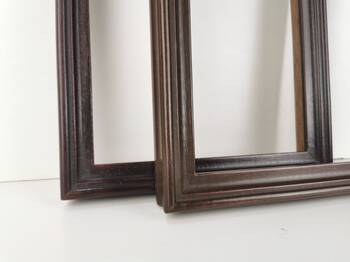
From the artwork side the frame opens with a rabbet 7 mm wide, deep enough to take a stretched canvas up to 20 mm thick. Immediately beyond it the face drops into a half-round hollow that runs the length of the moulding and holds the deepest tone of the paint. The hollow closes on a step, and from that step the face rises into a rounded swell, which forms the crown of the profile towards the outer edge. The lateral flank is profiled as well rather than left square: it carries a shallow concave cove that draws the side back in as it descends towards the wall.
The section measures 25 mm across the face and 30 mm deep, so from the front the frame reads as a narrow band and from an angle as a run of curves. The profile itself is milled; everything after that, the joining, the painting and the patination, is done by hand. On a moulding this size the shaping is what makes the finish work: the swell takes the light and the wear, the hollow keeps the colour dark, and the step between them is what makes the ground read as a clean line rather than a smudge.
Specification
- Style: hand-painted, rustic
- Profile: half-round hollow at the rabbet, stepping up into a rounded swell; coved lateral flank; milled
- Finish: coloured ground beneath the top colour, hand-patinated, sealed with wax; satin sheen
- Colours: black, dark brown, navy, grey
- Face width: 25 mm
- Section depth: 30 mm
- Rebate: 7 mm wide, deep enough for a stretched canvas up to 20 mm thick
- Material: timber low in tannins, of the kind used in museum and conservation work
- Corner joining: mitred at 45 ° and reinforced with wooden splines before painting
- Glass and backing: low-iron glass with a backing board can be added in the order menu; the full archival range is quoted separately
- Mounting and hanging: sprung clips and cord as standard
- Suitable for: oil and acrylic paintings on canvas, works on paper, photographs and posters behind glass
About the dimensions: the size you enter in the calculator is the size of the artwork, not the outside of the frame. I make the frame 2 to 3 mm larger than the work so it sits without pressure, and the rebate then covers about 4 to 5 mm of its edge. The outside dimension of the finished frame is the artwork size plus twice the width of the moulding.
Which artworks and interiors it suits
The frame was drawn for painting on canvas. A 25 mm face is narrow enough to leave a landscape or a still life its full weight, while the depth carries a thick stretcher and a heavily loaded surface without looking undersized. It works particularly well with muted, earthy palettes: the brown and the grey warm a restrained painting without adding colour to it, the black reads graphic, and the navy holds its own against cool greens and greys. I set out the reasoning behind this kind of mounting in more detail on my page about framing oil paintings.
In an interior it belongs where the walls are not perfectly smooth: a country house, a converted barn, a kitchen with painted panelling, a room with exposed timber. It also does useful work in a plain modern room that needs one warm object. If you are weighing this rustic look against a cleaner or more classical profile, my guide to rustic and vintage picture frames sets out where each one belongs, and the rest of the range is in custom picture frames.
How I make and finish it
The corners are cut at 45 ° and reinforced with wooden splines, and the frame is joined before any paint goes on. Joining first means the corner is a single continuous surface by the time it is painted, so the finish runs across the mitre instead of stopping at it. I then lay the ground colour, follow it with the top colour, and patinate the surface by hand until the ground reads through where a frame would naturally wear: along the outer edge, over the corners and in the open middle of the face. The last step is wax, which seals the paint and leaves a satin sheen rather than a flat, chalky surface.
All of this is done by hand for one frame at a time, which is why the four colours are starting points rather than fixed recipes. If you want the ground to read more strongly, or hardly at all, tell me before you order and I will work to that.
How it differs from a shop-bought frame
A hand-painted finish is one of the easiest things to imitate industrially and one of the hardest to imitate well. Mass-produced frames print the effect onto a foil wrap over fibreboard: the pattern repeats along the length, the corners break the illusion, and the depth of colour disappears at arm's length. Here the effect is what it appears to be, two real layers of paint on timber, worked back by hand, so it changes as you move across the frame and carries close inspection. The profile gives it away too: a printed wrap has to bend around the section, which is why industrial mouldings are shallow and soft-edged, while a milled hollow closed by a step holds its edge and gives the patination something to sit against. You also get the size to the millimetre, a choice of ground colour, and corners that are joined and reinforced rather than stapled.
Functionality
As standard the frame is supplied without glass, for a stretched canvas held from behind. The rebate takes a stretcher up to 20 mm thick, which covers the great majority of ready-made canvases as well as most studio-built ones. For a work on paper, a photograph or a poster, add glass and a backing board and the same frame becomes a glazed one.
I can also build this profile as a floating frame, with no rebate lip over the front of the canvas and a deliberate gap between the painting and the moulding, so the edges of the canvas stay visible. That version is explained here: floating picture frame for canvas art. Tell me before ordering if you want it built that way.
Frequently asked questions
Will it fit a 20 mm stretcher?
Yes. The rebate is cut deep enough for a stretched canvas up to 20 mm thick, and the canvas is held from behind with sprung clips. If your stretcher is deeper than that, say so when you order and I will make the rebate to suit.
Can I have a colour that is not on the list?
Yes. The four colours shown are the ones I keep as standard, but every frame is painted to order, so I can mix a different top colour or a different ground. Please write to me before you place the order, with an image of the painting.
Can I frame a photograph or a poster in it?
Yes, with glass and a backing board added. For anything you intend to keep, ask for UV-filtering glass and acid-free materials rather than ordinary glass.
Complete framing – additional options
Every frame I make can be completed with full archival and museum-quality framing: anti-reflective UV-filtering glass (four classes to choose from), acid-free museum mat board, spacers wrapped in acid-free paper and a Dibond backing. This kind of mounting protects the work from light, acids and distortion. I set out the full glass and material specification on a separate page: archival and museum framing for paintings and photographs. All components are available at extra cost, as an individual quote on request.
Mounting and hanging
I hold the painting in the frame with sprung clips that turn aside when you change the work, which makes the frame easy to handle. On request I fit permanent, screwed brass plates instead. For hanging, I attach cord as standard, in portrait or landscape orientation; a single D-ring on request.
Ordering made to measure
The base price shown on the site is the price per running metre of moulding. The perimeter of the painting is not the full length the frame needs: corners cut at 45 degrees take extra length, and the wider the moulding, the more they take. The calculator accounts for the full moulding consumption with corners and for any options you choose, so you only need to enter the dimensions of your painting to within 0.1 cm. The calculator handles formats up to 120 × 80 cm, and I make larger sizes to individual order. The lead time is 20 to 30 working days.