

Gold Leaf Floating Frame for Canvas Paintings
- Add feedback:
- Code: 94
- Manufacturer: Karol Milewski
-
Availability:
 Exists
Delivery time: 20 - 30 working days
- pcs.
- €247.22
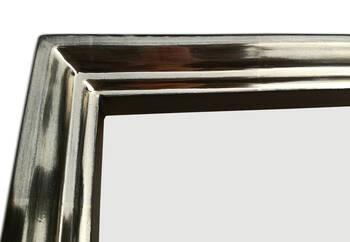
A floating frame for paintings on canvas, made to measure. The face is water gilded with 22-karat moon gold leaf on blue bole and burnished with an agate stone; the sides and the inner frame are hand-painted black. The same moulding is also made in a standard version that overlaps the edge of the canvas. Moulding width 24 mm, thickness 45 mm.
A floating frame for paintings on canvas. The stretcher sits on an inner frame, so an open gap runs between the canvas and the moulding and the painting reads as an object in its own right. I water gild the face with 22-karat moon gold leaf, paint the sides black, and make each frame to one particular painting.
Construction and frame profile
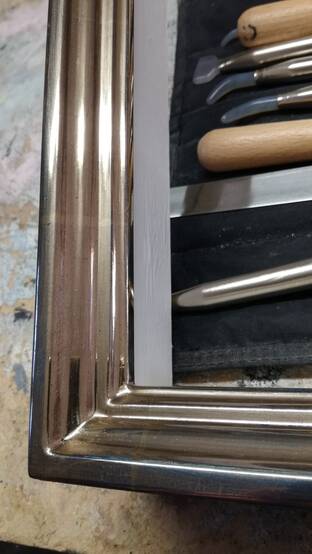
The frame has a double structure. The inner frame, on which the painting is mounted, sits within the outer moulding and is painted black like the inner side. It is at least 40 to 50 mm wide, so the stretcher has a solid surface to rest on and screw into, and carries its weight. It is not fitted in the frames photographed here. In a finished frame a 1 cm gap leaves it barely visible, and what shows of it is finished like the sides. The gilded face is narrow: the moulding is 24 mm wide, and this is the only gilded surface on the frame. The outer side wall is painted black, the brushwork left visible, waxed by hand to a satin sheen; the moulding thickness from face to back is 45 mm. A face this narrow above a side this deep gives the frame the character of a box.
Specification
- Frame version: floating, on an inner frame, or standard, overlapping the edge of the artwork; chosen when ordering
- Face finish: water gilding in 22-karat moon gold leaf over blue bole, burnished with an agate stone, sealed with shellac and wax
- Inner frame: at least 40 to 50 mm wide, a bearing surface for the stretcher
- Sides and inner frame: hand-painted black, satin sheen after waxing
- Moulding width: 24 mm
- Moulding thickness (face to back): 45 mm
- Stretcher thickness: 20 mm as standard, deeper bars on request
- Rebate, overlapping version: width 7 mm, depth 20 mm
- Material: low-tannin timber used in museum work and art conservation
- Corner joinery: mitred at 45 degrees, reinforced with wooden splines
- Fitting: screws through the back of the inner frame (floating), spring clips (overlapping)
- Hanging: picture wire between two eyelets, portrait or landscape
- Suitable for: oil and acrylic on canvas, prints and photographs on canvas
- Lead time: 20 to 30 working days
The calculator takes the size of the stretcher, not of the frame. In the floating version the figure you enter sets the gap: for 1 cm of space around the painting, add 2 cm to each dimension. In the standard version enter the size of the artwork; I make the frame 2 to 3 mm larger, the moulding overlapping the canvas by roughly 4 to 5 mm.
Which paintings and interiors it suits
I built this frame for painting on canvas: contemporary work, abstraction, landscape with strong colour. It also suits prints and photographs on canvas, where standing the work clear tidies an uneven edge. Narrow gold against black is restrained, so the frame suits a modern room as readily as a wall of older pictures. Other pairings of colour and gold leaf run through my range of picture frames gold gilded and partially painted.
How the frame is made and finished
I join the corners first, mitred at 45 degrees and reinforced with wooden splines, which hold even under a heavy stretcher. Only then does the assembled frame get its gesso, layer upon layer, rubbed back hard and even, and over that the bole, the gilder's clay, in blue: a ground dense enough for the gold to be burnished later.
The gilding is done in 22-karat moon gold leaf laid on gilding water, leaf beside leaf with a slight overlap. The leaves are around 80 by 80 mm, so for a face this narrow I cut them on the cushion. Once dry I burnish it with an agate stone, and a depth of shine appears that paint cannot reproduce. The face is sealed with shellac and wax, in one finish with no colour variants. More on the technique on my page about water gilding.
How it differs from a shop-bought frame
A frame from a trade supplier is a length of moulding cut to size, with a foil edge imitating gold. Here the gold is metal, not colour: laid on water over a layered ground and bole, then brought up with an agate stone. The inner frame is built to one particular stretcher, not glued in afterwards. With a face this narrow the detail is unforgiving: it shows in the gold edge and the mitre.
Space around the painting
The canvas no longer touches the moulding, so the eye reads it as a separate object with its painted edges in view, and with heavily worked paint nothing presses on the impasto. How it behaves, and how it differs from a frame that overlaps the artwork, I explain in my guide to the floating picture frame for canvas art. For warmer, fully gilded surroundings I build the same principle into the American Box floating frame. In the floating version the frame works without glass, so the canvas stays open to the air.
The interior is prepared for a stretcher 20 mm thick, the version the calculator prices. If your bars differ, write to me and I will set the interior to their real thickness.
Complete framing: additional options
Every frame I make can be completed with full archival and museum framing: anti-reflective UV-filtering glass (four classes to choose from), a mount cut from acid-free museum board, spacers faced with acid-free paper and a Dibond backing panel. Framing of this kind protects the work against light, acids and distortion. The full specification of the glass and the materials is set out on a separate page: archival and museum framing for paintings and photographs. All components are available at additional cost, priced individually on enquiry.
Fitting the artwork and hanging
In the floating version I drill the fixing holes from the back of the inner frame and supply the screws, so you fit the painting yourself, no special tools needed. In the overlapping version spring clips at the back hold the work; they swivel, so a painting can be swapped without tools.
The frame hangs on picture wire strung between two eyelets, and a single D-ring I fit on request. Please state portrait or landscape when ordering, because the hardware goes on in one position.
Made to measure
The base price on this page is the price per linear metre of moulding. The perimeter of the painting is not the whole length of moulding a frame needs: corners cut at 45 degrees take up extra length, and the wider the moulding, the more they take. The calculator accounts for the full consumption of moulding including the corners, together with any options you choose.
Measure the stretcher to within 0.1 cm, adding your allowance for the gap in the floating version. The calculator accepts artwork up to a perimeter of 180 cm, the limit set for a moulding of this width; larger formats I make to individual order, so write to me first. Making the frame takes 20 to 30 working days.