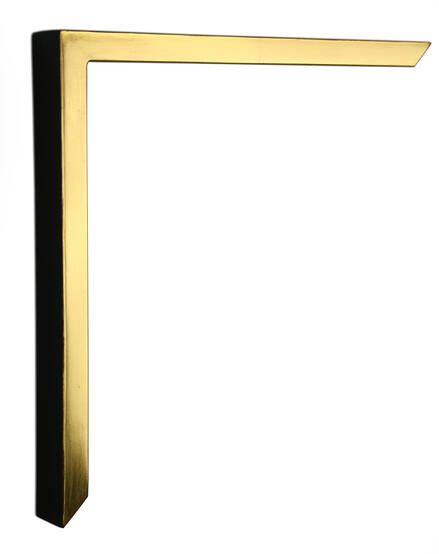
Gold box picture frame gilded with 23-karat gold leaf
- Add feedback:
- Code: 52
- Manufacturer: Karol Milewski
-
Availability:
 Exists
Delivery time: 20 - 30 working days
- pcs.
- €191.67
A gold box picture frame with a narrow 15 mm face and a 30 mm section, gilded in 23-karat yellow gold leaf over a yellow bole and left bright, without patination. The rebate is 24 mm deep, so a stretched canvas over 2 cm thick sits fully inside the frame instead of standing proud of it. Made to the size of your artwork.
A gold box picture frame, made to the size of one particular artwork. The face is 15 mm wide and the moulding runs 30 mm from front to back, with a rebate 24 mm deep: enough for a stretched canvas over 2 cm thick, for a painting panel, or for a photograph mounted behind glass with a mat and spacers. The face is gilded in 23-karat yellow gold leaf over a yellow bole and left bright, without patination, so the metal keeps its full reflection.
Proportions of the moulding
This moulding is twice as deep as it is wide. Seen from the front there is a narrow gilded face 15 mm across, and that is the whole of the frame in the picture plane: a bright metal line around the work rather than a decorative border. The lateral flank runs 30 mm back, which at this width makes the side a surface in its own right. You read it at an angle as you walk past, and it casts the shadow that separates the work from the wall, which is why the treatment of the sides is decided with the order rather than fixed: hand-painted as standard, gilded to order.
Specification
- Style: box construction with a narrow face
- Face finish: 23-karat yellow gold leaf over yellow bole, water gilded, left bright without patination
- Side finish: hand-painted, satin sheen; gilded sides to order
- Moulding width: 15 mm
- Moulding thickness (face to back): 30 mm
- Rabbet: 7 mm wide × 24 mm deep
- Material: seasoned timber low in tannins, of the kind used in museum and conservation work
- Corner joining: mitred at 45° and reinforced with wooden splines
- Ground under the gold: gesso and bole, built up in layers
- Glass, backing and matting: additional options, individually quoted
- Mounting and hanging: sprung clips and cord as standard
- Suitable for: oil and acrylic paintings on canvas, painting panels, watercolours, photographs, prints and posters
I make the frame to the size of one specific artwork. The dimensions you enter in the calculator are the dimensions of the work itself: I make the frame 2 to 3 mm larger, which gives the technical clearance needed to seat it, and the moulding then covers about 4 to 5 mm of its edge.
Which artworks and interiors it suits
The depth is what this frame is for. A rebate 24 mm deep closes over a standard stretcher, over a gallery canvas of about two centimetres, and over a cradled painting panel, none of which fit a shallow ready-made moulding. The same depth gives room for glass, an acid-free mat and spacers when the work is a watercolour, a drawing or a photograph, so one profile covers paintings and works on paper. It also takes objects and keepsakes that need air around them. If you want the construction explained before you decide, I go through it in my guide to box framing.
Because the face is only 15 mm, the gold reads as a line rather than a field: it takes almost nothing away from the picture and does not compete with the composition, which is what makes it workable on small and medium formats where a wide gilded moulding would swallow the work. Left without patination, 23-karat gold is the brightest and most classical of the finishes I work with, so a narrow face still registers clearly against a pale wall and against a dark one. It suits a modern room where it is meant to be the one warm note of metal, and a classical one where it sits with older gilding. The other gold tones and widths are gathered in picture frames gold gilded and partially painted.
How I make and finish it
The profile is milled from seasoned timber low in tannins, of the kind used in museum and conservation work. I cut the moulding at 45° and join the corners, reinforcing them with wooden splines. The order matters: the frame is a finished structure before any ground goes on, so the joints close under the layers and do not read through the gold later.
On the assembled frame I build up gesso layer by layer and sand it smooth, then lay yellow bole over it. The bole is not simply a bed for the leaf, it shows through the gold and shares in the final tone. Yellow holds the warm, sunlit character of 23-karat gold rather than pulling it towards red, which is what gives this frame its even, uninterrupted colour.
The gilding is done with loose 23-karat yellow gold leaf laid on water. A leaf measures about 80 × 80 mm, so for a face of 15 mm it is cut with a knife on a gilder's cushion and laid leaf beside leaf with an overlap of about 1 mm. Leaving the gold without patination is the demanding part: nothing is there to disguise the surface underneath, so any unevenness in the gesso would show up in the reflection. I set out the technique on my page about water gilding. The painted flank is worked separately and finished with wax to a satin sheen.
How it differs from a mass-produced frame
Deep narrow mouldings of this kind are usually produced industrially: an extruded or wrapped profile with a sprayed metallic coating, or an imitation leaf of copper and zinc that darkens and turns green over the years. On a 15 mm face that difference is not subtle, because the gold is the entire visible surface and there is no ornament to distract from how it ages. Here the metal is real gold in leaf form, laid on water over a bole ground, and the corners are cut and splined in solid timber rather than glued and stapled, which is what keeps the mitre closed once the frame carries the weight of a canvas. Each frame is made to the size of one artwork rather than to a stock format, and the schedule cannot be shortened: gesso, bole and gold each need time between stages.
Functionality
As standard the frame is made without glass, with the painting entering the rebate from behind, as in classical framing for oils. A rebate 24 mm deep means the same frame holds a thin panel and a full stretcher; with a thinner work the painting can sit level with the face or be set back inside the moulding for a deliberate shadow. For a support of unusual thickness I cut the rebate to measure once the dimension is agreed.
The same profile can also be made without a rebate, as a floating frame, with the canvas set inside the moulding and a visible gap around it. I explain that construction and its variants here: floating picture frame for canvas art.
Complete framing – additional options
Every frame I make can be completed with full archival and museum-quality framing: anti-reflective UV-filtering glass (four classes to choose from), acid-free museum mat board, spacers wrapped in acid-free paper and a Dibond backing. This kind of mounting protects the work from light, acids and distortion. I set out the full glass and material specification on a separate page: archival and museum framing for paintings and photographs. All components are available at extra cost, as an individual quote on request.
Mounting and hanging
I hold the painting in the frame with sprung clips that turn aside when you change the work, which makes the frame easy to handle. On request I fit permanent, screwed brass plates instead. For hanging, I attach cord as standard, in portrait or landscape orientation; a single D-ring on request.
Ordering made to measure
The base price shown on the site is the price per running metre of moulding. The perimeter of the painting is not the full length the frame needs: corners cut at 45 degrees take extra length, and the wider the moulding, the more they take. The calculator accounts for the full moulding consumption with corners and for any options you choose, so you only need to enter the dimensions of your painting to within 0.1 cm. The calculator accepts artwork up to a perimeter of 180 cm, the limit set for a moulding of this width; larger formats I make to individual order, so please write to me first. The lead time is 20 to 30 working days.