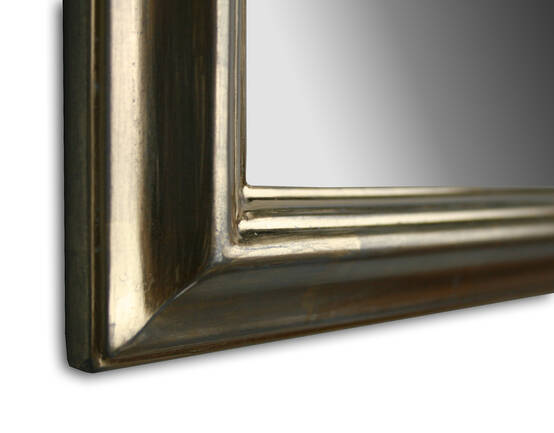
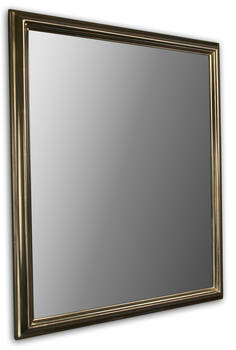
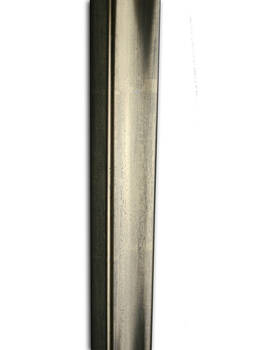
Gilded picture frame in moon gold over grey bole
- Add feedback:
- Code: 50MG
- Manufacturer: Karol Milewski
-
Availability:
 Exists
Delivery time: 20 - 30 working days
- pcs.
- €230.56
A picture frame water gilded in 22-karat moon gold leaf over a grey bole ground. The grey underlayer cools the metal, so the surface reads as a pale, silvery gold rather than a warm yellow one. A 32 mm moulding with a convex ridge across the face and a 9 mm rebate, made to measure in my workshop.
I gild this frame in 22-karat moon gold leaf, laid by hand on water over a grey bole ground. Moon gold is a paler, cooler alloy leaf than 23-karat yellow gold, and the grey bole beneath it quiets the tone further, so the finished surface reads as a soft, silvery gold. The moulding is 32 mm wide with a convex ridge running across the face, and the rebate is 9 mm deep, which suits panels, boards and glazed works rather than deep stretchers. If you are comparing tones across the range, the warmer and cooler leaves sit side by side in my gold gilded picture frames.
The moulding profile
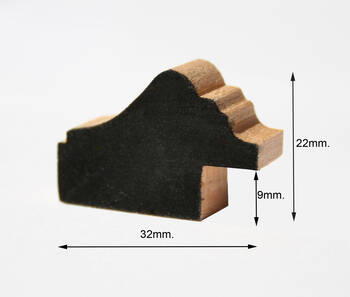
At the artwork side the moulding opens with a narrow flat frieze. Behind it a step lifts the surface, and from that point the profile forms a convex ridge that rises and falls across the full width of the face. At its base, close to the outer wall of the moulding, a second step closes the profile before the vertical outer edge. The convex ridge is the tallest and broadest element, and it carries the burnished gilding across most of the visible face.
Specification
- Style: classical gilded moulding with a convex ridge across the face
- Finish: gesso ground, grey bole, water gilding in 22-karat moon gold leaf, burnished with an agate stone
- Moulding width: 32 mm
- Moulding thickness (face to back plane): 22 mm
- Rebate: 7 mm wide, 9 mm deep (maximum artwork thickness 9 mm)
- Material: solid low-tannin timber used in conservation and museum framing
- Corner joinery: mitred at 45 degrees, reinforced with wooden splines
- Gilding: a single layer of leaf laid over a multi-layer gesso and bole ground
- Glass, backing and mount: available separately, priced individually
- Mounting and hanging: sprung clips fitted as standard, vertical or horizontal orientation chosen at order
- Suitable for: panels, painting boards, works on paper, photographs and prints
Enter the dimensions of the artwork itself into the calculator. I build the frame 2 to 3 mm larger for clearance, and the moulding overlaps the edge of the work by roughly 4 to 5 mm.
Which works and interiors it suits
The 9 mm rebate sets the character of this frame. It takes panels, cradled panels and painting boards, and it takes glazed work comfortably: glass, a mount and a backing board together sit well within that depth. Watercolours, drawings, etchings, photographs and fine art prints are its natural subjects. A deep stretcher will not sit in a 9 mm rebate, so for a canvas on a standard bar I would build the same profile with a deeper rebate or point you towards a floater instead.
The cool cast of moon gold over grey bole is what makes this frame useful. Yellow gold can fight a restrained palette; a pale gold sits with greys, blues, silverpoint, monochrome photography and anything where warmth would be an intrusion. In a room it behaves the same way, holding its own against plaster, stone and pale timber without the brightness of a yellow gilded frame. If you are weighing a frame against the work and the wall it will hang on, I go through that reasoning in my guide to matching a frame to your interior and artwork.
Making and finishing
The sequence matters. Mitres are cut at 45 degrees and reinforced with wooden splines first, so the joints are closed before any ground goes on. Layers of gesso follow, rubbed back between coats, then the grey bole, which is the coloured clay ground that the leaf is laid onto. The leaf comes in sheets of roughly 80 by 80 mm; for the narrower elements of this profile it is cut down with a knife on a gilder's cushion, sheet by sheet.
Water gilding means the leaf is floated onto a wetted bole surface, leaf beside leaf with an overlap of about a millimetre, and left to draw down as the water withdraws. It is a single layer of gold. What sits underneath it is multi-layered, not the metal itself. Once dry, the raised elements are burnished with an agate stone until the gold takes a mirror polish, and the grey clay reading through the leaf is what pulls the colour towards silver. The full process is set out on my page about water gilding.
How it differs from mass production
Most gold frames sold at scale are not gilded. They are wrapped in metallic foil or sprayed with a bronze-loaded finish over a synthetic moulding, which is why they cannot be burnished, patinated or repaired. Genuine leaf varies slightly from sheet to sheet, takes a polish, and can be reworked years later. The difference is worth understanding before you commit, and I set it out in my article on gold leaf and hand gilding.
Functionality
The frame is supplied without glass as standard, with sprung clips fitted so the work can be placed and removed without tools. The 9 mm rebate accepts artwork up to that thickness; if your work is thicker, tell me the measurement when you order and I will cut the rebate to fit. This profile can also be made without a rebate at all, as a floating or shadow frame, which holds the work clear of the moulding on a hidden support. I describe how that construction works in my guide to the floating picture frame.
Complete framing – additional options
Every frame I make can be completed with full archival and museum-quality framing: anti-reflective UV-filtering glass (four classes to choose from), acid-free museum mat board, spacers wrapped in acid-free paper and a Dibond backing. This kind of mounting protects the work from light, acids and distortion. I set out the full glass and material specification on a separate page: archival and museum framing for paintings and photographs. All components are available at extra cost, as an individual quote on request.
Mounting and hanging
Sprung clips are fitted as standard. They turn aside to let the work in and back to hold it, and they cope with anything from a thin board to a stretched canvas. Brass plates with screws are available on request and are supplied loose, for permanent fixing once the work is in place. Hanging orientation, vertical or horizontal, is chosen from the order menu. Picture wire is fitted as standard, and a single D-ring hanger can be fitted instead if you ask for it.
Ordering made to measure
The base price shown is the price per running metre of moulding. The perimeter of the artwork is not the whole length of moulding a frame consumes: mitres cut at 45 degrees take extra length at every corner, and the wider the moulding, the more they take. The calculator accounts for the full consumption including corners, along with any extras you select. For this moulding width the calculator handles artworks up to 180 cm around the perimeter; anything larger is made to individual order, so send me the dimensions and I will price it. Production time is 20 to 30 working days.