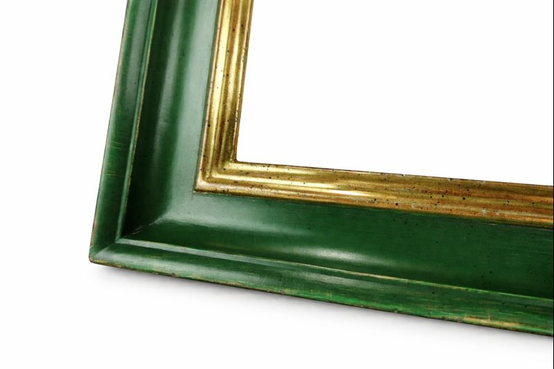
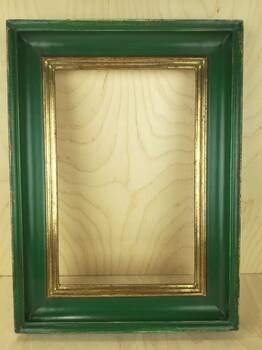
Bottle green picture frame with 23-karat gold trim
- Add feedback:
- Code: 108Z
- Manufacturer: Karol Milewski
-
Availability:
 Exists
Delivery time: 20 - 30 working days
- pcs.
- €219.44
Deep bottle green, hand painted and finished with French polish and wax, with a 23-karat gold trim laid leaf by leaf over gesso and bole. The moulding is 52 mm wide, a little over two inches, and its scooped face carries the eye down towards the painting. I make every frame in my own workshop, to the measurements of your work.
A green picture frame in deep bottle green, with a 23-karat gold trim on the raised parts of the profile and a patina that keeps the metal quiet rather than bright. The moulding is 52 mm wide with a scooped face, made to measure for canvases, panels and works on paper. It sits in my range of picture frames gold gilded and partially painted: paint carries the broad field, gold marks the edges that catch the light.
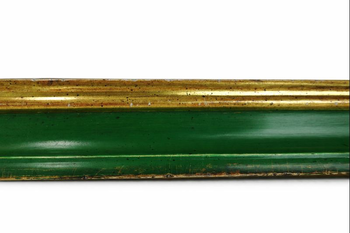
Profile of the moulding
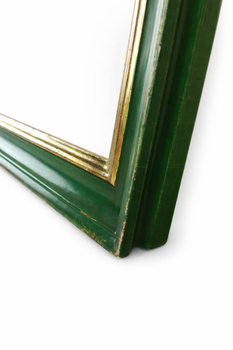
The face is concave, with the highest point of the section at the outer edge and the surface rising towards it from the side of the painting. At the rebate the profile opens with a shallow hollow, and behind it a flat closed by a half-round bead. From that bead a concave sweep is set out, the most pronounced part of the section, rising in a wide scoop towards the outer edge and giving the frame its character. It is closed by a narrow step, above which the profile turns into a convex curve rising to the crown of the moulding, finished with a vertical outer edge. A half-round hollow is scooped into the side of the moulding.
Specification
- Style: classical scooped profile, painted with a gilded trim
- Colour and finish: deep bottle green, French polish and wax, satin sheen
- Gilding: water gilding, 23-karat yellow gold leaf over gesso and bole, burnished and patinated
- Moulding width: 52 mm
- Moulding thickness (face to back): 43 mm
- Rebate: 7 mm wide by 20 mm deep, for a stretcher or panel up to 20 mm thick
- Material: timber low in tannins, used in museum work and art conservation
- Corners: mitred at 45 degrees, reinforced with wooden splines before grounding
- Glazing, backing and mount: available as add-ons, quoted individually
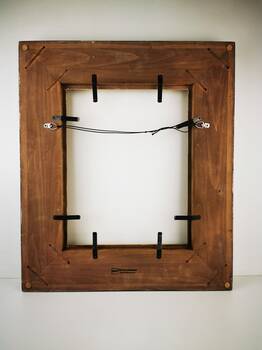
- Mounting and hanging: sprung clips and picture wire, vertical or horizontal
Enter the dimensions of the artwork, not of the frame. I allow 2 to 3 mm of clearance, and the moulding overlaps the edge of the work by 4 to 5 mm.
Which artworks and interiors it suits
Green and gold flatters landscape and nature subjects, portraits in a classical key, and still life with strong colour in it. The gold picks up any warm note in the paint, while the green field holds the picture apart from the wall. My guide to frame colour and materials covers how a painted field and a gilded edge behave together, and for more gold and less paint there is the green and gold frame for oil paintings.
How the frame is made
I cut the mitres at 45 degrees and reinforce each corner with a wooden spline, then build the ground: a chalk and glue gesso in several coats, smoothed by hand, followed by bole in red, yellow and grey. The bottle green goes on next and is rubbed back in places, so the bole shows through where the surface would naturally wear. The gold is genuine 23-karat leaf, laid on water leaf by leaf with about a millimetre of overlap, then burnished and patinated. The technique is set out on my page about water gilding. French polish and wax finish the frame to a satin sheen, and there is a short clip of it on my YouTube channel.
How it differs from mass production
A factory frame is cut from a length of moulding finished before anyone knew what would go inside it. Here the frame is joined first and only then primed, painted, gilded and patinated as one closed object, so the finish runs across the corners instead of stopping at them. No two frames match exactly: the depth of the green, the rubbed-back areas and the tone of the gold shift a little from one to the next.
Functionality
As standard the frame comes without glass or backing, as a mount for a stretched canvas. The work goes in from behind and sprung clips hold it. The rebate is 20 mm deep, and that depth decides what the frame can enclose, so measure the stretcher rather than estimating it. With works on paper it leaves room for a mount, spacers and glazing.
The same section can be made without a rebate, as a floating frame, with a visible gap around the canvas.
Questions I am asked about this frame
Is the whole frame gilded, or is the green painted with gold trim?
Painted, with gilded accents. The broad field is bottle green and the raised elements of the profile carry genuine 23-karat gold leaf, patinated so the two finishes sit at the same level. I also make this profile gilded across the whole face, on request.
What mount proportions suit a frame like this?
Inside a 52 mm moulding, a border of about 1 1/2 to 2 1/4 inches, 40 to 57 mm, keeps the proportions comfortable, with a little more at the bottom than at the top. Send me the sheet size and the image area and I will suggest the border.
Can this frame take conservation-grade low-reflection UV glazing?
Yes. The rebate takes glazing, a mount, spacers and a backing together. I fit conservation-grade low-reflection UV glazing on request, quoted separately.
Complete framing – additional options
Every frame I make can be completed with full archival and museum-quality framing: anti-reflective UV-filtering glass (four classes to choose from), acid-free museum mat board, spacers wrapped in acid-free paper and a Dibond backing. This kind of mounting protects the work from light, acids and distortion. I set out the full glass and material specification on a separate page: archival and museum framing for paintings and photographs. All components are available at extra cost, as an individual quote on request.
Mounting and hanging
Sprung clips are fitted as standard. They turn aside to let the work in and back to hold it, and they cope with anything from a thin board to a stretched canvas. Brass plates with screws are available on request and are supplied loose, for permanent fixing once the work is in place. Hanging orientation, vertical or horizontal, is chosen from the order menu. Picture wire is fitted as standard, and a single D-ring hanger can be fitted instead if you ask for it.
Ordering made to measure
Measure the artwork itself, and on a stretched canvas take the outside of the bars. Enter both figures in the calculator to the nearest millimetre without adding clearance, because the workshop allows for it. The options also cover the thickness of the work and the hanging orientation.
The base price shown is the price per running metre of moulding. The perimeter of the artwork is not the whole length of moulding a frame consumes: mitres cut at 45 degrees take extra length at every corner, and the wider the moulding, the more they take. The calculator accounts for the full consumption of moulding including the corners, together with the options you select.
At this moulding width the calculator handles artworks up to 180 cm around the perimeter; anything larger is made to individual order, so send me the dimensions and I will price it. The lead time is 20 to 30 working days.