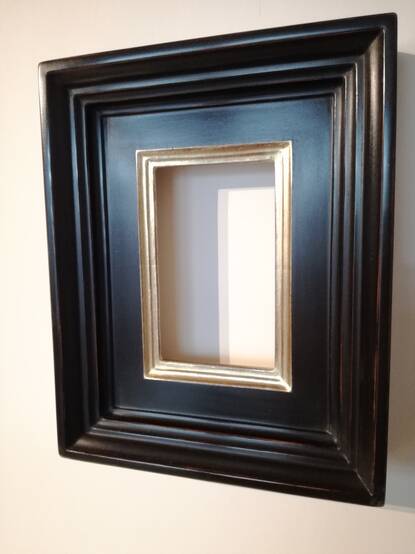
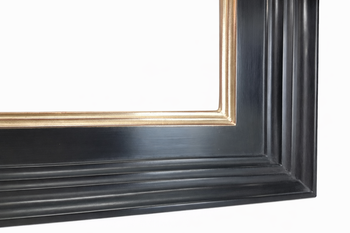


Black picture frame with gold trim, 70 mm
- Add feedback:
- Code: 207B
- Manufacturer: Karol Milewski
-
Availability:
 Exists
Delivery time: 20 - 30 working days
- pcs.
- €247.22
A black picture frame with a gold trim, 70 mm wide, made to measure. Genuine gold leaf runs along the sight edge, the rest of the moulding is hand painted black. Three gold tones and nine bole colours to choose from, water gilded over gesso in my workshop, with a 10 or 20 mm rebate for canvases and panels.
This is a black picture frame with a gold trim: a 70 mm moulding painted black by hand, with genuine gold leaf along the narrow flat and the first hollow at the sight edge. The gilded band sits directly against the painting, so the light is warm where the picture starts. Each frame is made to the size of one artwork, and you choose the gold tone and the bole colour beneath it.
The moulding profile
A narrow flat at the sight edge rises into the first hollow. That pair carries the gilding, a bright band between the painting and the black. Above it runs a flat frieze, then a second hollow carries the face further up, and a smaller hollow lifts it again. The moulding closes with an ogee that rises to the highest point and flattens there. The outer side is flat.
The shape is milled; the hand work begins at the corner joints and ends with the gilding. To compare it with a frame built the other way round, see my guide to reverse profile frames.
Specification
- Profile: concave face rising towards the outer edge
- Moulding width: 70 mm
- Moulding thickness (face to back): 58 mm
- Rebate: 7 mm wide – 10 mm or 20 mm deep
- Material: timber low in tannins, used in museum work and conservation
- Corner joints: mitred at 45 degrees, splined
- Ground: gesso and bole, nine colours
- Gilding: 23-karat yellow, 22-karat moon gold or 12-karat white gold leaf
- Painted parts: black, hand painted
- Mounting: sprung clips as standard
- Hanging: vertical or horizontal
- Suitable for: oil and acrylic on stretchers, prints, photographs
The frame is made to the dimensions of the artwork, which you give in the calculator. I make the opening 2 to 3 mm larger than the work as a technical clearance, and the moulding overlaps the edge of the artwork by about 4 to 5 mm.
What it suits
A rising concave face does most for work with a dense, saturated surface: oil and acrylic paintings, portraits, still life, a dark landscape. The black separates the picture from the wall, and the gilded band puts a warm line next to the paint, so the step from canvas to frame is not abrupt. With a pale palette it reads as strong contrast, so check for enough dark passages. I go further into that in my notes on framing oil paintings.
A 70 mm moulding needs room around it. Other painted models with gilding sit in the gold gilded and partially painted picture frames category.
How it is made and finished
I cut the moulding at 45 degrees and join the corners with wooden splines before gessoing, so later layers sit on a rigid structure. The gesso is worked smooth, bole is laid where the gold will go, and the gilding is water gilding: leaf laid one sheet at a time with an overlap of about a millimetre. For a band this narrow I cut the leaf with a knife on the gilder's cushion. Once the gold is down I patinate it, to bring the bole colour through and soften the raw shine. The rest of the moulding is painted black by hand.
Gold tone and bole colour
There are three gold tones: 23-karat yellow gold leaf, the most intense classical shine; 22-karat moon gold, lighter and cooler; 12-karat white gold, distinctly silvery. The nine bole colours are grey, Victorian grey, plum, black, brown, red, yellow, olive green and light blue. The bole is not cosmetic: it shows through the gold after patination and shifts its tone, so red warms the metal, grey cools it, olive green subdues it.
How it differs from mass production
On a mass produced frame the gold band is usually print or foil, one flat tone that does not answer the light. Here it is gesso, bole and real gold leaf on timber, and the corners hold their geometry because they are splined rather than glued alone.
Functionality
As standard the frame leaves the workshop without glazing, for a painting on a stretcher. The 10 mm rebate takes thinner panels and painting boards; the 20 mm option, chosen under picture thickness, takes a standard stretcher with room for the keys. I can also make the same profile without a rebate, as a floating frame with a visible gap around the canvas; its limits are on my floating frame for canvas page.
Frequently asked questions
Is this frame gilded all over, or painted with gold trim?
Painted, with a gold trim. The gold leaf runs on the narrow flat and the first hollow at the sight edge; everything above it is black. A frame gilded across the whole face is a different group of models I make.
Which gold tone should I choose for an oil painting?
For warm palettes of earths, umbers and reds, 23-karat yellow gold leaf holds its own; for cooler paintings 22-karat moon gold is calmer; for a contemporary palette 12-karat white gold reads almost as silver. Send a photograph and I will suggest one.
Can I have a mat and conservation grade low reflection UV glazing with this frame?
Yes, ordered separately once the size and type of work are known. For work on paper a border of about 1½ to 2¼ inches, 40 to 57 mm, suits a moulding this wide, usually deeper at the bottom. Paintings on stretchers go into the rebate without a mat.
Complete framing – additional options
Every frame I make can be completed with full archival and museum-quality framing: anti-reflective UV-filtering glass (four classes to choose from), acid-free museum mat board, spacers wrapped in acid-free paper and a Dibond backing. This kind of mounting protects the work from light, acids and distortion. I set out the full glass and material specification on a separate page: archival and museum framing for paintings and photographs. All components are available at extra cost, as an individual quote on request.
Mounting and hanging
Sprung clips are fitted as standard. They turn aside to let the work in and back to hold it, and they cope with anything from a thin board to a stretched canvas. Brass plates with screws are available on request and are supplied loose, for permanent fixing once the work is in place. Hanging orientation, vertical or horizontal, is chosen from the order menu. Picture wire is fitted as standard, and a single D-ring hanger can be fitted instead if you ask for it.
Ordering made to measure
The base price shown is the price per running metre of moulding. The perimeter of the artwork is not the whole length of moulding a frame consumes: mitres cut at 45 degrees take extra length at every corner, and the wider the moulding, the more they take. The calculator accounts for the full consumption of moulding, corners included, along with any extras you select.
Give the dimensions of the artwork to the nearest millimetre, for example 30.3 × 40.7 cm. For this moulding width the calculator handles artworks up to 180 cm around the perimeter; anything larger is made to individual order, so send me the dimensions and I will price it. The lead time is 20 to 30 working days.