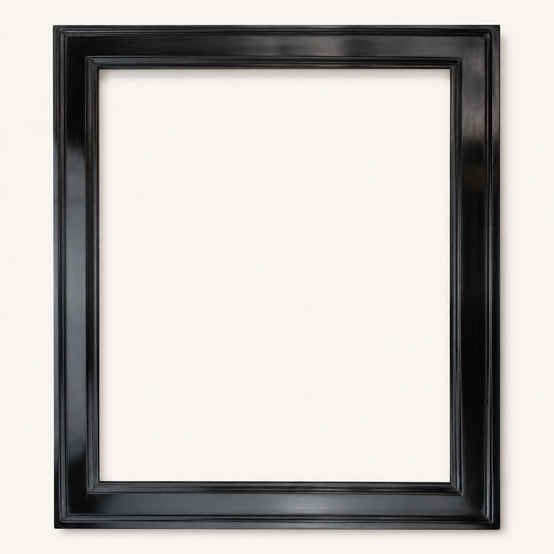
Black picture frame for oil paintings, made to measure
- Add feedback:
- Code: 173
- Manufacturer: Karol Milewski
-
Availability:
 Exists
Delivery time: 20 - 30 working days
- pcs.
- €163.89
A black picture frame for oil paintings, cut to the size of one particular canvas. The moulding is 52 mm wide, hand painted in the workshop in successive coats and sealed with shellac and wax to a satin sheen. The rabbet comes in two depths, for standard and for deeper stretchers, and the corners are mitred at 45 degrees and reinforced with wooden splines.
A black picture frame made for oil paintings on canvas and on panel. The moulding is 52 mm wide, hand painted in the workshop in successive coats of black and sealed with shellac and wax, so the surface keeps a soft satin sheen instead of a hard reflection. Each frame is cut to the size of one particular work, and the rabbet is offered in two depths, so that a standard stretcher or a deeper gallery stretcher sits properly in it. It belongs with the rest of the black picture frames I make to measure.
Moulding profile
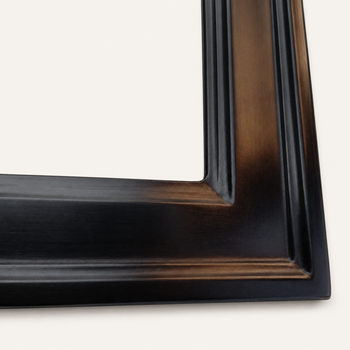
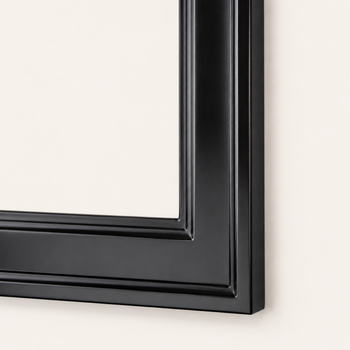
At the artwork the face rises through a half-round hollow closed by a step, and opens onto a wide, smooth frieze: a flat field taking up about half the width of the moulding. The same arrangement repeats at the outer edge, where a second half-round hollow with a step lifts the face to a narrow flat fillet that closes the profile.
Specification
- Style: classical, symmetrical profile with a wide flat frieze
- Finish: hand painted black, satin sheen, sealed with shellac and wax
- Moulding width: 52 mm
- Moulding thickness (face to back): 25 mm
- Rabbet: 7 mm wide, 13 mm or 20 mm deep, chosen at checkout
- Timber: low-tannin timber of the kind used in museum work and art conservation
- Corner joinery: mitred at 45 degrees, reinforced with wooden splines
- Colour options: black or white, chosen from the menu on this page
- Glass, mount and backing: available as add-ons, individual quote on request
- Fixing: sprung retaining clips as standard, brass plates with screws on request
- Hanging: picture wire as standard, single D-ring on request
- Lead time: 20–30 working days
- Suited to: oil and acrylic paintings on canvas and panel, prints, drawings, photographs
The frame is made to the size of one particular work. In the calculator you enter the dimensions of the painting itself: I build the frame 2–3 mm larger, a technical clearance that lets the work seat freely, so the moulding covers roughly 4–5 mm of its edge.
What it suits
Black is the frame colour that argues least with a painting. It closes the composition, holds the eye inside it and adds no colour of its own, which is why it carries oils and acrylics with a strong palette so well: reds, blues and earth tones gain in saturation instead of competing with a warm moulding. The wide flat frieze gives the work a margin of quiet before the wall begins, and that suits monochrome and black and white work, prints, drawings and photographs just as well as painting on canvas.
In a room the frame behaves like punctuation. Against pale walls it reads as a drawn line around the work; against dark walls it recedes and leaves the painting as the only accent. It sits equally well in classical, modern and gallery interiors. If you are still weighing up the shape and width of the moulding, my guide to the best frame for a canvas painting goes through the choice in more detail, and I write about the wider question of framing oil paintings on a separate page.
How I make it
The moulding is milled from low-tannin timber, the material museums and conservators use for its dimensional stability and because it does not carry acids into the work. The corners are cut at 45 degrees and reinforced with wooden splines, small wooden tongues set into a slot cut across the joint, and the frame is joined into one stable structure before any paint reaches it.
Only then does the surface begin. The frame is primed, painted in successive coats of black and sanded lightly between them, until the colour is deep and even across the whole face. The finish is sealed in the traditional way, with shellac and then wax worked in by hand: shellac closes the pigment and stabilises the colour, wax gives the satin sheen and a surface that takes handling. The same moulding is also available hand painted in white, chosen from the menu on this page.
How it differs from a factory frame
Most black frames on the market are MDF or plastic profiles wrapped in black foil or sprayed in a single pass. They look flat under a raking light, they chip at the corners, and once the surface is damaged there is nothing underneath to repair. This frame is timber, so it holds its dimensions, takes a screw and can be retouched years later. The colour is built up in coats rather than sprayed on in one, which is what gives it depth, and the corner is held by a wooden spline rather than by glue and a staple, which is what keeps the mitre closed as the timber moves with the seasons.
Practical points
The frame is supplied without glass, as a setting for a work on a rigid support: canvas on a stretcher, board or panel. The rabbet is 7 mm wide, and you choose the depth at checkout: 13 mm for standard stretchers and painting panels, 20 mm for the deeper bars common in contemporary painting.
The same moulding can also be made without a rabbet, as a floating frame: the canvas sits inside the frame with a visible gap around it and the edges of the stretcher left open. I write more about that in my guide to floating frames for canvas art.
Complete framing – additional options
Every frame I make can be completed with full archival and museum-quality framing: anti-reflective UV-filtering glass (four classes to choose from), acid-free museum mat board, spacers wrapped in acid-free paper and a Dibond backing. This kind of mounting protects the work from light, acids and distortion. I set out the full glass and material specification on a separate page: archival and museum framing for paintings and photographs. All components are available at extra cost, as an individual quote on request.
Mounting and hanging
This frame is intended for paintings on canvas and stretchers, so it does not include glass as standard. To hold the painting, I fit sprung retaining clips as standard; they pivot to the side, so the canvas can be removed and replaced quickly without tools. On request I supply brass plates with screws instead (provided loose, for permanent self-installation). The hanging orientation – portrait or landscape – is chosen at checkout. Picture wire is standard, with a single D-ring available on request.
Ordering made to measure
The base price shown on the site is the price per running metre of moulding. The perimeter of the painting is not the full length the frame needs: corners cut at 45 degrees take extra length, and the wider the moulding, the more they take. The calculator accounts for the full moulding consumption with corners and for any options you choose, so you only need to enter the dimensions of your painting to within 0.1 cm. The calculator handles formats up to 120 × 80 cm, and I make larger sizes to individual order. The lead time is 20 to 30 working days.