


White and Gold Picture Frame for Canvas Paintings
- Add feedback:
- Code: 138DB
- Manufacturer: Karol Milewski
-
Availability:
 Exists
Delivery time: 20 - 30 working days
- pcs.
- €238.89
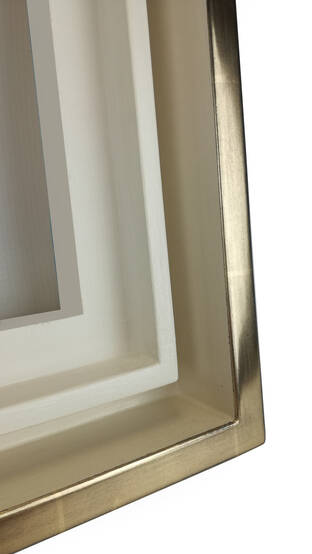
A white and gold picture frame built as a deep double frame for paintings on stretched canvas. The sides are hand-painted with the texture of the brush left visible, the front face water-gilded with 22-karat moon gold leaf. Also available in black with 23-karat yellow gold.
A white and gold picture frame built as a deep double frame for paintings on stretched canvas. The outer frame carries a narrow gilded front face; a second, smaller frame sits inside it and holds the artwork, and the open channel between the two lets the painting stand clear of its surround instead of being closed in by it. I make every frame to measure in my workshop: the timber is mitred and keyed, gessoed, painted and gilded by hand, and the front face is water-gilded with genuine 22-karat moon gold leaf. The frame is also made in black with 23-karat yellow gold.
Frame profile
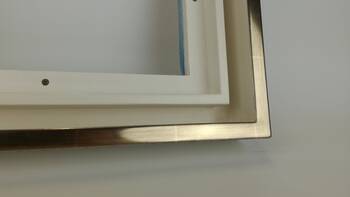
At the artwork the inner frame presents a flat face 10 mm wide, hand-painted in white with the texture of the brush left in the surface. Beyond it the section drops away into an open channel 20 mm wide, the gap that separates the painting from the surround and gives the construction its depth. The outer frame then rises to a flat front face 15 mm wide, water-gilded with 22-karat moon gold leaf, which carries the gold to the outer edge. Read across both frames the border measures 45 mm; overall depth is 60 mm with a standard canvas and more with a deeper stretcher.
Specification
- style: deep double frame for stretched canvas, contemporary
- finish: hand-painted white sides with visible brush texture and a gilded front face; also available in black with a smooth painted finish
- gilding: water gilding, 22-karat moon gold leaf over blue bole; 23-karat yellow gold over red bole on the black version
- visible width: 45 mm in total (inner frame face 10 mm, open channel 20 mm, gilded front face 15 mm)
- overall depth: 60 mm with a 20 mm canvas, increasing with the thickness of the artwork
- inner frame depth: 10, 20, 25 or 35 mm, selected from the order menu to match the stretcher
- artwork retention: no rabbet; the canvas is screwed to the inner frame through pre-drilled holes
- frame material: solid timber with low tannin content, used in museum conservation and fine-art framing
- corner joinery: mitred at 45–degree corners reinforced with wooden splines, fitted while the moulding is still raw
- surface protection: sealed with a thin coat of lacquer and finished with wax
- hanging: cord as standard, portrait or landscape selected from the order menu
- optional: glass, archival backing, matting (priced individually, see below)
- lead time: 20–30 working days
The dimensions entered in the calculator refer to the picture, not to the finished frame. The inner frame is built 2 to 3 mm larger than the dimension given, a technical clearance that lets the canvas seat cleanly inside it. External frame dimension = picture dimension + 2 × 45 mm.
Which artworks and interiors it suits
The construction is made for painting on a stretcher: oil and acrylic on canvas, and above all contemporary work meant to sit clear of its surround. Landscape, abstraction, still life and portrait all read well in it, and the deep section takes heavier, thickly painted surfaces without looking overloaded. Because the canvas is held from behind rather than overlapped at the edge, the whole painted surface stays visible, including work carried right out to the edge of the canvas.
White with moon gold is the quieter of the two finishes. Moon gold is cooler and paler than yellow gold, so the gilded face reads as a fine line of light rather than a warm gold band: it suits pale walls, oak, linen and rooms where the painting is meant to be the only strong accent. The black version with 23-karat yellow gold does the opposite, closing the work with contrast and a warmer gleam. The rest of the range is on the white picture frames page.
How the frame is made
Both mouldings are cut and mitred at 45–degree corners, and the corners are keyed with wooden splines while the wood is still raw, before any surface work begins. That joinery is what keeps the corners closed as the timber moves with the seasons.
The face that will be gilded is then prepared for water gilding: several layers of chalk-and-glue gesso, then the bole, a fine clay laid under the metal that shows faintly through it and sets its final tone (blue under moon gold, red under yellow gold). Sheets of leaf roughly 80 × 80 mm are cut to the width of the face on a gilder's cushion, then laid one beside the next with an overlap of about a millimetre, so the face carries a single continuous layer of gold. The sides are hand-painted, with the brush texture deliberately left in the surface on the white version and worked smooth on the black. The frame is then sealed with a thin coat of lacquer and finished with wax, which gives the painted surfaces their satin sheen.
How it differs from a mass-produced frame
Factory box frames are normally assembled from pre-finished moulding, mitred and stapled, with the metallic effect achieved by foil wrap or spray. It looks even and it stays even, because there is nothing underneath it: the reflection sits on the surface and stops there.
Water-gilded leaf behaves differently. The bole beneath gives the metal a depth that paint cannot imitate, and because each sheet is laid by hand the face returns light with a slight irregularity that is obvious the moment you stand in front of it. Spline-keyed corners hold their geometry for decades instead of opening as adhesives age, and the substrate is solid timber with low tannin content, the same material used in conservation framing. This is the technique that has been used for centuries on works that end up in museum collections.
Function and fit
The frame is supplied without glass, as a setting for a canvas on a stretcher. The inner frame is built to the depth of your artwork, with 10, 20, 25 and 35 mm offered in the order menu; if your stretcher falls outside that range the inner frame can be made to any depth you need. The canvas is fixed into the inner frame with screws, and I can pre-drill the holes so that the work goes together in minutes.
This is the same double construction as my American Box floating frame, which is offered with a wider choice of leaf and bole colours if you want the gilding matched to one particular painting. If you are weighing this style against a conventional rebated frame, my guide to floating frames for canvas art sets out what each one does to the work inside it.
Complete framing – additional options
Every frame I make can be completed with full archival and museum-quality framing: anti-reflective UV-filtering glass (four classes to choose from), acid-free museum mat board, spacers wrapped in acid-free paper and a Dibond backing. This kind of mounting protects the work from light, acids and distortion. I set out the full glass and material specification on a separate page: archival and museum framing for paintings and photographs. All components are available at extra cost, as an individual quote on request.
Mounting and hanging
There is no rabbet in this frame, so the artwork is not held by clips. The canvas is screwed to the inner frame through holes I can pre-drill before the frame is dispatched. The fixing is permanent, entirely hidden from the front, and can be released with a screwdriver if the work ever has to come out.
Hanging orientation, portrait or landscape, is selected from the order menu and the frame is prepared only in that position. Hanging is by cord as standard; a single D-ring hanger is available on request, please add a note to your order.
To order
Each frame is built individually for one specific painting. Measure the canvas precisely, to 0.1 cm, and enter those figures in the calculator: the dimensions refer to the picture, not to the finished frame. The calculator covers artworks up to 120 × 80 cm. Larger formats are made to individual order, so please get in touch with the dimensions of your work.
The base price shown on the page is the price per linear metre of moulding. The perimeter of the picture is not the full length of moulding a frame consumes: corners cut at 45–degree angles take additional length, and the wider the moulding the more each corner takes. The calculator accounts for the full consumption including corners and for any add-ons selected.
Lead time: 20–30 working days.