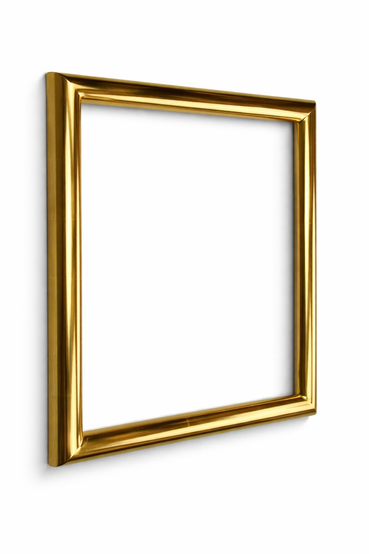
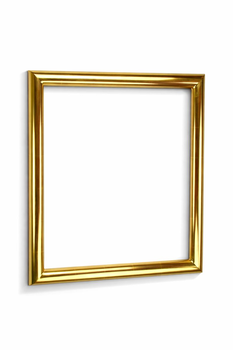
Rounded gold leaf picture frame in gilded wood
- Add feedback:
- Code: 45
- Manufacturer: Karol Milewski
-
Availability:
 Exists
Delivery time: 20 - 30 working days
- pcs.
- €358.33
A gold leaf picture frame whose whole face is one convex curve: the 40 mm moulding rises straight from the rabbet in a single half-round and closes on a narrow outer wall. The gold is laid by hand over red bole, in 23-karat leaf, and I cut every length to the measurements of one particular painting.
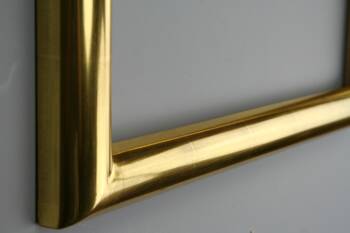
Gold behaves differently on a curved surface than on a flat one. The face of this moulding is a single convex half-round, so the leaf never presents one flat plane to the room: the highlight travels along the curve as you move past it, and the frame reads as a line of warm light around the work rather than as a bright flat border. There is no ornament anywhere on the section. It is water gilded in 23-karat gold leaf over red bole and made to measure, alongside the rest of my gold gilded picture frames.
Moulding profile
At the artwork side the profile begins immediately with a convex half-round: the curve rises straight from the rabbet and runs in one sweep across almost the full width of the moulding, with its highest point in the middle of the face. Towards the outer edge the arc closes and turns into a flat outer wall, a narrow perpendicular plane that finishes the section at the side.
Specification
- Style: plain half-round moulding, gilded, without ornament
- Finish: 23-karat yellow gold leaf, water gilded over red bole on a gesso ground, sealed with shellac and wax
- Moulding width: 40 mm
- Moulding thickness, face to back: 30 mm
- Rabbet: 7 mm wide × 10 mm or 20 mm deep, chosen at the order stage
- Material: low-tannin timber of the kind used in museum and conservation framing
- Corner joinery: mitred corners reinforced with wooden splines
- Glass, backing and mounts: available as add-ons
- Mounting and hanging: sprung clips as standard, cord for hanging
- Suited to: oil and acrylic on canvas, works on paper, photographic prints, icon and devotional painting
Enter the dimensions of the artwork itself. I build the frame 2–3 mm larger as a technical clearance, and the moulding overlaps the edge of the work by roughly 4–5 mm.
What it frames, and where it sits
A narrow gilded frame is the practical answer when a painting needs gold but not weight. At 40 mm the moulding stays subordinate to the image, which makes it usable on small and medium oils where a wide ornamented section would swamp the work. It suits landscapes and portraits in oil or acrylic, works on paper behind glass, photographic prints and icon painting, and it is the section I reach for when someone wants gilded frames for paintings that will hang in a plainly decorated room.
Against a grey or deep-toned wall the curve gives the gold somewhere to move, so the frame stays legible from across a room without needing a wide border. In classically furnished interiors it sits comfortably beside older gilding; in modern rooms it does the job a plain metal frame does, but with a hand-laid surface rather than a plated one.
How it is made
The lengths are mitred at 45 degrees and reinforced with wooden splines before any finishing begins, so the corners are already one piece by the time the ground goes on. I then build the ground in thin coats of gesso, sand it back until the curve runs true, and lay red bole over it. Red is the bole I use here because it warms the yellow gold from underneath and keeps the reflection from going cold.
The gold is laid by water gilding: the surface is wetted and the leaf is drawn down onto it sheet by sheet, with an overlap of about a millimetre where the sheets meet. Leaf arrives at roughly 80 × 80 mm, so for a 40 mm face it is cut down on the gilder's cushion before it goes on. Gilding is done in 23-karat gold leaf, and the finished surface is sealed with shellac and wax.
How it differs from a factory frame
A machine-finished gold frame is usually a printed foil or a sprayed metallic lacquer over a moulded core, and it is uniform by design: the same tone everywhere, the same reflection from every angle. Gilding with real leaf is not uniform, because it cannot be. The sheets are laid by hand and overlap, the bole shows through wherever the gold sits thinnest, and the curve of the face turns those small variations into movement. I have written about how that surface is built up, and how to tell it from an imitation, in my note on gold leaf and hand gilding.
The other difference is fit. A ready-made frame is cut down from stock lengths to the nearest standard size and the artwork is packed out to suit. Here the rabbet is cut to the measurements of one stretcher, and the frame is joined, grounded and gilded as a finished object rather than assembled from pre-finished lengths, so there is nothing to touch in at the corners afterwards.
Function
The frame is supplied without glass, as a mount for a painting on a stretcher. The rabbet is 10 mm or 20 mm deep, chosen when you order, so it takes either a thin stretcher or a standard gallery one, and deeper rabbets can be cut to order for a thicker canvas. Where the sides of the stretcher are meant to stay visible, the same moulding can be made without a rabbet at all, as a floating frame for canvas art, with the canvas set into a gap inside the section.
Complete framing – additional options
Every frame I make can be completed with full archival and museum-quality framing: anti-reflective UV-filtering glass (four classes to choose from), acid-free museum mat board, spacers wrapped in acid-free paper and a Dibond backing. This kind of mounting protects the work from light, acids and distortion. I set out the full glass and material specification on a separate page: archival and museum framing for paintings and photographs. All components are available at extra cost, as an individual quote on request.
Mounting and hanging
I hold the painting in the frame with sprung clips that turn aside when you change the work, which makes the frame easy to handle. On request I fit permanent, screwed brass plates instead. For hanging, I attach cord as standard, in portrait or landscape orientation; a single D-ring on request.
Ordering made to measure
The base price shown on the site is the price per running metre of moulding. The perimeter of the painting is not the full length the frame needs: corners cut at 45 degrees take extra length, and the wider the moulding, the more they take. The calculator accounts for the full moulding consumption with corners and for any options you choose, so you only need to enter the dimensions of your painting to within 0.1 cm. The calculator handles formats up to 120 × 80 cm, and I make larger sizes to individual order. The lead time is 20 to 30 working days.