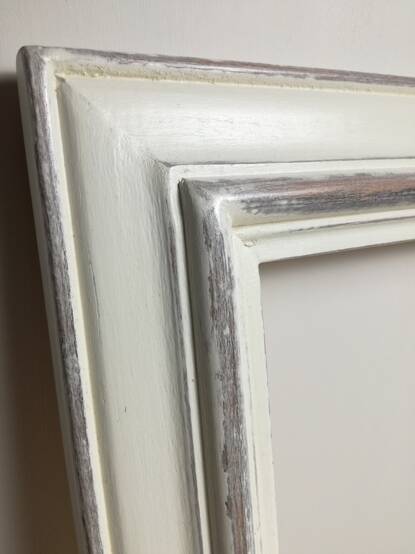
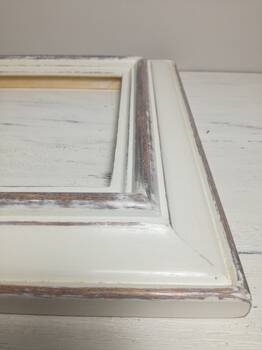
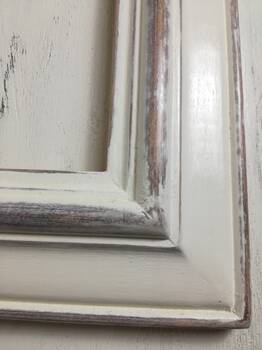
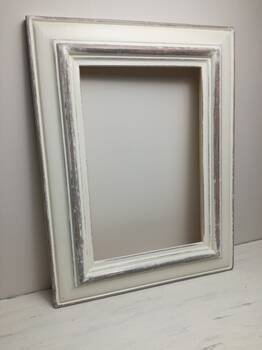
DIstressed white picture frame
- Add feedback:
- Code: 116
- Manufacturer: Karol Milewski
-
Availability:
 Exists
Delivery time: 20 - 30 working days
- pcs.
- €136.11
A distressed white picture frame made to your measurements in my workshop. The moulding is 67 mm wide and carries a reversed profile, hand painted in an off white chalk tone, patinated and waxed to a satin sheen. The rebate is 20 mm deep and takes a standard stretched canvas without glass. Light grey is available as an alternative.
I make this distressed white picture frame one at a time, to the dimensions you give me, for paintings on stretched canvas. The 67 mm moulding has a reversed profile, so the frame reads as a low shelf around the picture. The colour is an off white with a chalk cast, closer to bone or limewash than to a clean laboratory white, built up in successive coats and then patinated and waxed by hand. Light grey is available as an alternative, and other muted colours can be mixed to suit a particular painting.
The moulding profile
The crown of this moulding sits at the artwork side. A concave hollow occupies the inner section and rises to a half-round that forms the highest point of the frame. From there the surface descends in a long frieze across the middle of the width, and a small bead closes the moulding at the outer edge. This is the same logic used in the Dutch frame tradition, where the highest point stands next to the painting and the eye is carried inwards rather than out to the wall.
Specification
- Style: reversed profile, hand painted and patinated
- Finish: off white with a chalk cast, patinated and waxed to a satin sheen; light grey available as an alternative
- Moulding width: 67 mm
- Moulding thickness (face to back): 36 mm
- Rebate: 7 mm wide, 20 mm deep
- Material: low tannin timber of the kind used in museum conservation
- Corner joinery: mitred at 45 degrees and reinforced with wooden splines
- Mounting: spring clips fitted in the workshop; brass plates with screws on request
- Hanging: picture wire as standard, vertical or horizontal orientation chosen at checkout
- Suits: oil and acrylic paintings on stretched canvas up to 20 mm thick
Enter the dimensions of the artwork itself in the calculator. I build in 2 to 3 mm of clearance so the canvas seats without forcing, and the moulding overlaps the edge of the picture by roughly 4 to 5 mm.
Which artworks and interiors it suits
The reversed profile was developed for paintings, and it still serves them best. Oils and acrylics on canvas sit well here, particularly landscapes, still life and looser figurative work where a pale surround lifts the palette without competing with it. Because the crown stands closest to the picture, the frame gives a painting a defined boundary while keeping the outer edge quiet against the wall.
In an interior the off white reads as warm rather than stark. It suits limewashed and plastered walls, older houses with painted joinery, and rooms furnished in a coastal or pared back Scandinavian register. The light grey version does the same work against stronger wall colours. The guide to rustic and vintage picture frames sets out how aged painted surfaces behave next to different kinds of painting, and the wider range of pale options sits in the white picture frames category.
How the frame is made and finished
The profile itself is milled, then the lengths are cut and mitred at 45 degrees and joined with wooden splines before any finishing begins. Joining first matters: the corner is a piece of joinery rather than a filled seam, and the surface that goes over it afterwards is continuous.
Colour is applied by hand in successive coats, each allowed to settle before the next. The patination that follows is deliberate and controlled: it lets the layers beneath show through at the raised points of the profile, so the half-round and the bead read slightly lighter than the frieze between them. The surface is then waxed and buffed to a satin sheen. Every frame differs a little in the detail, which is what hand applied colour does.
How it differs from a mass produced frame
A ready made frame is cut to a standard format and finished by machine in one pass, usually as a printed foil over a composite core. Nothing about it responds to the painting it will hold. Here every side is cut to your measurement, the corners are splined by hand, the colour is mixed in the workshop, and the patination is worked to suit the width of this profile. The timber is chosen for low tannin content, the same criterion used in conservation work, so the frame stays chemically quiet against the artwork over time.
Functionality
The frame is supplied without glass, the normal arrangement for an oil or acrylic on canvas. The 20 mm rebate accepts a standard stretcher, and the canvas is held from behind with spring clips that swivel aside if you want to change the picture later. For deeper stretchers I can increase the rebate, so send me the thickness of the bar with the picture dimensions. This profile can also be made as a floating frame, with the painting set inside a shadow gap instead of under a rebate. My notes on framing paintings cover how the choice affects a canvas.
Frequently asked questions
Can I order this frame in grey rather than white?
Yes. Light grey is a standing alternative on the same profile, finished the same way. Other muted colours can be mixed to a sample or to a photograph of the painting.
Will it fit a deep edge canvas?
The rebate as listed is 20 mm deep. Deeper stretchers are straightforward to accommodate; tell me the thickness of the bar when you order and I will cut the rebate to match.
How white is the finish?
It is an off white with a chalk cast rather than a bright white. Against a white wall it will read slightly warmer; against a coloured wall it holds its own as a pale, quiet boundary.
Complete framing: additional options
Every frame I make can be completed with a full archival mounting prepared in the workshop: anti reflective UV filtering glass, acid free museum matting, spacers and a Dibond backing panel, combined into museum framing that protects the work from light, from acid migration and from mechanical distortion. Glass sits outside the calculator and is priced individually. The materials and the four glass classes are set out in full on the archival and museum framing page.
Mounting and hanging
Spring clips are fitted in the workshop as standard. They hold the stretcher firmly and rotate aside, so a picture can be swapped without tools. Brass plates with screws are available on request and are supplied loose for you to fit. Picture wire is fitted as standard; a single D ring can be supplied instead if you prefer to hang from one point. Vertical or horizontal orientation is chosen at checkout.
Made to measure
The base price shown is the price per running metre of moulding. The perimeter of the painting is not the whole length the frame consumes: corners cut at 45 degrees take up additional length, and the wider the moulding, the more they take. The calculator accounts for the full length used, corners included, along with the options you select. For this moulding width the calculator handles artworks up to 180 cm around the perimeter; anything larger is made to individual order, so send me the dimensions and I will price it. Production time is 20 to 30 working days.