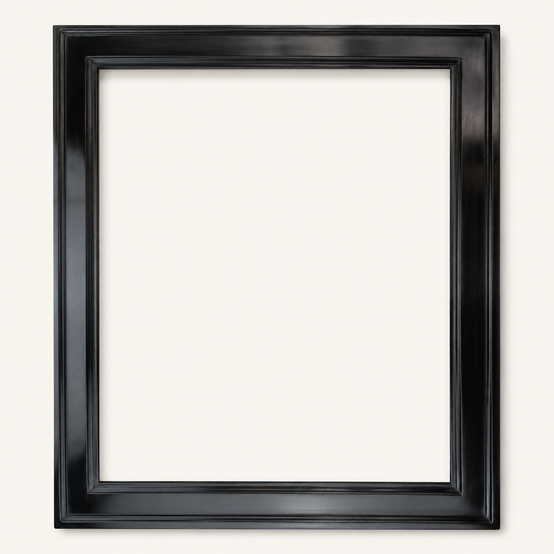
Black Picture Frame — Made to Measure, Hand-Painted
- Add feedback:
- Code: 173
- Manufacturer: Karol Milewski
-
Availability:
 Exists
Delivery time: 20 - 30 working days
Exists
Delivery time: 20 - 30 working days
- pcs.
- €163.89
A black picture frame with a classical architectural profile — raised outer edge, wide central frieze, stepped descent to the rabbet. A 52 mm-wide moulding, hand-painted in the workshop in successive coats of semi-matte black, sealed with traditional shellac and wax. Solid timber, cut to measure for any artwork.
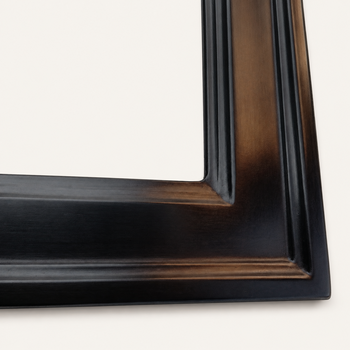
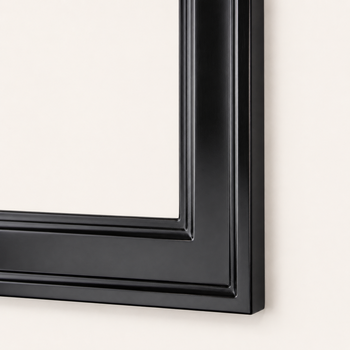
A black setting behaves in an interior almost like a graphic mark in itself. It does not compete with the artwork for attention — it draws the boundary, surrounds the work in shadow, separates it from the wall. This particular black is deep and silken: hand-painted in successive coats of semi-matte, without the flat, chalky tone of industrial paints and without the mirror reflection of lacquer. The surface has an even texture and a soft satin sheen that catches light without point reflections to distract from the work itself.
The profile combines classical restraint with a clear architectural presence. On the outer side, a raised edge subtly defines the frame's boundary — descending through a soft rounded transition to the level field below. The central section is a wide, smooth frieze — a uniform face that catches light without ornamental detail. Toward the artwork, the frieze descends in a stepped descent marked by an inner edge — a soft yet deliberate movement that guides the eye to the work itself. The drawing is pared back to three legible architectural elements.
What artworks and interiors it suits
Semi-matte black is chromatically neutral and behaves in framing like a piece of punctuation — closing the work without adding a tone of its own. It performs well with:
- oil and acrylic paintings with a strong palette (reds, blues, earth tones) — black intensifies saturation without introducing a competing warmth from the frame
- monochrome and black-and-white works, prints and drawings — it orders the contrast and emphasises the geometry of the composition
- art and documentary photography — a neutral tone that adds no colour cast
- abstract and contemporary works — the geometric simplicity of the profile does not collide with the language of the work
In an interior, the frame brings order. On pale walls (white, ecru, light grey) it reads as a graphic mark in its own right; on dark walls it merges with the background, leaving the work as the sole chromatic accent. It suits classical, modernist, gallery and minimalist interiors alike. In each, it performs the same role: separating the work from the room. More on choosing the perfect frame for your artwork and on matching a frame to the style of your interior — on the workshop's journal.
Specification
- Style: classical, architectural
- Finish: semi-matte black
- Moulding width: 52 mm
- Moulding depth: 25 mm
- Rabbet width: 7 mm (workshop standard)
- Rabbet depth: 13–20 mm (accommodates standard and deep stretcher bars)
- Frame material: solid timber with a low tannin content, used in museum conservation and fine art preservation
- Corner joinery: mitred at 45°, reinforced with wooden splines (a conservation technique)
- Surface finish: multi-layered hand-painted coats, sealed with traditional shellac and wax
- Artwork retention: spring clips fitted in the rabbet as standard; brass plates with screws on request
- Hanging: cord strung between two D-rings; single central D-ring on request
- Orientation: portrait or landscape — selected from the product menu
- Lead time: 20–30 working days
- Suited to: oil and acrylic paintings, prints, photography, works on stretchers and rigid supports
The dimensions in the calculator refer to the size of the artwork, not the outer dimensions of the frame. The frame is made 2–3 mm larger than the work — a technical clearance that allows the stretcher to be fitted without forcing. The base price is the price per linear metre of moulding. Mitred corners add length proportional to the moulding width. The calculator accounts for the full material usage including corners and any selected add-ons.
Workshop process
The black of this frame is not the work of a single coat. Each piece goes through successive applications in the workshop: priming, undercoat, two to three coats of opaque paint, interlayer sanding, and final coats in semi-matte. The surface develops an even texture and a deep, uniform tone — without patches, streaks or visible brushwork.
The finish is sealed using the traditional method — shellac and wax. Shellac (a natural resin applied in fine films) closes the pigment and stabilises the colour. Wax worked in by hand in the final stage gives the surface a soft satin sheen and resistance to minor abrasion. The same technique is used in the conservation of historical frames and furniture — it produces a surface that gains depth over the years rather than losing its finish.
Corners are mitred at 45° and reinforced with wooden splines — a wooden tongue inserted into a slot cut into both lengths of the moulding. The reinforcement of the joint gives dimensional stability and resistance to the joint opening up over decades of natural timber movement.
How it differs from mass production
Black frames from production lines are painted in a single coat or sprayed onto MDF — a fast, inexpensive technology that produces a flat, plastic-looking tone and tends to chip at the corners over time. This frame differs in three ways:
- Material — solid timber with a low tannin content, not MDF and not plywood. Timber holds its dimensions, does not swell with humidity, and is repairable. MDF, once scratched or chipped, cannot be restored.
- Multi-layered hand-painting — depth of colour comes from the number of coats, not from a single, heavy spray. The surface has an even tone and a soft sheen that cannot be achieved by industrial means.
- Shellac and wax finish — a traditional conservation technique. It does not only protect; it also gives the surface a hand-made character: it does not have a plastic gloss and does not look machine-smooth.
See the rest of the black frames made in the workshop — they differ in moulding width, profile and finish, but all are made using the same technique.
Functionality
The frame is supplied without glass, as a setting for an artwork on a rigid support: canvas on stretcher bars, panel, or painting board. The work is fixed in the rabbet from the back — directly, with no intermediate layers.
Artwork retention — two options
As standard, the frame is supplied with spring clips factory-fitted in the rabbet. The clips rotate to the side to insert or remove the work, allowing quick changes of artwork without disassembling the frame. The spring accommodates different stretcher depths, from thin painting panels to deep gallery-wrap stretcher bars.
On request, brass plates with screws can be supplied instead — provided loose with screws included, fitted by the customer. This is a permanent solution, used when the work will not be exchanged and the mounting is to be entirely rigid.
Hanging
Portrait or landscape orientation — selected from the product menu in the shop. The frame is prepared in the chosen orientation only, with the appropriate hanging system fitted to the back. As standard: a cord strung between two D-rings. On request: a single central D-ring — used with lighter works and preferred in some gallery contexts.
Variant without rabbet — floater frame
Each of our profiles can also be made without a rabbet, as a floater frame: a canvas on a stretcher is set into the gap inside the frame, with the stretcher edges remaining visible. This is a standard presentation in contemporary painting and premium framing — it gives the impression of an artwork floating within the frame. Available on request.
Complete framing — additional options
Every frame can be completed with a full archival mounting prepared in the workshop: glass, archival backing and matting. All components are available as a custom add-on — quote on request.
Glass — four classes available
Opti White, 4mm — low-iron glass with a neutral, colourless appearance (no green tint typical of standard float glass). Available up to 90×90 cm — the only option for larger works.
Ultra Vue UV70 (Tru Vue), 2.0mm — anti-reflective glass with 70% UV protection, low-iron. Available up to 60×80 cm.
Art View — premium-class anti-reflective glass: reflection reduced below 1%, up to 75% UV protection, scratch-resistant coating, low-iron, can be cut and mounted from either side. Meets ISO 18916 (Photographic Activity Test) — safe for archival photography. Premium quality at an accessible price. Available up to 60×80 cm.
Optium Museum Acrylic (Tru Vue) — top-tier museum acrylic: over 99% UV protection, museum-grade reflection reduction, anti-static, lightweight, shatter-resistant. The museum standard for conservation work and archival photography. Available up to 60×80 cm.
Archival backing
Dibond 3mm aluminium composite panel — two layers of aluminium with an acid-free polymer core. Rigid, chemically neutral, dimensionally stable. An industry standard in archival photographic framing and art conservation.
Mounting and matting
Acid-free foam board — chemically neutral, will not yellow over time, will not react with paper or photographic emulsions. Archival standard.
Full museum framing
Combining anti-reflective UV-filtering glass, acid-free matting, Dibond backing and conservation hinging tapes provides a museum-grade mounting — protecting the work from light damage, acid migration from typical framing materials, and mechanical distortion. This type of framing is used in museums, galleries and private collections.
To order: all of the above components are available as a frame add-on on request. Please get in touch with the dimensions of your work and your preferred glass class — I will prepare an individual quote.
Custom order
Each piece is made individually to the dimensions of a specific artwork. To order:
- Measure the width and height of the artwork precisely (the edge of the substrate itself, not the stretcher with overhanging canvas).
- Enter the dimensions in the shop calculator to within 0.1 cm.
- Select the orientation (portrait or landscape) from the product menu.
- Add the product to the basket — the calculator will automatically compute the price based on the perimeter of the artwork and the base price per linear metre of moulding.
The online price calculator supports artwork sizes up to 120×80 cm. Larger formats are made to individual order — please get in touch with the dimensions of your work.
Lead time: 20–30 working days from order confirmation.
The base price is the price per linear metre of moulding. Mitred corners take up additional length, proportional to the moulding width. The calculator accounts for the full material usage including corners and any selected add-ons.