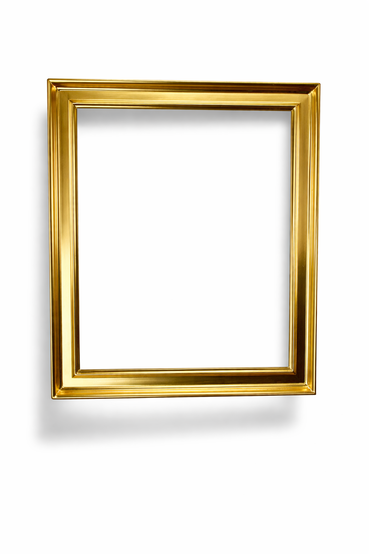
Antique-style gilded picture frame in 23-karat gold leaf
- Add feedback:
- Code: A169/G
- Manufacturer: Karol Milewski
-
Availability:
 Exists
Delivery time: 20 - 30 working days
- pcs.
- €358.33
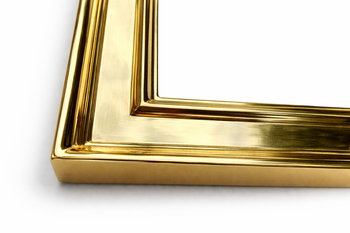
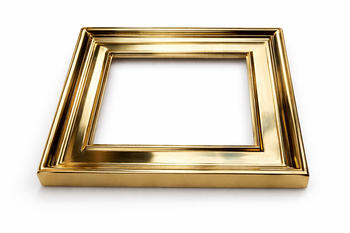
A gilded picture frame with the character of an antique gilt frame, newly made in my workshop. The 55 mm moulding is water gilt across the face and the sides in genuine 23-karat gold leaf laid over red bole, burnished with an agate stone and then patinated by hand, so the warmth of the red ground reads through the metal. I cut every frame to the size of one particular painting.
People come to this frame after looking at antique gilded picture frames and deciding they want that depth of colour without inheriting a hundred years of losses and repairs. The gold here is genuine 23-karat yellow leaf, laid on wet over a red bole ground, burnished to a mirror shine and then patinated by hand so the red reads softly through the metal wherever the surface catches light. The face, the outer edge and the sides are all gilt, so the frame reads as one object from any angle. The rest of the yellow gold work sits in gold gilded picture frames.
The moulding profile
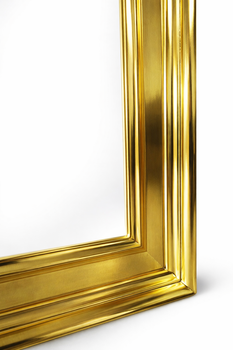
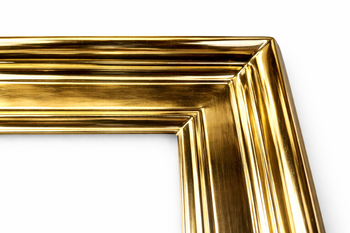
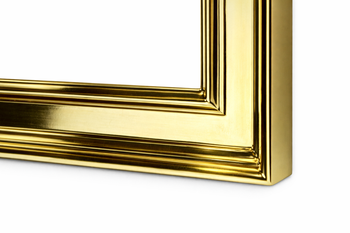
At the artwork edge the moulding carries a small bead, a rounded ridge that lifts just clear of the sight line and falls away again. Beyond it a wide flat frieze takes up most of the 55 mm width and gives the gold an open, uninterrupted surface. At the far end of the frieze the profile steps up into a shallow cove, breaks at a narrow fillet, and then sweeps up through a tall ogee that turns convex at the crown. The outer edge closes as a straight vertical face at the full thickness of the moulding.
Specification
- Style: swept classical profile, wide frieze rising to an ogee crown
- Finish: water gilding in 23-karat yellow gold leaf over red bole, burnished with an agate stone, patinated by hand
- Gilt surfaces: face, outer edge and sides
- Moulding width: 55 mm
- Moulding thickness, face to back: 35 mm with the 10 mm rabbet, 45 mm with the 20 mm rabbet
- Rabbet: 7 mm wide, 10 mm or 20 mm deep, chosen at checkout
- Material: timber with a low tannin content, of the kind used in museum and conservation work
- Corners: mitred at 45 degrees and reinforced with wooden splines, cut and assembled before any ground goes on
- Glazing, backing and mounts: available as an add-on, not fitted as standard
- Mounting and hanging: sprung retaining clips and picture wire
- Suitable for: oil and acrylic on canvas and stretcher, and works on a rigid support
- Lead time: 20 – 30 working days
Enter the dimensions of your painting, not of the finished frame. I cut the rabbet 2 to 3 mm larger than the artwork so the canvas sits without pressure, and the moulding then covers the edge of the painting by roughly 4 to 5 mm.
Which artworks and interiors it suits
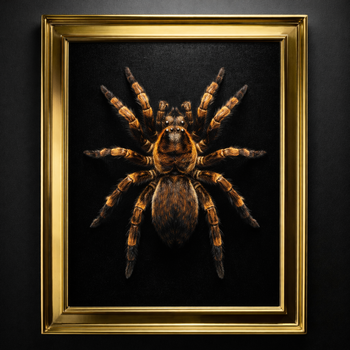
The wide frieze and the height of the crown give the frame enough presence to carry a painting with strong tonal contrast: oils and acrylics on canvas, portraits, still life, sacred subjects and copies after the old masters. Yellow gold over red bole warms up earth pigments and reds in particular, which is why the combination has stayed in use since the fifteenth century. I write more about proportion and rabbet depth in framing oil paintings.
In a panelled or period room the frame settles in as though it had always been there. In a plain contemporary room it does the opposite and works as a deliberate contrast: one gilt object against flat wall colour, which is how most collectors and galleries use gilding now. Large gilded frames of this kind also hold their own on a long wall where a narrower moulding would disappear.
Workmanship and finish
The moulding is milled to profile, then cut at 45 degrees and joined with wooden splines. The corners are closed and levelled before anything else happens, because a joint that moves later will always show through gold. Layers of gesso follow, rubbed back between coats until the surface is dead smooth, and then the red bole, which is what allows the metal to be burnished at all.
The gilding is done with genuine 23-karat gold leaf, laid leaf by leaf on wet with an overlap of about a millimetre, in a single layer of metal over the built-up ground. Leaves come at roughly 80 × 80 mm and are cut down on a gilder's cushion for the narrower members of the profile. The surface is then burnished with an agate stone and patinated by hand, so the red ground shows through along the high points in the way it does on a frame that has been on a wall for a long time. The technique is set out in more detail in gilded picture frames, gold leaf and hand gilding.
How it differs from mass production
Most gold frames on the market are finished with copper and zinc leaf or with metallic paint, both of which sit on the surface as a flat, even film and cannot be burnished. Real gold on bole behaves differently: it takes a polish, it changes tone as you walk past it, and the colour comes from the ground beneath as much as from the metal. It is also stable. Gold does not oxidise, so the frame will look the same in thirty years as it does on delivery, which is not true of imitation leaf.
The other difference is fit. This is a frame cut to one painting, not a stock size the painting has to be talked into. The rabbet is sized to your canvas, the corners are splined rather than stapled, and the gilding is done after assembly so the mitres do not read as seams across the gold.
Functionality
The frame is supplied without glazing, as a setting for canvas on a stretcher. The rabbet comes in two depths, 10 mm for a standard stretcher and 20 mm for a deeper one, and you choose the depth at checkout. If your stretcher is deeper still, tell me the measurement before you order and I will cut the rabbet to it.
This profile can also be made without a rabbet, as a floating frame that leaves a shadow gap around the canvas instead of covering its edge. That construction is described in floating picture frames for canvas art.
Complete framing – additional options
Every frame I make can be completed with full archival and museum-quality framing: anti-reflective UV-filtering glass (four classes to choose from), acid-free museum mat board, spacers wrapped in acid-free paper and a Dibond backing. This kind of mounting protects the work from light, acids and distortion. I set out the full glass and material specification on a separate page: archival and museum framing for paintings and photographs. All components are available at extra cost, as an individual quote on request.
Mounting and hanging
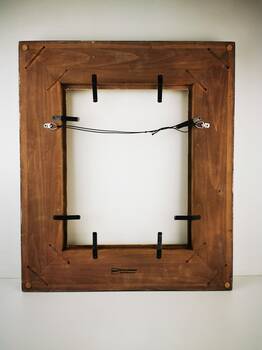
This frame is intended for paintings on canvas and stretchers, so it does not include glass as standard. To hold the painting, I fit sprung retaining clips as standard; they pivot to the side, so the canvas can be removed and replaced quickly without tools. On request I supply brass plates with screws instead (provided loose, for permanent self-installation). The hanging orientation – portrait or landscape – is chosen at checkout. Picture wire is standard, with a single D-ring available on request.
Ordering made to measure
The base price shown on the site is the price per running metre of moulding. The perimeter of the painting is not the full length the frame needs: corners cut at 45 degrees take extra length, and the wider the moulding, the more they take. The calculator accounts for the full moulding consumption with corners and for any options you choose, so you only need to enter the dimensions of your painting to within 0.1 cm. The calculator handles formats up to 120 × 80 cm, and I make larger sizes to individual order. The current lead time is 20 – 30 working days.