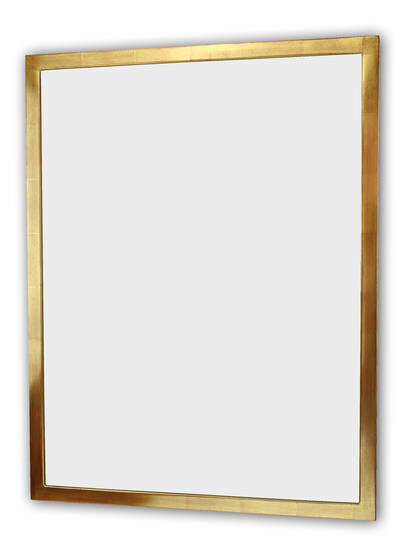
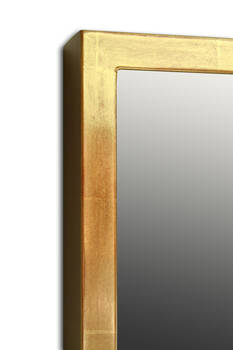
Custom gold leaf picture frame, made to measure in 23-karat gold
- Add feedback:
- Code: 17
- Manufacturer: Karol Milewski
-
Availability:
 Exists
Delivery time: 20 - 30 working days
Exists
Delivery time: 20 - 30 working days
- pcs.
- €355.56
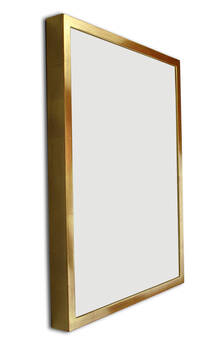
A narrow gold leaf picture frame made to measure, water-gilded by hand in real 23-karat gold over red bole. The moulding is 22 mm wide and 46 mm thick, with a rabbet up to 40 mm deep, so one frame takes a deep stretcher, a work on paper with spacers, or an object in a box configuration.
I make this frame to measure, in real 23-karat gold leaf laid by hand over red bole. The moulding is deliberately narrow: 22 mm across the face, so the gold reads as a framing line rather than a border competing with the painting. Behind that narrow face the moulding is 46 mm thick, with a rabbet up to 40 mm deep, and that depth is what lets one frame take a deep stretcher, a work on paper held away from the glass, or a three-dimensional object under glass. It is the narrowest profile in my range of gold gilded picture frames.
The moulding profile
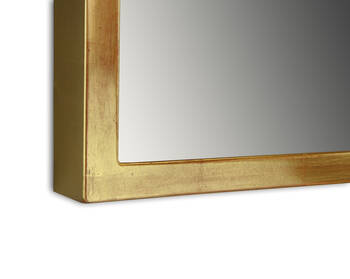
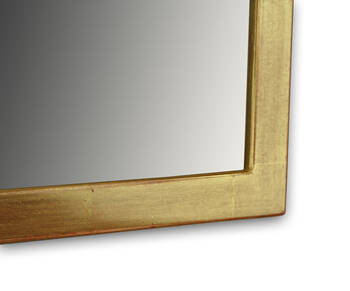
The face is a single flat plane 22 mm wide, running unbroken from the rabbet to the outer edge: no hollow, no bead, no step, and no rise or fall across its width. The whole of that plane carries the gold, which is why a moulding this narrow still reads clearly from a distance. The lateral flank is deep in proportion to the face, 46 mm from front to back, and it is this surface that takes either the gilding or the black paint.
Specification
- Style: classical, plain narrow profile, machine-milled
- Face finish: 23-karat gold leaf on red bole, hand-patinated, sealed with traditional shellac and wax
- Moulding width: 22 mm
- Moulding thickness (face to back): 46 mm
- Rabbet: 7 mm wide × up to 40 mm deep (other depths to order)
- Side finish: gilded like the face, or painted black for a sharper graphic contrast
- Material: timber with a low tannin content, of the type used in museum and conservation framing
- Joinery: mitred at 45° and reinforced with timber splines, before any ground is applied
- Gilding: water gilding, 23-karat gold leaf laid one leaf at a time over gesso and red bole
- Glass, archival backing and matting: available as an add-on, quoted individually
- Mounting and hanging: supplied with the frame (details below)
- Lead time: 20 to 30 working days
- Suitable for: oil and acrylic on canvas, watercolours, prints, photography, certificates, box display
The dimensions above describe the moulding itself. The aperture is correspondingly smaller than the outside dimensions of the frame, and I build every frame with a working allowance of about 2–3 mm against the artwork size you give me, so the work slides in without forcing. Each frame is made to measure for one specific painting, photograph or stretched canvas.
What it suits
A 22 mm face is narrow enough that the frame supports the work instead of arguing with it, and 23-karat gold is the warmest of the leaf tones, so it sits comfortably against oil paint. In practice I make this profile for oil and acrylic on stretched canvas, fitted straight into the rabbet with no glass, which is the traditional presentation for framing oil paintings; for watercolours, prints and works on paper, under glass with acid-free matting; for fine-art photography and archival prints, in full conservation framing; and for collectibles and small three-dimensional objects in a box configuration with spacers and front glass.
The warm 23-karat tone settles into classical, neoclassical and traditional rooms without effort. The narrow line keeps it usable in a modern, gallery-style interior as well, where a wide gilded moulding would read as costume.
How I make it
The moulding is milled from timber with a low tannin content, of the type used in museum and conservation framing, and the corners are cut at 45° and reinforced with timber splines before any ground goes on. Joining first and finishing afterwards is what gives a closed, continuous corner; frames assembled from pre-finished lengths always show the joint.
The ground is built up in the traditional way: gesso, which is chalk bound with animal glue, then red bole, the fine gilding clay that goes under the leaf. Each layer dries and is smoothed before the next one goes on. This is the only multi-layered part of the process. The gold itself is a single layer: 23-karat leaf laid one piece at a time with a small overlap onto the leaf beside it. A sheet of leaf measures roughly 80 × 80 mm, so for a moulding this narrow I cut each piece to width on the gilder's cushion with a gilder's knife, by hand, immediately before laying it.
Once the gold has dried I patinate it by hand, selectively rather than evenly, so the warm red of the bole shows through only where I want it. That is what separates a water-gilded surface from a sprayed one: the colour underneath is doing part of the work. I explain the technique in more detail in my guide to gilded picture frames and hand gilding. The finished surface is sealed with traditional shellac and wax, the same materials used in conservation gilding.
How this differs from a factory frame
Most gold frames sold in this width are extruded by machine, usually in polyurethane, MDF or softwood, and finished either with sprayed metallic paint or with imitation leaf made from copper and zinc alloys. Those finishes oxidise: they darken and go green over the years and lose the tone they had when new.
Real gold leaf does not oxidise. What it costs is time. Each ground layer dries and is worked separately, the gold goes on leaf by leaf, and the shellac needs its own drying, which is why a frame takes 20 to 30 working days rather than a few hours. What you get back is a frame that holds its value, ages properly, and can be repaired or regilded by any gilding workshop in the future.
The deep rabbet in use
A rabbet up to 40 mm deep is the structural feature that separates this frame from a standard moulding. It takes a painting on a deep stretcher, either with the canvas edge showing or with the stretcher hidden inside the frame. It takes a three-dimensional object under glass with spacers fitted inside the rabbet: keepsakes, medals, miniatures, textiles, small sculptural pieces, natural-history specimens. And it takes a work on paper held clear of the glass, where a spacer or a mount separates the glazing from the surface of the sheet and removes the risk of paper sticking to glass when humidity moves.
The spacers are narrow timber strips made to measure and painted to suit the work, usually white, black or the dominant tone of the composition, so they read either as a quiet recess or as a deliberate second line around the object. For an unusual project I can build the frame with a rabbet deeper or shallower than standard; send me the dimensions of the object.
The same profile can also be made without a rabbet, as a floating frame: the canvas sits inside the frame with a visible gap around it and the edges of the stretcher left exposed. I cover that construction in my guide to floating frames for canvas art.
Complete framing – additional options
Every frame I make can be completed with full archival and museum-quality framing: anti-reflective UV-filtering glass (four classes to choose from), acid-free museum mat board, spacers wrapped in acid-free paper and a Dibond backing. This kind of mounting protects the work from light, acids and distortion. I set out the full glass and material specification on a separate page: archival and museum framing for paintings and photographs. All components are available at extra cost, as an individual quote on request.
Mounting and hanging
As standard the frame is fitted with sprung clips, which turn to release and make it easy to change the canvas. On request I fit brass plates with screws instead, supplied loose for you to install for a permanent fixing. For hanging, the frame takes picture wire as standard, with a single D-ring hanger available on request; you choose portrait or landscape orientation when you order.
Ordering to measure
Measure the artwork to the millimetre and enter those dimensions in the calculator on this page. I build the frame with a working allowance of about 2–3 mm against the size you enter, so the work seats freely. The calculator handles formats up to 120×80 cm; larger sizes I make to individual order. The side finish, gilded or painted black, and any non-standard rabbet depth are agreed with me when the order is placed.
The base price shown on the page is the price per running metre of moulding. The perimeter of the artwork is not the full length of moulding a frame needs: the corners, cut at 45°, take up additional length, and the wider the moulding, the more they consume. The calculator accounts for the full run of moulding including its corners, together with the fittings and options you choose. Glass, archival backing and matting are quoted separately.
Lead time is 20 to 30 working days. If your order is tied to a date, an exhibition or a gift, get in touch before you order and I will tell you what is realistic.