Picture Framing Techniques and Accessories
Good picture framing is a system, not a single decision. The moulding gets most of the attention, but the picture framing techniques and accessories behind it decide whether a piece is actually protected and whether it reads correctly on the wall. The glazing, the mount, the depth of the rebate and the way the work is held and sealed all matter as much as the profile you see. In my workshop I build every frame from raw moulding to finished corner, and I choose each of these elements for the specific artwork in front of me rather than to a standard recipe.
This guide walks through the framing techniques and accessories I use most often, what each one does, and when it matters. My aim is to help you brief a frame properly, whether you are framing an oil on canvas, a watercolour on paper, a photograph or a textile, and to show where a made to measure approach earns its place over an off the shelf frame.
Glazing: museum glass, anti-reflective and UV protection
Glazing is the first accessory most people underestimate. It is not just a sheet of glass; it is the layer that controls light, reflection and, in the best grades, ultraviolet damage. For most work I offer three levels:
- Standard clear glass, which is fine for posters, prints and decorative work that is easy to replace.
- Conservation glass with a UV filter, which blocks most of the ultraviolet light responsible for fading pigments, papers and photographs over time.
- Museum, anti-reflective glass, which combines UV protection with a coating that all but removes reflections, so you see the work and not the room behind you.
For large formats, or where a frame has to travel, I sometimes recommend acrylic glazing instead of glass, because it is lighter and does not shatter. This is also why, when I ship frames abroad, I dispatch them without glass to the United States and advise fitting local glazing on arrival: it removes the single most fragile part from a long courier journey. If you want the full reasoning on why glazing choices affect the price of a frame, I set it out in my guide to what professional framing costs.
Mounts, passe-partout and spacers
A mount, or passe-partout, is a window of board placed between the artwork and the glazing. It does two jobs at once. Visually, it gives the work room to breathe and sets a considered border. Physically, and this is the part that matters for longevity, it holds the surface of the work off the glass so that condensation or contact cannot mark it. I use acid-free board so that the mount itself does not discolour or transfer acidity into the paper over the years.
Mounts can be single or double, cut in different colours and materials to pick up the palette of the work. Where you want no visible border at all, for example on a photograph framed close, I use spacers hidden inside the rebate to achieve the same air gap without a visible mount. For a closer look at how these finishing details change the presentation of a piece, see my notes on decorative frame elements and additions. Most of these decisions are made properly only on a made to measure basis, which is why the majority of my work comes through as custom picture frames rather than stock sizes.
Rebate depth: shallow profiles, deep frames and the box frame look
The rebate is the recess on the inside back edge of the moulding that holds the artwork, glazing and backing. Its depth is one of the most practical, and most overlooked, framing decisions.
A shallow rebate suits flat work: prints, drawings, watercolours and photographs, where you only need to hold thin materials. A deep rebate is essential for anything with thickness, above all a stretched canvas or a panel, which needs room for the stretcher bars to sit fully inside the frame. If the rebate is too shallow, the canvas stands proud of the frame and looks unfinished.
Depth also opens up a specific contemporary look. A box frame, sometimes called an American box or a float frame, sets the artwork so that a visible gap runs between the edge of the work and the inner face of the frame. The piece appears to float, with a clean shadow line all around it. This is why box framing has become the default for modern canvases and for work where the raw edge is part of the appeal: the frame separates the piece from the wall without crowding it. A box frame differs from a flat frame in exactly this respect, a flat frame sits directly against the edge of the work, while a box frame deliberately holds it away. I cover the full range of constructions, including deep and float options, in my guide to canvas picture frame types, and I build these to measure for oils and acrylics through my service for framing oil paintings.
Backing, sealing and hanging
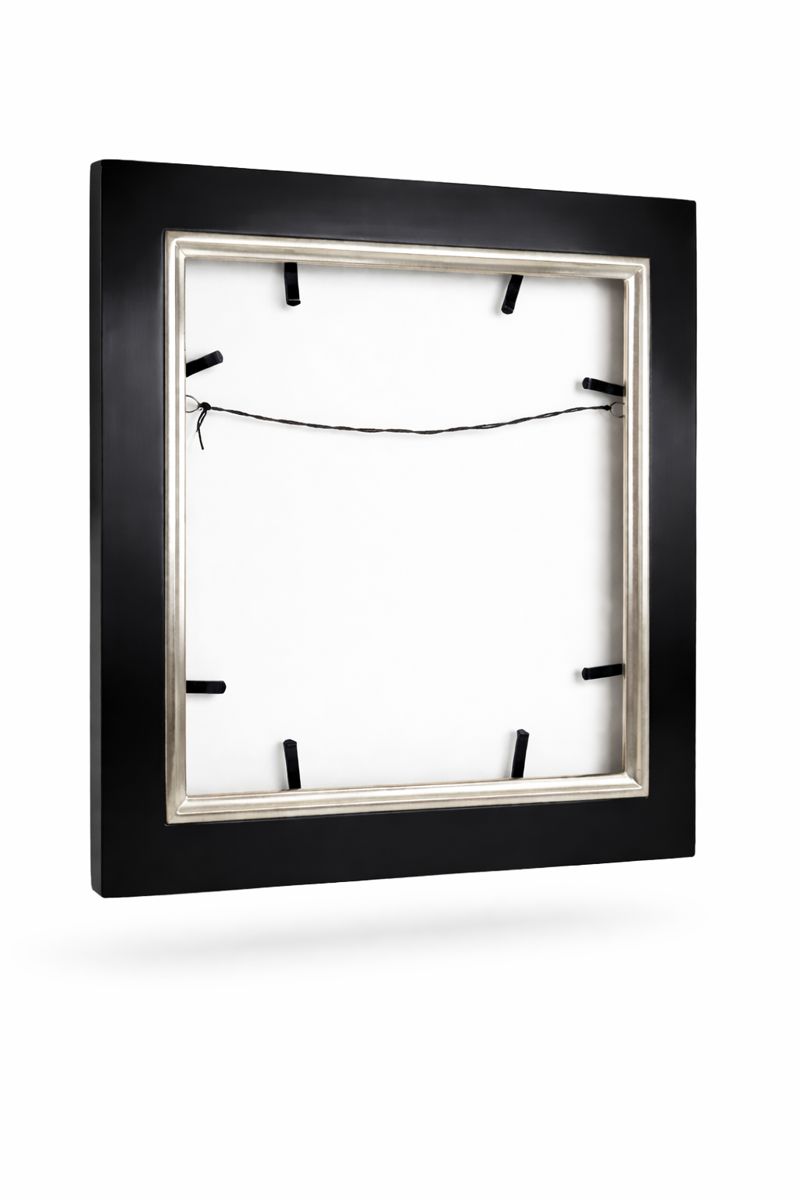
Behind the artwork sit the accessories no one sees but everyone benefits from. I use acid-free backing board to support the work and buffer it from the wall, and I seal the back of a finished frame against dust and airborne dirt. On the reverse I fit hanging hardware sized to the actual weight of the frame: D-rings and cord for lighter pieces, heavier security fixings for large gilded frames and mirrors. It sounds obvious, but a great many damaged works arrive in my workshop simply because the original frame was hung on fittings that were never rated for its weight. For collectors and for anything of real value, I treat backing and sealing as part of a full conservation approach, described on my page for archival and museum framing.
Finishing techniques: water gilding and real gold leaf
Finishing is where a frame stops being joinery and becomes a technique in its own right. My core method is traditional water gilding on a bole ground. I lay a multi-layered gesso base, then coloured clay (the bole, in red, ochre, black and other tones), and onto that I lay genuine gold leaf. Once the leaf is down and dry, I burnish it with an agate stone to bring up a deep, mirror-like sheen that no metallic paint can imitate. I work across the full range of carats, from cool 6 carat white gold, through 12 carat and 22 carat moon gold, to warm 23 carat and 23.75 carat yellow gold. I do not use imitation leaf.
Because the tone of the finished gold depends on the colour of the bole beneath it, and on how far I rub the surface back, water gilding gives control that painted or oil-gilt finishes cannot. You can see the range of tones and profiles in my gold gilded picture frames, and I explain the method itself, step by step, on my page about water gilding. The same finishing techniques carry straight across to mirrors: a hand-gilded surround is what turns a plain sheet of glass into a statement piece, which is how I make my glamour mirrors to measure.
Matching the technique to the artwork
None of these choices is made in isolation. The right combination depends entirely on what you are framing:
- Oil and acrylic on canvas. A deep rebate to house the stretcher, usually no glazing, and often a box or float construction, or a traditional gilded frame for classical work. My service for frames for canvas prints and photo on canvas covers the practical side of this.
- Works on paper (watercolours, drawings, prints). A mount to hold the sheet off the glazing, conservation or museum glass, and acid-free materials throughout, because paper is the most vulnerable surface I handle.
- Photographs. Anti-reflective glazing so the image is legible from any angle, with spacers or a mount to prevent the print touching the glass.
- Textiles, medals and three-dimensional objects. A deep box frame that gives physical depth, so the object sits protected inside the frame rather than pressed flat.
If you are still deciding on style and proportion before you reach these technical questions, my guide on how to choose the perfect frame for your artwork is the place to start.
How I build each frame to measure
Every frame I make is built to order for a specific piece; I do not keep stock. I cut the moulding from properly seasoned solid timber and join the corners with mortise-and-tenon or splined joints rather than staples, which is what keeps a frame square and stable for decades. From there the frame goes through substrate preparation, finishing and glazing, and each stage is checked by hand. A made to measure frame takes roughly four to eight weeks depending on the finish, since hand-gilded work needs far more time in the workshop than a painted profile. For fine art, paintings and collections I set the whole process out on my page for bespoke picture frames for fine art.
Frequently asked questions
What is the difference between museum glass and standard glass?
Standard glass simply covers the work. Museum glass adds two things: a UV filter that blocks most of the light responsible for fading, and an anti-reflective coating that removes the mirror-like glare of ordinary glass, so you see the artwork clearly from any angle. For anything of value, or anything hung opposite a window, it is the glazing I recommend.
What is a box frame, and how is it different from a flat frame?
A box frame holds the artwork away from the inner edge of the frame so that a visible gap, or shadow line, runs all the way around it and the piece appears to float. A flat frame sits directly against the edge of the work. Box framing suits modern canvases and any piece whose raw edge is part of its character; a flat frame gives a tighter, more traditional finish.
Do I need a mount for an oil painting?
Usually not. Oils and acrylics on canvas are framed without a mount and without glass, because the paint surface needs air and the stretcher needs a deep rebate. Mounts belong with works on paper, where they hold the sheet off the glazing and set a border. For a canvas, the equivalent decision is whether to use a close-fitting frame or a box frame with a visible gap.
What is water gilding, and how is it different from gold paint?
Water gilding is the traditional method of laying genuine gold leaf onto a prepared gesso and clay ground, then burnishing it with an agate stone to a deep shine. Gold paint is pigment and binder, and always looks like paint. Real leaf, laid and burnished by hand, has a depth and a way of catching light that no paint reproduces, and it can be finished from brightly reflective to softly aged depending on how it is worked.
How long does a made to measure frame take?
Around four to eight weeks, depending on the finish. A painted profile is quicker; a fully hand-gilded frame needs more days in the workshop for the gesso, bole, leaf and burnishing stages. Because every frame is made to order for a specific piece, I confirm the exact lead time when the details are agreed.
Framing a piece that deserves the right technique
The point of understanding these picture framing techniques and accessories is not to turn you into a framer, but to help you brief one well. When the glazing, the mount, the rebate depth and the finish are all chosen for your particular work, the result protects the piece and lets it read as it should, both now and in many years. If you have something you would like framed, or a mirror you would like made to measure, tell me the artwork, the dimensions and where it will hang, and I will advise on the right combination and prepare a quote.