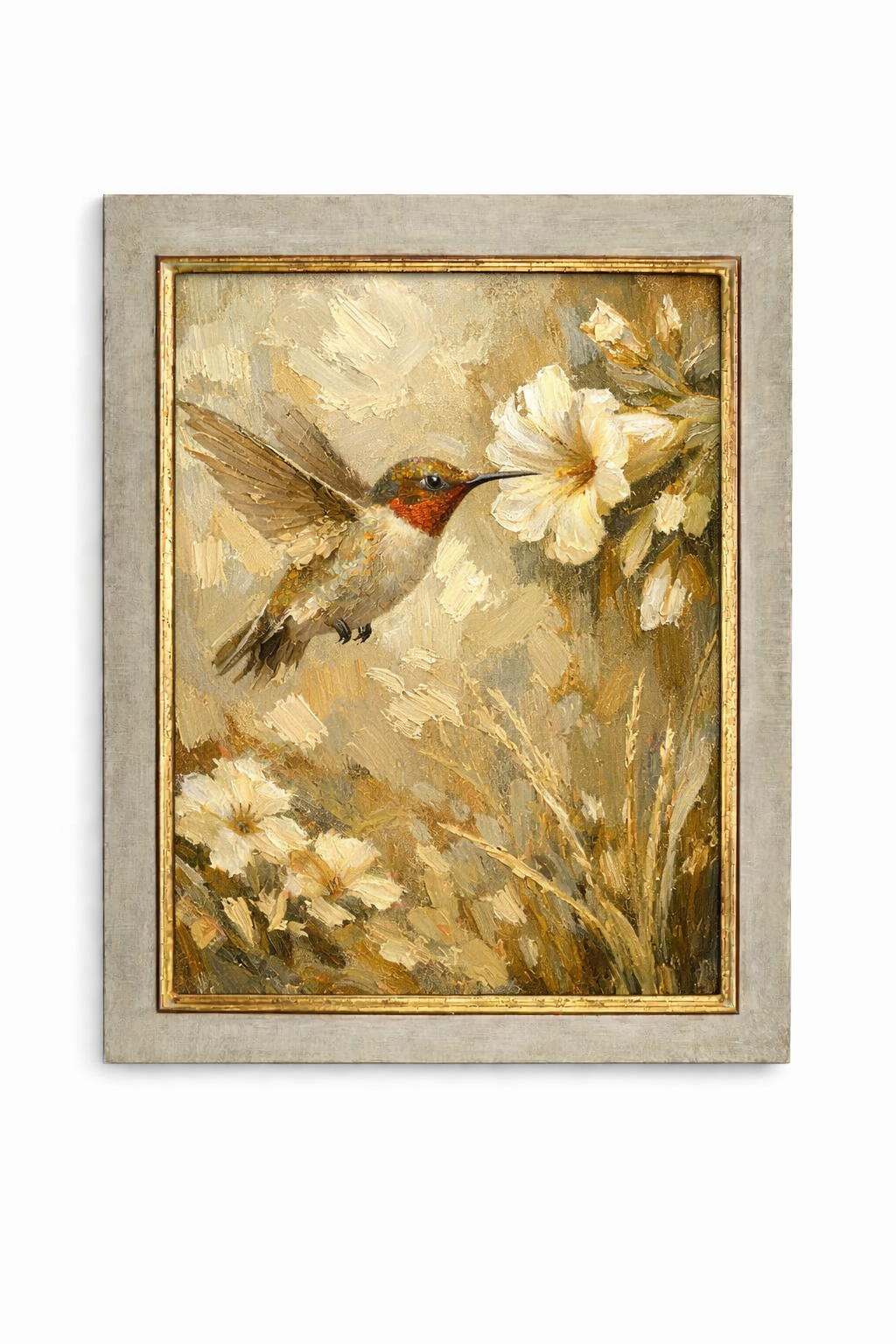
Made-to-Measure Picture Frames: Built to Fit Your Artwork
Ready-made frames come in fixed formats, and most artwork does not. A canvas comes off the stretcher a few millimetres over a round number. A panoramic photograph sits at a ratio no shelf frame matches. An inherited oil is an awkward size nobody mass produces. That gap between the piece you own and the sizes on offer is the entire reason made-to-measure picture frames exist. Instead of trimming the work or accepting a frame that almost fits, you have the frame built around it. In my workshop that is simply how I make custom picture frames: from the measurements of the actual piece outward, never the other way round.
I work alone, by hand, from raw moulding through to the final finish. That means a made-to-measure frame from me is not a stock profile cut down to length in a back room. It is cut, joined, prepared and finished as one project for one artwork, which is what lets the proportions, the depth and the surface all answer to the work in front of me.
The limits of ready-made sizes
Off-the-shelf framing is built around a short list of popular dimensions. It is efficient, and for a standard print it can be perfectly sensible. The trouble starts the moment the work steps outside that list, which happens more often than people expect:
- Stretched canvases are rarely exact. Two paintings sold as the same size can differ by several millimetres, and a frame fitted "more or less" shows it at the corners.
- Oil paintings on deep stretcher bars need a rebate deep enough to hold the whole body of the work, not just its face.
- Panoramic and non-standard ratios, long and narrow, square, or anything unusual, simply do not exist as shelf sizes.
- Older and inherited works were often made to dimensions that no longer correspond to any modern format.
In each of these cases a made-to-measure frame is not a luxury, it is the only honest fit. A frame that is slightly too big has to be packed out and still rattles; one that is slightly too small cannot take the work at all. Building to the real measurement removes that compromise.
How I measure and build a frame to size
The process starts with the work, not a catalogue. For a stretched canvas I take the outer dimensions of the stretcher and its depth, because both decide the rebate. For a work on paper I account for the sheet, any mount, and the glazing. From there I plan the moulding width and profile against the scale of the piece, since a small study and a large landscape call for very different proportions.
Once the design is agreed I cut the moulding, join the corners, prepare the surface, and apply the chosen finish. Corners are checked individually; a mitre that is even slightly open is the first thing the eye finds on a finished frame, so it is the last thing I let through. This is the same hand-built sequence I set out in more detail in my guide to how to choose custom picture frames, and it is the reason a made-to-measure frame holds its geometry over years rather than warping like a mass-produced length.
When a made-to-measure frame is the right choice
Not every picture needs one. A made-to-measure picture frame earns its place when the work is unusual in size, valuable, or both. In practice I build them most often for:
- Original paintings and works held by collectors, where the frame is part of how the piece is preserved and presented. For fine art specifically I offer dedicated bespoke picture frames for fine art, paintings and collections.
- Oil paintings on canvas, which need the right depth and a frame that respects the texture of the surface.
- Photographs and prints on canvas, where a clean, exact boundary matters; I cover this in custom frames for canvas prints.
- Large or oversized works, where a wider, deeper profile is needed simply to carry the weight and stabilise the composition on the wall.
If you want a gallery look in which the painting appears to float clear of the moulding, a deep box construction does exactly that; I explain the style in my piece on the American box frame for a painting. And if the question is less about size and more about how the frame should sit within the room, my notes on matching a frame to an interior are a useful companion to this one.
Finishes for a bespoke frame, from hand-painted timber to gold leaf
Building to size is only half the work; the finish decides the character. Because I prepare every surface myself, a bespoke frame can be taken in almost any direction:
- Hand-painted timber in a chosen colour and sheen, from matte through satin to gloss. A clean black frame or a soft white frame suits contemporary and minimalist work.
- Natural and exotic woods, where the grain is left visible and the timber itself becomes the decoration.
- Real gold leaf, applied by traditional water gilding on bole. This is the most demanding finish and the one with the most depth; you can see the range in my gold gilded picture frames.
Clients often come to me specifically for custom gilded work: a frame made to their dimensions and then finished in genuine gold rather than a printed gold effect. That combination, exact size plus a hand-applied leaf finish, is something only made-to-measure work can give you. If you would like to see every customisation option laid out together, my overview of the picture frame shop, types, styles and customisation covers the full picture.
Protection built into the frame, not added on
A frame made to measure is also a frame made to protect. Because I am building the construction rather than adapting a finished product, the protective elements are part of the design from the start:
- Glazing matched to the work, from standard glass to conservation glass with a UV filter that slows the fading of pigments and paper.
- A rebate and backing that seat the work securely and seal the reverse against dust.
- Acid-free mounting and reversible fixings, so nothing in contact with the work can damage it over time.
For paintings, photographs and documents of real value, this is where made-to-measure framing matters most. I set out the full conservation approach in my archival and museum framing service.
The same principle applied to mirrors
Everything that makes a frame work for a painting applies just as directly to a mirror. A frame around glass has the same job as a frame around art: it sets a boundary, carries the weight, and ties the piece to the room. I make mirrors in frames to measure for exactly the situations where a shelf size will not do: an alcove, a specific wall, an unusual proportion. The finishes are the same hand-applied paints and gold leaf I use on picture frames, which is why a made-to-measure mirror can be built to match a framed work elsewhere in the same room. If you are looking for something more ornamental, my decorative mirrors show how far the frame can be taken.
Made-to-measure picture frames: common questions
How much does a made-to-measure picture frame cost?
There is no single price, because the cost follows the work: the width and depth of the moulding, the type of wood, the glazing, and above all the finish. A hand-painted frame takes less time than one gilded in real gold leaf, and the price reflects that. I quote each project individually once I know the dimensions and the finish. My article on why professional picture framing costs what it does breaks the components down in full.
Can you frame any size or shape?
Within reason, yes. Because I build from raw moulding, I am not limited to standard formats, and I regularly make frames for oversized, panoramic and otherwise non-standard works. Unusual shapes are possible too; they simply take more planning and time.
How do I measure my artwork for a frame?
For a stretched canvas, measure the outer width and height of the stretcher and its depth. For a work on paper, measure the sheet itself and tell me whether you want a mount. If you are unsure, send a photograph with the dimensions noted and I will confirm what is needed before anything is cut.
How long does a made-to-measure frame take?
Lead time is set per project. A painted finish is quicker; a water-gilded frame needs more days in the workshop because the gilding cannot be rushed. I give a realistic timeline when I quote.
Do I need a made-to-measure frame for a valuable painting?
If the work matters to you, materially or personally, it is worth it. A frame built to size with conservation glazing and acid-free materials protects the piece in a way a fixed-size product fitted approximately cannot.
If you have a piece that does not fit anything on a shelf, that is exactly the work I am set up to frame. Tell me the dimensions and the finish you have in mind, or send a photograph of the artwork and the wall it is destined for, and I will design a frame built to it. You can start from my range of custom picture frames or go straight to a bespoke commission.