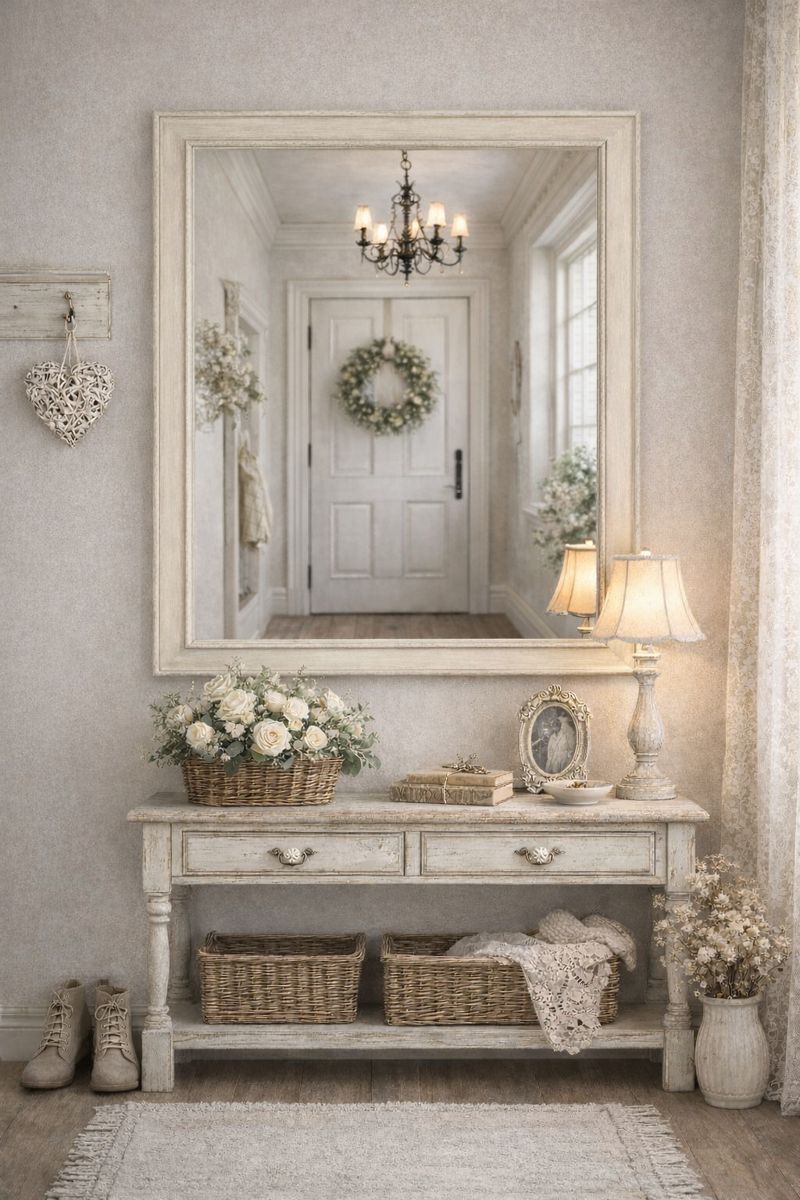
Hallway Mirror Ideas: Styling Inspiration for Entryways of Every Size
The hallway is the first room anyone walks into, and it is almost always the smallest and the trickiest to furnish. A well-placed hallway mirror solves several problems at once: it bounces daylight into a dim corridor, makes a tight entrance feel wider, gives you a last look before you leave, and sets the tone for the rest of the home. If you have been searching for an entryway mirror, an entrance mirror or a hall mirror, you are looking for the same thing under a different name, and everything below applies equally.
This is a collection of practical hallway mirror ideas, drawn from pieces I make by hand in my workshop and organised by the shape of your space, the style you are after, and the frame finish that carries it. Where a topic deserves a fuller treatment, I have linked to a dedicated guide so you can go deeper without wading through everything at once.
Hallway mirror ideas for narrow corridors
A narrow corridor has room to spare in only one direction: upward. A tall, vertical mirror draws the eye up the wall and lengthens the space without stealing the few centimetres of walking room you have. A slim moulding matters here. A heavy, ornate frame crowds a narrow wall, whereas a restrained profile keeps the reflection doing the work. My Linea Slim design, a narrow gold frame on a tall format, was made with exactly this situation in mind.
If the corridor is genuinely tight, a full-length mirror fitted flush to the wall gives you a head-to-toe reflection without a console taking up floor space. Where there is a little room, a tall mirror leaning lightly against the wall is a relaxed alternative; I set out the trade-offs in my guide on choosing a freestanding or wall-mounted hallway mirror.
Ideas for small entryways
In a small entryway the goal is light and a sense of openness. A round or oval mirror softens the boxy geometry of a compact hall and reads as less bulky than a large rectangle. Hang it opposite the front-door glazing or a wall light and the mirror will multiply whatever daylight reaches the space, the single simplest way to make a small entrance feel larger. A compact rectangular mirror above a slim console works just as well, keeping proportions tidy without dominating the wall.
Ideas for wide and grand entrance halls
A generous entrance hall can carry a statement. An oversized mirror above a console or sideboard becomes a focal point, and in a period hall a large gilded frame holds its own against high ceilings and detailed joinery. Pairing a wide mirror with a bench or a console gives the entrance a considered, hotel-like composition. Where the wall is unusually large, a made-to-measure piece is the only reliable way to get the format exactly right, rather than settling for the nearest off-the-shelf size.
Hallway mirror ideas by style
Style is where a hallway mirror stops being purely functional and starts shaping the character of the entrance. The directions I am asked for most often:
- Modern and minimalist: clean rectangles, a slim border or no frame at all, quiet finishes that let the architecture speak.
- Scandinavian: light, restrained framing in pale or natural tones, nothing that competes with wood and soft colour.
- Glamour: a richly profiled moulding and a strong gold or high-gloss finish, used as a deliberate decorative accent.
- Classic gold leaf: a traditional profile water-gilded with genuine gold leaf, at home in period and contemporary interiors alike.
- Black-framed: a modern, decisive finish that reads sharply against light walls, popular in loft and industrial-leaning spaces.
For a fuller comparison of these looks and how to match one to the rest of your interior, see my guide to hallway mirror styles.
Shape ideas: rectangular, round, oval and irregular
Not every hallway calls for a classic rectangle, and the main types of hallway mirror each suit a different space. Rectangular formats are timeless and work in almost any interior. Round and oval shapes soften long corridors and sit beautifully above a console, and an arched top lends a gentle, architectural feel. If you want the entrance to have a real signature, an irregular or organic-shaped mirror turns the mirror itself into the decorative object. A frameless mirror is the most discreet choice of all, when you want reflection without any visual frame.
Frame and finish ideas
The frame is what ties a hallway mirror to the rest of your home, and it is the part I spend most of my time on. A few of the finishes I make:
Gold leaf, applied by traditional water gilding over a gesso ground, in 6, 12 and 22-karat moon gold or warm 23-karat yellow gold, each tone catching light differently. Deep black lacquer taken to a high gloss for a modern, graphic look. Soft silver and white-gold tones for a cooler, understated finish. Hand-painted colour, from muted neutrals to a single bold accent, sealed for durability. Distressed and patinated finishes, gently aged and waxed, for interiors with a vintage or shabby-chic character.
Behind the finish, the glass matters too. I use SGG Miralite Pure Diamant OptiWhite glass, which is neutral in tone and free of the greenish cast you see in ordinary mirrors, and a ground bevel up to 20 mm is available where you want a quiet, crystalline sparkle at the edge. You can see the range of finishes across my decorative mirrors, and because every piece is made to order, I agree the exact colour and gold tone with you from photographs of previous work before I begin.
Hallway mirror or entryway mirror? A note on terminology
These terms all describe the same object. In British usage it is usually a hallway mirror or hall mirror, while in American interiors the same piece is called an entryway mirror, an entrance mirror or a foyer mirror. Whatever you call it, the practical questions are identical: the size of the wall, the height of the ceiling, and how much daylight the space receives.
Lighting and LED ideas
A hallway is often the darkest part of a home, with no window of its own. Positioning the mirror to catch light from a wall sconce or from glazing in the front door is the first move. Where that is not enough, an integrated LED mirror adds a soft, even glow that lifts a dim entrance, which I cover in more detail in my article on LED hallway mirrors.
How I make hallway mirrors to measure
Every mirror I make is built from scratch for one specific wall. I mill the moulding from solid timber, cut and join the corners (usually with biscuit joints), prepare the ground, and apply the finish by hand, whether that is water gilding with genuine gold leaf or hand-painted colour. The mirror plate is cut to your exact format, so the piece fits the wall precisely rather than being approximated to it. Typical lead time is 15 to 30 working days, depending on size, finish and the current workshop schedule, and I ship worldwide, packed to travel safely.
If you have a size and a style in mind, browse the made-to-measure hallway mirrors in my collection, or read more about why a made-to-measure hallway mirror suits an awkward wall far better than an off-the-shelf size. Send me your dimensions and preferences and I will prepare an individual quote. A first enquiry is completely non-binding, and I am glad to suggest options for your particular hall.
Hallway mirror ideas: common questions
What size mirror is best for a hallway?
As a rule of thumb, a mirror above a console looks balanced at around 60 to 70 per cent of the console width, with the centre at eye level, roughly 150 to 160 cm from the floor. In a narrow hall, a tall vertical format is more forgiving than a wide one. For a full walk-through of proportions and hanging heights, see my guide on how to choose the right hallway mirror.
What shape mirror suits a narrow hallway?
A tall, vertical rectangle or a full-length mirror works best, adding a sense of height without eating into the width. Round and oval mirrors suit slightly wider corridors and soften long, straight walls.
Where should a hallway mirror hang?
Opposite a light source wherever possible, whether that is a wall light or glazing in the front door, so the mirror reflects and multiplies the available daylight. Keep it clear of opening doors and out of the main walking line.
What is the difference between a hallway mirror and an entryway mirror?
None, beyond the word. Hallway mirror and hall mirror are the usual British terms; entryway mirror and entrance mirror are the American ones, for the same piece in the same spot.
Can I have a hallway mirror made to a specific size?
Yes. Every mirror I make is produced to your exact dimensions and finish, which is the reliable way to fill an awkward wall or match an existing colour scheme. Send me the measurements and I will take it from there.
Whether your entrance is a narrow corridor or a wide period hall, the right mirror changes how the whole space feels. Have a look through my hallway mirrors collection for finished pieces, and get in touch if you would like something made to measure for your own hall.