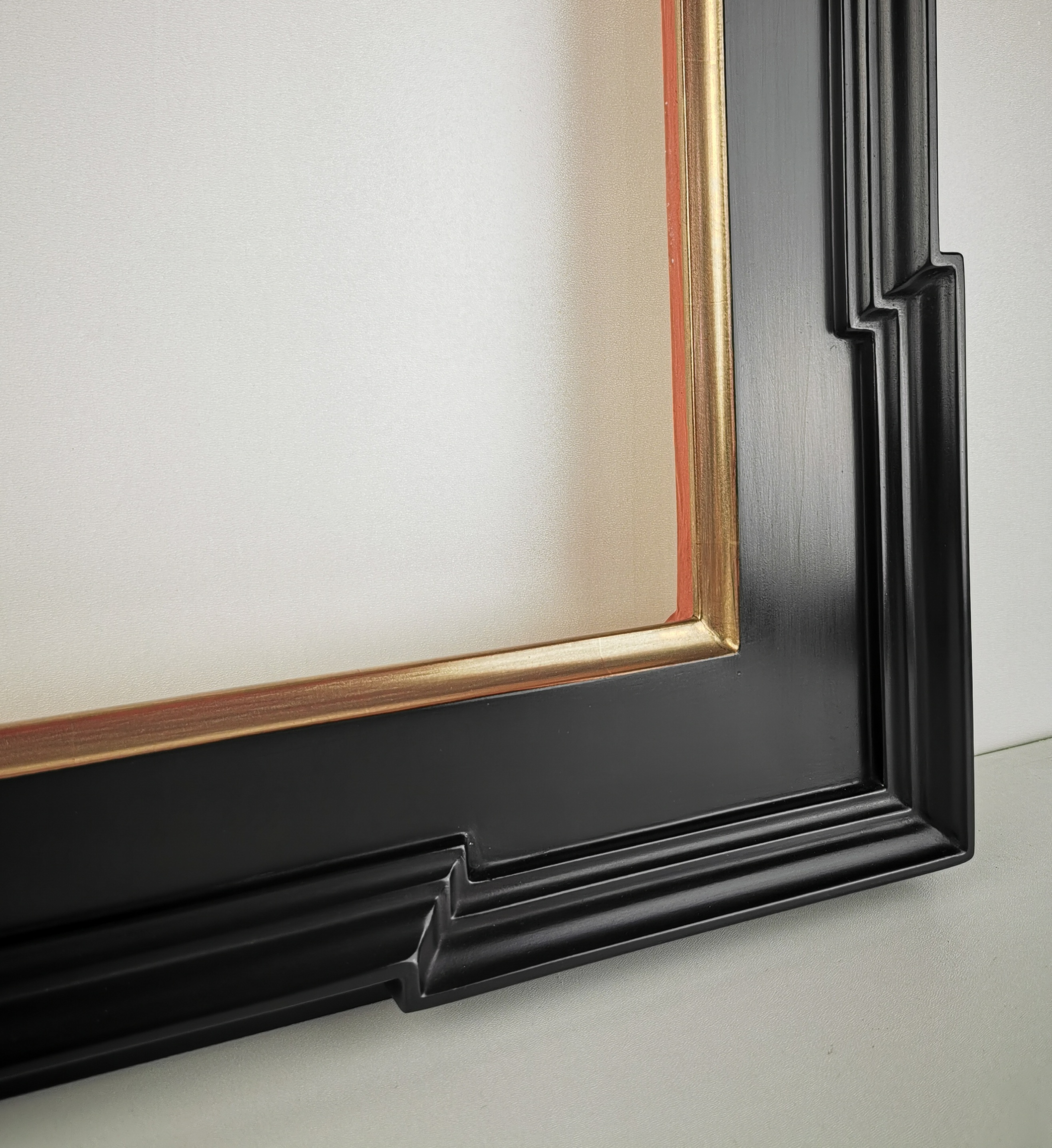
Casina 2 – Classic Picture Frame in Moon Gold on a Red Clay Base
Casina 2 is a classic picture frame in moon gold over red bole, and it is one of the profiles I come back to most often when a painting needs weight without noise. The leaf is 22 carat moon gold, laid by hand over a red clay bole on a chalk gesso ground, and the corners are worked in the Flemish manner rather than simply mitred and left plain. What follows is a walk through how that frame is actually built in my workshop, and why every layer underneath the gold changes what you finally see on the wall.
What the Casina 2 profile actually is
The profile is drawn as a sequence of planes rather than a single moulding. From the outside, the edge steps down through a cascading cyma, a run of narrow falls broken by a soft curve. That cyma drops into the dominant frieze, a wide and almost flat field that carries most of the frame's visual mass. At the sight edge the frieze turns into a narrow rounded bead, and it is that bead which catches the light and leads the eye into the picture.
The drawing is not invented. It follows the framing traditions of seventeenth and eighteenth century Flanders and northern Italy, where gilders and carvers built frames that supported a painting and stood as objects in themselves. I mill the profile from solid timber, cut and mitre it to the exact size of the work, and join the corners with biscuit joints so the frame stays flat and true across large spans. Casina 2 sits inside the wider family of made to measure picture frames I build, and it belongs to the same lineage as the other classic picture frames in the workshop.
Flemish corners, and why they change the whole frame
A Flemish corner is a corner that has been worked, not just closed. Instead of two lengths of moulding meeting at forty five degrees and stopping there, the profile is shaped so the corner reads as a deliberate event: the planes turn, the frieze widens, and the ornament resolves rather than running off the end of the stick.
This matters for two reasons. First, the eye always goes to the corners of a rectangle, so a corner that is composed rather than merely cut lifts the whole frame. Second, a worked corner needs the frame to be finished after assembly, not before. Ready made mouldings are gilded in the length and then chopped, which leaves the joint visible as a break in the gold. A Flemish corner has to be gessoed, boled and gilded once the frame is already joined, so the gold runs across the mitre without interruption. That is what the trade calls closed corner construction, and it is the reason these frames cannot be assembled from stock lengths.
Flemish corners are sometimes confused with the Dutch reverse profile, which is a different idea altogether. There the drama lies in the section, in a moulding that leans back towards the wall rather than towards the viewer. I have written separately about Dutch frames and the reverse profile if you want the distinction in full. The short version: Dutch frames are defined by their section, Flemish frames by their corners.
The chalk gesso ground beneath the gold
Everything that makes a water gilded frame look the way it does happens before any gold appears. Gesso is a warm mixture of animal glue and chalk whiting, brushed onto the bare timber in thin successive coats. I lay on somewhere between eight and twelve, each one going off before the next arrives, until the timber grain has disappeared under a solid white body.
That body is then cut back by hand until it is glass smooth. This is the slowest and least glamorous stage of the work, and it is the one that decides everything afterwards. Gold leaf is a few ten thousandths of a millimetre thick, so it hides nothing at all. A scratch left in the gesso will still be a scratch under the gold, and a soft dip in the frieze will read as a dull patch in the finished frame no matter how good the gilding is.
A gesso frame, then, is not a frame with a coating on it. It is a frame whose entire surface is a separate sculpted material sitting on top of the timber, capable of being carved, recut and burnished in ways that paint on wood never can be. It is also why these frames can be repaired: the gesso can be locally rebuilt and regilded decades later without touching the timber underneath.
Why the bole under the gold is red
Once the gesso is cut back, I brush on bole. Bole is an extremely fine clay, ground and bound in weak glue, and it does two jobs. It gives the leaf something soft to bed into when the surface is rewetted, and it supplies the colour that will glow through the metal.
Gold leaf is translucent. Whatever sits underneath it will change how it reads. Red bole, the traditional choice under warm golds, pushes a deep amber warmth up through the leaf and makes the burnished areas look lit from within rather than simply shiny. It also matters at the wear points: on the high edges of the cyma and the bead, where the gold is naturally thinnest and where a frame will be handled over its life, that red glows through as a fine warm line. Antique gilded frames read the way they do largely because of this.
Red is not the only option. Yellow bole gives a flatter, brighter gold that stays cool and even, and it is what I use when a painting needs the frame to recede. Black or grey bole under white gold produces a silvered, almost pewter effect. Blue bole is the traditional ground under silver and palladium. The choice of bole is a real decision about how a finished frame will sit against a specific painting, and I make it case by case across the gold gilded picture frames I build.
22 carat moon gold, and how it differs from yellow gold
Moon gold is genuine gold leaf at 22 carat, alloyed so that it reads noticeably paler and cooler than standard yellow leaf. Beside 23.75 carat gold it looks almost lunar, which is where the name comes from, and it has a slightly greenish, silvery cast in daylight that flatters cool palettes.
The practical difference is which paintings it serves. Full 23.75 carat yellow gold is rich and unmistakably warm, and it is superb on old master work, gilded religious panels and anything with an amber varnish. Moon gold gives the same depth of real metal but without pushing warmth into the picture, so it works with cool blues and greys, modern figurative painting, black and white photography and contemporary abstract canvases that would fight with yellow gold. Alongside these I also gild in 12 carat and 6 carat white gold, which take the tone further towards silver again.
All of these are genuine metal leaf, which is worth saying plainly because a great deal of what is sold as gilded is not gold at all. If you want the full comparison, I have set out the differences between genuine gold leaf and imitation metal leaf in a separate article. Casina 2 is also frequently made as a part gilded frame, with a painted frieze and only the cyma and bead in leaf, and those variants live in the painted and partially gilded frames category.
Water gilding, burnishing and the two sheens
The leaf is laid by water gilding, which means the bole is wetted with dilute alcohol and size and the leaf is drawn down onto it from a gilder's tip. The glue in the bole softens, the leaf sinks into the clay, and as it dries it is pulled tight against the surface.
What that allows, and what no other gilding method allows, is burnishing. Once the surface is dry, an agate stone is worked over the gold until the metal is compressed into a mirror bright polish. Oil gilding cannot be burnished at all, because the leaf sits on a film of oil size rather than on a compressible clay body, and it stays matt for ever.
On a Casina 2 I almost never burnish the whole frame. The bead at the sight edge and the high points of the cyma are taken to full polish so they throw light towards the picture, while the frieze is left matt so it holds the composition steady. That contrast between burnished and matt gold, on one continuous surface and in one metal, is the thing that separates a hand gilded frame from a gold coloured one, and it is difficult to photograph and immediately obvious in a room.
Which artworks suit a Casina 2
This profile carries weight, so it wants a work that can hold its own. It sits particularly well on oil paintings on canvas, on portraits, on old master copies and on sacred and devotional works, and I build it regularly for collectors framing a single significant painting rather than a wall of prints. If that is the case for you, the notes on framing oil paintings cover stretcher clearance, rebate depth and fixing.
Where the work is on paper, or where a canvas is old, fragile or of real value, the frame is only half the job. Conservation grade mounting, spacers that keep glazing off the surface, ultraviolet filtering glass and reversible fixings all belong to the same commission, and I set that out under archival and museum framing. A gilded frame around an unprotected work is a false economy.
The same profile, made as a mirror
Casina 2 is not only a picture frame. Because the profile is milled and the corners worked before finishing, exactly the same drawing can be made up as a mirror at any size, with the rebate milled deeper to take a mirror panel instead of a stretcher.
Gilded in moon gold over red bole, a Flemish corner mirror is a very different object from a plain rectangle of glass: the gold picks up whatever light the room already has and redistributes it, which is why these profiles do so much work over a fireplace, in a dining room or on a dark landing. I make them to measure using low iron mirror glass so the reflection stays neutral rather than going green at the edges. The equivalent pieces sit under mirrors in frames and, for the more ornamental finishes, under decorative mirrors.
Commissioning a Casina 2 to your own dimensions
Every frame is built for one specific work, so the starting point is the artwork rather than a size chart. What I need from you is the height and width of the piece, whether it is a stretched canvas, a panel or a work on paper, its depth if it is on a stretcher, and a photograph of the work itself. From there I can advise on frame width, on whether red or yellow bole suits the palette, and on whether full gilding or a part gilded finish will serve the picture better.
Finish is agreed from photographs of frames I have already made, so you see the actual gold and the actual burnish on a real frame rather than a swatch. The commissioning process is described in more detail on the bespoke picture frames page, current build times are on the lead time page, and dimensions and photographs can go straight to me through the contact page.
Questions I am asked about gesso, bole and Flemish corners
What is a gesso frame?
A gesso frame is a frame whose surface is built up in layers of animal glue and chalk whiting before it is finished, rather than being painted or foiled directly onto bare timber. The gesso is sanded to a glass smooth body and then either gilded or painted. It is the traditional ground for water gilding, and it is what allows a frame to be recut, repaired and regilded generations later.
What are Flemish corners on a picture frame?
Flemish corners are corners in which the profile is shaped and resolved at the mitre rather than simply cut through it, following seventeenth and eighteenth century framing practice in Flanders and northern Italy. Because the ornament has to be completed after the frame is joined, a Flemish corner frame is finished as a whole, so the gold runs continuously across the joint.
Why is the bole under gold leaf red?
Gold leaf is translucent, so the clay beneath it colours the metal. Red bole pushes a warm amber tone up through the gold and makes burnished areas look lit from within. It also shows as a fine warm line where the leaf wears thin on high edges, which is a large part of why antique gilded frames look the way they do.
Is moon gold real gold?
Yes. Moon gold is genuine gold leaf at 22 carat, alloyed to read paler and cooler than standard yellow leaf. It is not an imitation metal and it does not tarnish, so it needs no lacquer over it.
Can a water gilded frame be repaired later?
It can, and that is one of the real arguments for building this way. Damaged gesso can be locally rebuilt, reboled and regilded so the repair disappears into the original surface, which is exactly the approach I take when restoring and regilding antique frames. A gold coloured finish sprayed onto bare timber cannot be repaired in the same way.