Bevelled Mirrors in Beautiful Frames: How a Faceted Edge Catches the Light
A bevelled mirror is one of those quiet details that changes a room the moment light reaches it. Instead of a flat sheet of glass, the edge is ground and polished at a shallow angle, so it behaves almost like a prism: light bends across the facet and scatters soft reflections back into the space. In my workshop I make bevelled mirrors to measure and set them in frames I build and finish by hand, and that is where a simple mirror becomes something worth looking at, not only looking into.
What a bevelled edge actually is
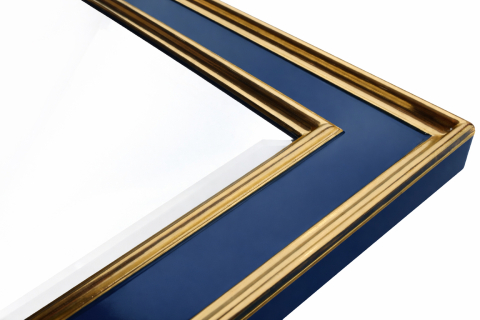
A bevel is a band running around the perimeter of the glass that has been ground down at an angle and then polished until it is perfectly clear. Catch it from the side and you see a slim, faceted border that refracts the light; face it straight on and the reflection sits a fraction deeper, framed by a faint line of brightness. A flat or pencil-edge mirror reflects cleanly but flatly. A mirror with a bevelled edge adds depth, a sense of weight and a quiet sparkle along its border.
I grind and polish the bevel on 4 mm and 5 mm glass, and for the clearest result I recommend OptiWhite low-iron glass. Ordinary float glass carries a faint green tint that shows most on a cut edge, so the bevel can read as a greenish line. Low-iron glass removes that cast, and the facet reads as clean light and true colour instead.
How a bevelled mirror changes a room
A well-placed mirror does far more than show your reflection. It borrows light from a window or a lamp and spreads it, so a room feels brighter and larger than it is. A bevelled edge takes this further: the facet picks up daylight and lamplight and returns it as soft highlights, which is why a bevelled mirror often works like a decorative panel or a piece of art on the wall. Set above a console, a sideboard or a fireplace, it becomes the point your eye keeps returning to.
Choosing the width of the bevel
The width of the bevel sets the whole character of the piece. As standard I offer a ground bevel up to around 20 mm wide, and up to 25 mm on larger mirrors. A narrow bevel of roughly 10 mm is understated and elegant, suited to calm, modern interiors. A wide bevel of 20 mm to 25 mm is a clear decorative statement and catches noticeably more light. One detail worth knowing: the visible width is always a little less than the cut width once the mirror sits in its frame, so a 20 mm bevel typically reads at about 15 mm. For larger mirrors I usually suggest 5 mm glass, which is more rigid and gives the facet more depth. If you like the Venetian look, I can also bevel a central field and leave the outer panels plain.
Pairing a bevelled mirror with the right frame
This is the part I care about most, because a bevelled mirror deserves a frame made to suit it rather than a standard moulding cut to length. I build my frames from solid wood, carve the profiles myself and finish them by hand. That might mean traditional water gilding with genuine gold leaf laid over a clay (bole) ground, a cooler white gold, a decorative painted finish, a black and gold glamour look, an aged silver or a soft, distressed white. Because I make every framed mirror to order, the bevel and the frame are chosen together: a wide bevel under a richly gilded, decorative frame for a classic, glamour feel, or a slim bevel inside a clean profile for something more contemporary. A rectangular mirror sits naturally above furniture, while a round or oval shape softens a scheme. You can see the range of hand-finished frames among my mirrors in frames.
Bevelled mirrors room by room
In a living room, a large bevelled mirror in a gilded frame makes an easy centrepiece above a console or sofa, adding both light and a sense of occasion. In a hallway or entrance, the same idea lengthens a narrow wall and bounces daylight into a space that often has none of its own. In a bathroom I make the mirror from OptiWhite glass for a clean, true reflection and can fit a concealed anti-fog heating mat so the surface stays clear after a hot shower. Whatever the room, the mirror is cut to your wall and the frame finished to your scheme.
Made to measure in my workshop
Every mirror I make can be ordered with a bevel of the width you choose, in the size you need, set in a frame finished entirely by hand. Because I work alone, from cutting the glass and grinding the bevel through to gilding the frame, I can match the facet, the glass and the finish to your room rather than to a catalogue. Tell me your dimensions and the look you are after, and I will build a bespoke, bevelled mirror that suits the wall it is going on.