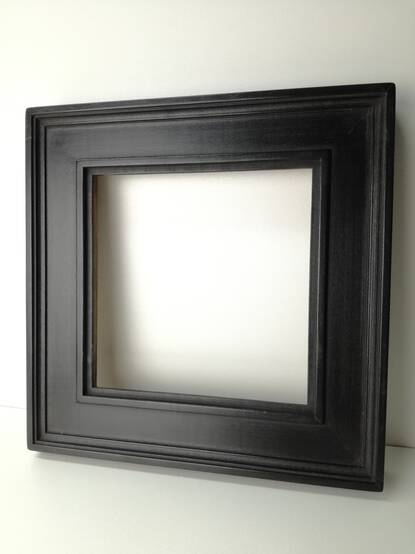
Black wooden picture frame with visible wood grain
- Add feedback:
- Code: 242T
- Manufacturer: Karol Milewski
-
Availability:
 Exists
Delivery time: 20 - 30 working days
- pcs.
- €136.11
A black wooden picture frame with the grain left visible: I paint the 56 mm moulding, about 2¼ inches, by hand in thin layers of black and polish it with wax to a soft satin sheen. Solid, low-tannin timber, made to measure for paintings on stretched canvas.
A black wooden picture frame in which the timber stays part of the design. I paint the moulding by hand in several thin layers, so the grain keeps reading through the colour, then polish it with wax to a soft satin sheen. The face is 56 mm across, about 2¼ inches, and sits slightly dished, which is what keeps the black from looking like a uniform factory surface. It is made to measure from solid timber for oil and acrylic paintings on stretched canvas, framed without glazing, and it stands between the painted profiles in my black picture frames and the natural-wood tradition.
Moulding profile
At the sight edge the moulding rises in two low steps to a narrow flat. Behind that flat the surface drops one small step onto the broad flat that takes up most of the 56 mm width, and this is where the grain shows most clearly under the black. Towards the outside the broad flat lifts into a shallow cavetto, a concave quarter-round that climbs gently and is closed by a small step, and then runs out onto the flat outer edge, the highest point of the section. The outer flank is flat and drops vertically to the wall. Because the broad flat lies lower than both the narrow flat and the outer edge, the face of the moulding reads as slightly dished.
Specification
- Style: black wooden frame, grain left visible under the paint
- Finish: hand painted black, polished with wax, satin sheen
- Moulding width: 56 mm, about 2¼ inches
- Moulding thickness (face to back): 32 mm in the version for 10 mm artwork, 37 mm in the version for 20 mm artwork
- Rebate: 7 mm wide; two depths in the ordering menu, for artwork 10 mm or 20 mm thick
- Material: solid, low-tannin timber of the kind used in museum and conservation work
- Corner joinery: mitred at 45 degrees and reinforced with wooden splines
- Glazing, backing and mat: available as additional options, quoted separately
- Artwork retention: sprung clips as standard; brass plates with screws on request
- Hanging: cord as standard, portrait or landscape chosen when ordering; single D-ring on request
- Use: oil and acrylic paintings on stretched canvas, canvas prints, works framed without glazing
- Lead time: 20 to 30 working days
The dimensions you order refer to the artwork. Each frame is made 2 to 3 mm larger than the canvas for an easy fit, with the sight edge overlapping the artwork by roughly 4 to 5 mm.
Which artworks and interiors it suits
Black with visible grain is an unusually flexible combination. It frames oil and acrylic paintings on stretched canvas without competing with the palette, and I cover the choices behind that in my notes on framing oil paintings. It gives monochrome photography and graphics a defined, gallery-style border, and it works equally well around canvas prints. In a room it reads as a natural material rather than a lacquered object: at home in modern and Scandinavian interiors, in industrial spaces where timber softens the setting, and on a classic gallery wall where black frames have always hung.
Craftsmanship and finishing
Each frame starts as solid timber with a low tannin content, of the kind used in museum work and art conservation, chosen because it stays dimensionally stable and will not bleed acids into the frame over time. I cut the corners at 45 degrees and reinforce them with wooden splines before any finish goes on, so the joint is structural rather than cosmetic and the geometry holds at large formats. The black is then built up by hand in several thin layers from a curated, richly pigmented paint range, laid straight onto the wood so the grain keeps showing through the colour instead of disappearing under it. Finally I polish the surface with wax, which gives the satin sheen and a finish that is pleasant under the hand. The timber is chosen for stability rather than for showy figure, so what comes through the black is a fine, even texture rather than a heavy pattern, and it shifts slightly from one length to the next. I write more about that way of working in my guide to handmade wooden picture frames.
How it differs from mass production
A mass-produced black frame is usually a foil-wrapped or spray-lacquered length: the surface is uniform, the corners are stapled, and the material underneath is often not wood at all. Here the moulding is cut from solid timber, the corners are mitred and splined, the black is painted by hand in layers, and the grain you see is the real structure of the wood rather than a printed pattern. The frame is also built to the size of your painting instead of to a shelf standard.
Functionality
The frame is supplied without glazing and without a backing board, prepared for a painting on a stretcher or another support that does not need to be covered. The rebate depth is chosen from the menu when you order, for artwork 10 mm or 20 mm thick, and the sprung clips make it easy to take the work out or swap it later. If you would rather the canvas edges stayed visible, I can make the same moulding as a floating frame; how that construction works is explained in my article on floating picture frames for canvas art.
Common questions
Will the grain look the same on every frame?
Not exactly. The paint is thin enough for the structure of the wood to come through, and that structure follows whatever length of timber your frame is cut from. It is a fine, even grain rather than a heavy figure, so expect the same depth of black and the same sheen every time, with a texture that is individual to your frame.
What thickness of stretcher does it take?
Two rebate depths are offered in the ordering menu, for artwork 10 mm and 20 mm thick. If your stretcher bars are deeper than that, send me the measurement and I will cut the rebate to suit.
Can it be supplied with glazing?
Yes, although this profile is designed for canvas framed open. If the work is on paper I can add conservation-grade low-reflection UV glazing, an acid-free mat and an archival backing, quoted for the size of your piece.
Complete framing – additional options
Every frame I make can be completed with full archival and museum-quality framing: anti-reflective UV-filtering glass (four classes to choose from), acid-free museum mat board, spacers wrapped in acid-free paper and a Dibond backing. This kind of mounting protects the work from light, acids and distortion. I set out the full glass and material specification on a separate page: archival and museum framing for paintings and photographs. All components are available at extra cost, as an individual quote on request.
Mounting and hanging
I hold the painting in the frame with sprung clips that turn aside when you change the work, which makes the frame easy to handle. On request I fit permanent, screwed brass plates instead. For hanging, I attach cord as standard, in portrait or landscape orientation; a single D-ring on request.
Ordering made to measure
The base price shown on the site is the price per running metre of moulding. The perimeter of the painting is not the full length the frame needs: corners cut at 45 degrees take extra length, and the wider the moulding, the more they take. The calculator accounts for the full moulding consumption with corners and for any options you choose, so you only need to enter the dimensions of your painting to within 0.1 cm. For this moulding width the calculator handles artworks up to 180 cm around the perimeter; anything larger is made to individual order, so send me the dimensions and I will price it. The lead time is 20 to 30 working days.