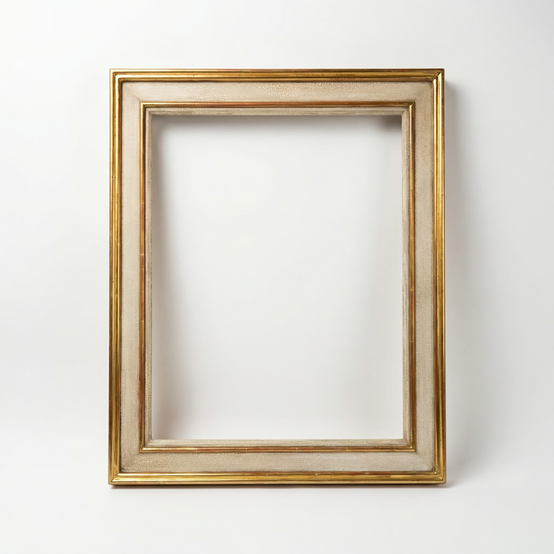
White and gold picture frame with 23-karat gold leaf
- Add feedback:
- Code: 294
- Manufacturer: Karol Milewski
-
Availability:
 Exists
Delivery time: 20 - 30 working days
- pcs.
- €247.22
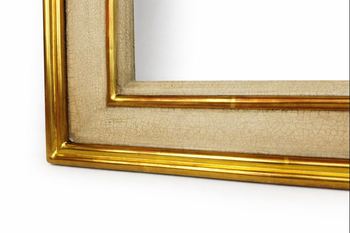
A white and gold picture frame made to measure: a wide, flat canted frieze in off-white, closed on either side by beads of genuine 23-karat gold leaf water-gilded over red bole. A fine, controlled craquelure across the white and the warm glow of burnished gold make a classic gallery frame for oil paintings and works on canvas.
Light, but never cold. This white and gold picture frame sets a warm off-white face between slim beads of genuine 23-karat gold leaf, laid by hand over red bole. The wide, flat frieze rises towards the outer edge, so the moulding funnels the eye inwards and gives a painting a calm, gallery-like setting, while a fine craquelure across the white surface lends a softly antiqued character. I build each frame to the size of the artwork, so it works as a white picture frame with the presence of classic, museum-style framing: made to serve the work rather than compete with it.
The moulding profile
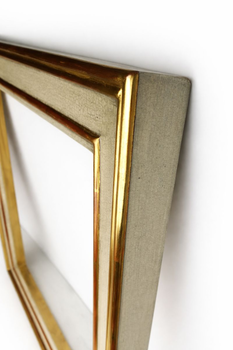
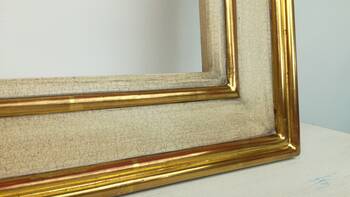
Read from the rabbet outwards, the moulding opens with a shallow hollow at the sight edge, which runs smoothly into a single bead. Beyond it the frieze opens up: a completely flat, canted plane that rises steadily towards the outer edge, where a pair of beads closes it at the very top of the moulding. That pair is the crown of the section. The beads are the gilded elements, warmed by a thin line of red bole that reads through the gold in places, while the frieze between them carries the off-white and the network of controlled craquelure. The flank of the frame is chamfered, cut back at an angle towards the wall. The section measures roughly 60 mm wide and 38 mm deep, so the frame has real presence and reads clearly from the side as well. The profile itself is machine-milled; everything after that, the ground, the paint, the craquelure and the gilding, is done by hand.
Specification
- Style: classic, gallery, softly antiqued
- Profile: shallow hollow and a single bead at the sight edge, flat canted frieze, a pair of beads at the outer edge, chamfered flank, machine-milled
- Finish: off-white with a fine, controlled craquelure, sealed with traditional shellac and wax
- Gilding: water gilding in genuine 23-karat gold leaf over red bole, burnished with an agate stone, sealed with traditional shellac and wax
- Moulding width: approx. 60 mm
- Moulding depth: approx. 38 mm
- Rabbet: 7 mm wide × 20 mm deep, for artworks up to 20 mm thick; the frame made 2–3 mm larger than the work
- Material: solid, low-tannin timber used in museum and conservation work
- Corners: mitred at 45° and reinforced with wooden splines
- Glass: optional, four classes (see complete framing below)
- Backing: optional, 3 mm Dibond aluminium composite
- Mount: optional, acid-free foam board
- Fixing and hanging: spring clips fitted as standard; portrait or landscape chosen with the order
- Suitable for: oil and acrylic paintings on canvas, works on paper, photography
- Lead time: 20–30 working days
Order by the size of the artwork itself, not the size of the frame you want. Measure the canvas or panel to within a millimetre and enter those figures: I add the 2 to 3 mm of clearance myself, so there is nothing for you to add on.
Which paintings and interiors it suits
The warm white and the wide flat frieze work beautifully with oil paintings and acrylics on canvas, particularly landscapes, still lifes, portraits and compositions with a classic feel. A light frame opens up the darker passages of a painting and lets the composition breathe, which is also why it suits prints, watercolours and fine-art photography once glass and a mount are added. In an interior it brings classic and light together: an elegant living room, a French or transitional scheme, a gallery wall or a formal room. For canvases in oil I set out how I approach the job on a separate page: framing oil paintings.
How I make and finish it
The moulding is milled from solid timber, then cut and assembled into the complete frame before any painting or gilding begins. The corners are mitred at 45° and reinforced with wooden splines, which gives a rigid, dimensionally stable structure. Only once the frame is fully assembled do I build up the finish: layers of gesso and bole, the off-white paint, the controlled craquelure, then the gold.
The gilding is done by water gilding in genuine 23-karat gold leaf over red bole, which gives a warm tone and natural variation across the surface. I burnish the beads with an agate stone until they take a bright, almost mirror-like shine, and the red bole reads through here and there, which is what tells you the gold was laid by hand. The craquelure across the white face is kept fine and controlled, adding depth rather than noise. Both the white face and the gold are sealed with traditional shellac and wax, which leaves a satin sheen across the white and holds the craquelure in place. What hand gilding actually brings to a frame is set out here: gold picture frames. Small differences of finish between frames are a normal feature of work made entirely by hand.
How it differs from mass production
In mass production, lengths of moulding are finished first and joined into a frame afterwards. I work the other way round: I build a fully assembled, well-fitted structure, then paint, craquelure and gild the finished form. It takes longer and it is harder to do, but it gives an unbroken finish across the corners and a frame that does not open along the joints as the years pass. Water gilding in genuine gold leaf is a craft technique rather than a print or a foil, and that is where the depth and the glow come from.
Functionality
The frame is made first of all for paintings on canvas and panel, without glass. Spring clips are fitted at the back as standard, so you can insert the work and swap it later yourself, with no tools. The rabbet is 7 mm wide and 20 mm deep, which takes a standard stretcher or panel up to 20 mm thick and leaves roughly 4 to 5 mm of the painting covered along each edge. For a deeper contemporary stretcher the same moulding can be made as a floater frame, without a rabbet, with the canvas edges visible and a narrow gap between canvas and frame: I explain that construction in the guide to floating picture frames for canvas art. If you intend to frame under glass, the archival options are set out below.
Frequently asked questions
Is the gold real? Yes. The beads are gilded in genuine 23-karat gold leaf, laid on a wet bole ground and burnished with an agate stone. It is not a gold-effect paint and not a foil.
Will it take my stretcher? The rabbet is 20 mm deep, so it takes a standard stretcher or a panel up to 20 mm thick. If your canvas is on a deeper stretcher, I can make the same moulding as a floater frame instead.
Is the craquelure printed on? No. It develops in the paint layer itself during finishing, so the pattern is different on every frame and follows the shape of the moulding.
Can I have it in a different white? The face is an off-white rather than a bright white. If you need a cooler or warmer shade, or a different bole colour under the gold, tell me when you order and I will match it.
Is the frame made to measure? Yes. Each one is built to the size of your painting, with a technical allowance of 2 to 3 mm, so there is no need to look for a standard format.
Complete framing – additional options
Every frame I make can be completed with full archival and museum-quality framing: anti-reflective UV-filtering glass (four classes to choose from), acid-free museum mat board, spacers wrapped in acid-free paper and a Dibond backing. This kind of mounting protects the work from light, acids and distortion. I set out the full glass and material specification on a separate page: archival and museum framing for paintings and photographs. All components are available at extra cost, as an individual quote on request.
Fixing and hanging
As standard the painting is held by spring clips, factory-fitted: they rotate, so swapping the work is quick. On request I prepare brass plates with screws, supplied loose for a permanent fixing you fit yourself. For hanging there is a picture cord as standard; a single D-ring is fitted on request, and portrait or landscape orientation is chosen with the order.
Made-to-measure ordering
The base price shown is the price per running metre of moulding. The perimeter of the painting is not the whole length the frame needs: the 45° mitres take extra length, more so the wider the moulding. The calculator accounts for the full use of moulding with the mitres and any options, and it handles paintings up to 120 × 80 cm; larger formats are made to individual order. The lead time is 20 to 30 working days.