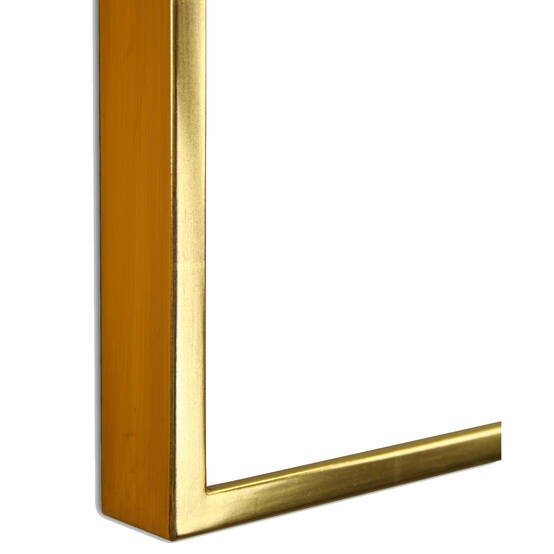
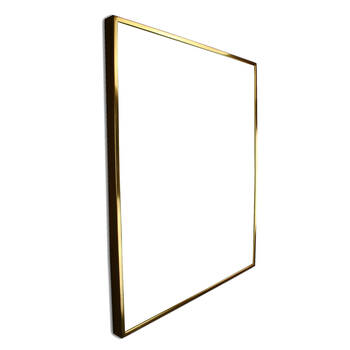
Thin gold picture frame, 13 mm moulding in 23-karat gold leaf
- Add feedback:
- Code: 140
- Manufacturer: Karol Milewski
-
Availability:
 Exists
Delivery time: 20 - 30 working days
- pcs.
- €191.67
A thin gold picture frame with a 13 mm face, water gilded by hand in 23-karat gold leaf over red bole, with the sides hand painted in yellow ochre. Behind that thin face the moulding is 38 mm thick, with a 30 mm rabbet that takes a deep stretcher, so the frame reads as a fine gold line and still holds a substantial canvas. I make each one to measure for a single work.
A 13 mm face is about as thin as a gilded moulding gets, and the whole of it carries real gold: 23-karat leaf laid on water over red bole. This is a frame for paintings that want a gold edge rather than a gold border. What the front does not show is the depth behind it, 38 mm from face to back with a 30 mm rabbet, so a thin gold line can still hold a substantial canvas. It is the thinnest section I gild in my range of gold gilded picture frames, and I make each one to measure for a single work.
The moulding profile
The face is flat and smooth, 13 mm wide, and gilded across its full width. From its outer edge the lateral flank drops square through the whole 38 mm thickness of the section, and that flank is hand painted in yellow ochre, a tone close to the gold itself. The moulding is nearly three times thicker than it is wide, so from the front it reads as a fine gold line and from the side as a tall, straight edge. The profile is machine-milled; everything that happens on its surface afterwards is done by hand.
Specification
- Style: plain thin profile, deep section, machine-milled
- Face finish: 23-karat gold leaf on red bole, water gilded, sealed with traditional shellac and wax
- Moulding width: 13 mm
- Moulding thickness (face to back): 38 mm
- Rabbet: 7 mm wide × 30 mm deep, so the maximum artwork thickness is 30 mm
- Side finish: hand painted in yellow ochre, sealed with shellac and wax; black or any other colour to order
- Material: timber with a low tannin content, of the type used in museum and conservation framing; oak or American walnut to order with the side left exposed and finished in French polish or shellac and wax
- Joinery: mitred at 45° and reinforced with timber splines, before any ground is applied
- Gilding: water gilding, 23-karat gold leaf laid one leaf at a time over gesso and red bole
- Object framing: with spacers fitted the frame will close over an object up to about 20 mm thick
- Customisation: side colour, timber species, a different moulding width or thickness to individual order
- Glass, archival backing and matting: available as an add-on, outside the order menu
- Mounting and hanging: sprung clips as standard, brass plates on request; picture wire as standard, single D-ring on request; portrait or landscape chosen when you order
- Lead time: 20 to 30 working days
- Suitable for: oil and acrylic on stretched canvas, photography and prints on a rigid support, textiles framed with spacers; supplied without glass as standard
You give the calculator the dimensions of the artwork, not of the finished frame. I build the frame 2 to 3 mm larger than the size you enter, so the work seats without strain, and the moulding then overlaps the artwork by about 4 to 5 mm.
What it suits
A thin frame closes the work and leaves the attention on the painting. It earns its place where a wide moulding would smother the composition: small and medium formats, densely worked surfaces, abstraction, landscape in a restrained palette, still life, an intimate portrait. It takes oil and acrylic on stretched canvas, and equally photography or prints mounted on a rigid support.
Gold over red bole gives a warm, deep tone with a little of the red showing through the metal. That colour sits with earth, ochre, sienna and warm green, and against cool, grey or blue-grey work it reads as deliberate contrast. On the wall a thin gilded line draws a fine bright edge around the picture, which is why it works as well in a dense classical hang as on white plaster in a minimal room.
How I make it
I start from the milled profile and cut the lengths at 45°. The corners are joined and reinforced with timber splines, always before any ground goes on, so the joint behaves as one body rather than four glued sections. Only then does the gesso go on, coat after coat, smoothed back to an even, closed surface. On a 13 mm face any flaw in the ground would run the whole length of the moulding.
Over the gesso goes the bole, the gilding clay, red in this case, and it is the bole that decides the final tone of the gold. The gilding is done on water, leaf by leaf with a small overlap, in 23-karat gold. A sheet of leaf measures roughly 80 × 80 mm, so for a face this thin I cut it on the gilder's cushion with a knife and lay each piece individually. The gold is then sealed with shellac and wax, and the sides I paint by hand in yellow ochre. I set out the technique itself on my page about water gilding.
How this differs from a factory frame
Frames sold as gold usually are not. Ready-made mouldings are finished with metallic paint or with imitation leaf pressed from a copper and zinc alloy, which darkens and dulls over the years. Here the face carries metal rather than pigment: real gold leaf laid on water over gesso and bole. The difference shows in the depth of the reflection and in the way the surface answers changing light. I go through how to tell the real thing from the imitation in my guide to telling genuine gold leaf from imitation.
The second difference is dimensional. The frame is built to the measurements of one painting rather than cut down from a stock length in fixed sizes.
What the frame takes
The frame is supplied without glass, as a mount for a canvas on a stretcher. A 30 mm rabbet is unusual behind a moulding this thin: it swallows deep stretchers, heavy-section bars and work mounted on a rigid support. The painting sits inside the frame across its full thickness, so from the side you see the moulding alone.
Those same 30 mm open a second use. With spacers fitted I can build a chamber inside the frame for an object up to about 20 mm thick: a textile, an embroidery, a piece on a soft support, with the glazing held clear of its surface.
The sides can also be painted black or in any other colour. I can cut the moulding in oak or in American walnut and leave the side exposed, with the grain visible and the surface finished in French polish or in shellac and wax, so a gilded face meets figured timber in a distinctly contemporary pairing. A different moulding width or thickness is possible, as is a version without a rabbet, made as a floating frame in which the canvas hangs inside the frame with a visible gap around its edge. I describe that construction in my guide to floating frames for canvas art.
Complete framing – additional options
Every frame I make can be completed with full archival and museum-quality framing: anti-reflective UV-filtering glass (four classes to choose from), acid-free museum mat board, spacers wrapped in acid-free paper and a Dibond backing. This kind of mounting protects the work from light, acids and distortion. I set out the full glass and material specification on a separate page: archival and museum framing for paintings and photographs. All components are available at extra cost, as an individual quote on request.
Mounting and hanging
As standard the frame is fitted with sprung clips, which turn to release and make it easy to change the canvas. On request I fit brass plates with screws instead, supplied loose for you to install for a permanent fixing. For hanging, the frame takes picture wire as standard, with a single D-ring hanger available on request; you choose portrait or landscape orientation when you order.
Ordering to measure
Measure the artwork to the millimetre and enter those dimensions in the calculator on this page. The calculator handles formats up to 120×80 cm; larger sizes I make to individual order. The side colour, the timber and any non-standard section are agreed with me when the order is placed.
The base price shown on the page is the price per running metre of moulding. The perimeter of the artwork is not the full length of moulding a frame needs: the corners, cut at 45°, take up additional length, and the wider the moulding, the more they consume. The calculator accounts for the full run of moulding including its corners, together with the fittings and options you choose. Glass, archival backing and matting are quoted separately.
Lead time is 20 to 30 working days. If your order is tied to a date, an exhibition or a gift, get in touch before you order and I will tell you what is realistic.