Deep White Gold Picture Frame for Canvas
- Add feedback:
- Code: 57
- Manufacturer: Karol Milewski
-
Availability:
 Exists
Delivery time: 20 - 30 working days
Exists
Delivery time: 20 - 30 working days
- pcs.
- €244.44
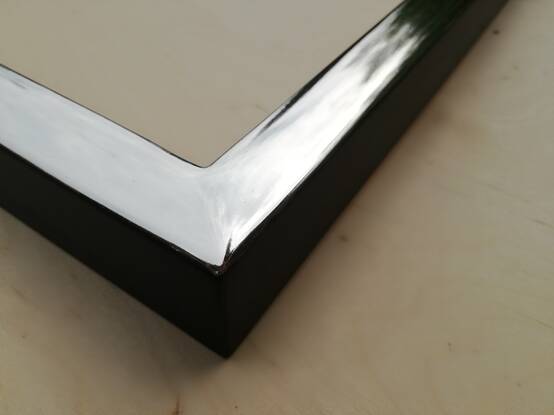
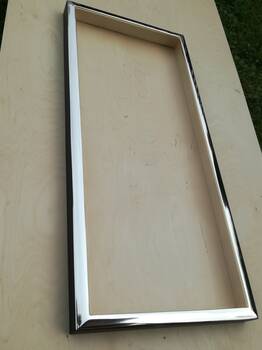
A narrow, deep moulding: 22 mm across the face, 48 mm from face to back, with a 42 mm rabbet that takes thick stretcher bars. The face is water gilded with 6-karat white gold leaf, the sides are finished in satin black. I make each frame to the size of one particular painting.
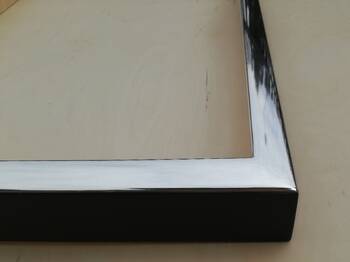
This is one of the narrowest and at the same time deepest mouldings in my workshop. The face measures only 22 mm across, the frame stands 48 mm off the wall, and the 42 mm rabbet takes stretcher bars thicker than a standard gallery frame will hold. The painting gains a clear metallic border and gives up almost nothing of its own surface. The face is water gilded with 6-karat white gold leaf and the sides are finished in satin black, which places it among my gilded and partially painted picture frames.
Frame profile
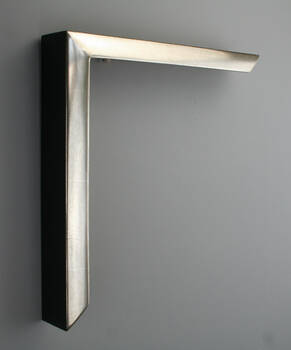
The highest point of the profile is the edge next to the artwork. From there the face falls away towards the outside of the moulding in a convex curve, and the swell of that curve sits below the level of the inner edge. It is the reverse of the usual gallery arrangement: the full height of the profile is at the painting, not at the outer margin. An outer edge closes the curve.
Reversing the direction has a practical consequence. The moulding does not overhang the work and casts no shadow across it, and the eye is led from the outside inwards. I write about this family of shapes in more detail in my guide to reverse and coved frame profiles.
Specification
- Style: modern, minimalist, reverse profile
- Face finish: water gilded with 6-karat white gold leaf over a gesso and bole ground
- Side finish: black with a satin sheen, oak burr or another decorative veneer on request
- Moulding width: 22 mm
- Moulding depth: 48 mm
- Rabbet: 7 mm wide, 42 mm deep
- Material: low-tannin wood, the timber used in museum work and art conservation
- Corner joints: cut at 45 degrees, reinforced with wooden splines
- Artwork mounting: spring clips as standard, brass plates with screws on request
- Hanging: portrait or landscape, selected in the order, hanging cord as standard
- Glass, backing and mounts: outside the calculator, individually quoted on request
- Intended for: paintings on canvas and on stretchers up to 42 mm thick, works on paper once glass and spacers are added
- Lead time: 20 to 30 working days
I make the frame to the size of one particular work. The calculator asks for the dimensions of the artwork, not of the frame: the finished frame is 2 to 3 mm larger so the work slides in freely, and the moulding covers about 4 to 5 mm of its edge.
Which paintings and interiors it suits
A narrow face and a cool metal make this a frame for contemporary painting: abstraction, work built on strong colour, monochrome canvases, and photography and prints as well. It closes the work with a definite line but does not enter into a decorative conversation with it, so the painting keeps the upper hand. Against a dense, worked surface it reads as a technical border; around a minimal composition it reads as a thin line of light.
White gold at 6 karat is noticeably paler than yellow gold and gives a cool, almost chrome-like reflection. The frame belongs in modern rooms with steel, chrome, glass and black rather than in classical schemes built on warm wood. The black sides close the volume and let the frame hang on a pale wall without the outer edge dissolving into it.
How it is made and finished
I mill the moulding from low-tannin wood, the same timber used in museum work and art conservation. The corners are cut at 45 degrees and reinforced with wooden splines before the surface is prepared for gilding and painting, so the frame is one rigid structure before any metal touches it.
The face is gilded by hand using water gilding, the traditional method. The wood is built up first in layers of gesso, then in bole, the fine coloured clay ground that sits directly under the metal. The leaf is laid onto a water-wetted surface which draws it down onto the bole, leaf beside leaf with an overlap of about a millimetre, so the face carries one continuous layer of metal. The multiple layers are in the ground, not in the gold.
The leaf is white gold at 6 karat: real gold of a lowered karat, not an imitation and not metallic paint. I seal the gilded surface with a protective layer, paint the sides black and finish them to a satin sheen. On request the side of the moulding can be made in oak burr or another decorative veneer instead of black.
How it differs from mass production
Ready-made deep frames are usually built from a moulding wrapped in metallic foil or sprayed with metallic pigment. Here the metal is real: gold leaf at 6 karat, water gilded by hand in the workshop over a gesso and bole ground. No two frames come out identical, because I make each one singly, to the dimensions of one particular painting.
The construction differs too. A corner reinforced with a wooden spline does not open with changes in humidity as readily as a corner held by a staple, and at 48 mm deep that matters: a deep frame weighs more and moves harder than a flat one.
Function
I call this frame deep not because of the thickness of the moulding but because of what can be closed inside it. The rabbet depth decides that: 42 mm is the greatest thickness of object or space the frame will hold. In practice that means a painting on a thick stretcher, several layers of mounting, or a work that has some depth of its own.
The frame is supplied without glass, prepared for a stretched canvas. Works on paper, photographs and prints need glass, a backing and spacers, and I make those to order, outside the calculator, after an individual quote.
The same profile can be made without a rabbet, as a shadow frame in which the edge of the stretcher stays visible in the gap between the work and the moulding. I show that solution and its variants on the page for the floating frame, American box.
Frequently asked questions
Will the frame take a painting on a thick stretcher?
Yes. The rabbet is 42 mm deep, so it takes a stretcher up to 42 mm thick. A deeper support will not sit in this profile without altering it, so please get in touch before ordering.
Can glass and a mount be added to this frame?
Yes, but outside the calculator. Anti-reflective UV-filtering glass, backing and mounts are quoted individually once I know the dimensions and the type of work.
Is white gold the same as silver?
No. White gold leaf is gold of a lowered karat, here 6 karat, with a cold, silvery tone. It does not darken the way sterling silver leaf does, and its colour is closer to steel than to milk.
Complete framing – additional options
Every frame I make can be completed with full archival and museum-quality framing: anti-reflective UV-filtering glass (four classes to choose from), acid-free museum mat board, spacers wrapped in acid-free paper and a Dibond backing. This kind of mounting protects the work from light, acids and distortion. I set out the full glass and material specification on a separate page: archival and museum framing for paintings and photographs. All components are available at extra cost, as an individual quote on request.
Mounting and hanging
The artwork is held in the rabbet by spring clips, fitted to the back of the frame in the workshop. They rotate aside, so one work can come out and another go in without tools. Brass plates with screws are available on request instead: they are supplied loose with the screws, you fit them yourself once the work is in, and the fixing is permanent. This is not a menu choice, so add a note to the order if you want the brass plates.
Hanging orientation, portrait or landscape, is selected from the order menu, and the frame is prepared for that orientation only. Hanging cord is fitted as standard. A single D-ring hanger is available on request.
Made to measure
The price shown is the price per running metre of moulding. The perimeter of the picture is not the whole length a frame needs: the 45 degree mitres take additional length at each corner, and the wider the moulding, the more they take. The calculator works out the full consumption including corners, along with any add-ons you select.
Measure the artwork itself, width and height, to the nearest millimetre, and type those figures in. For this moulding width the calculator handles artworks up to 180 cm around the perimeter; anything larger is made to individual order, so send me the dimensions and I will price it. Lead time is 20 to 30 working days.