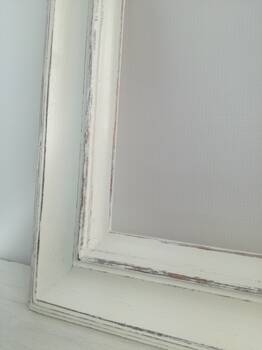
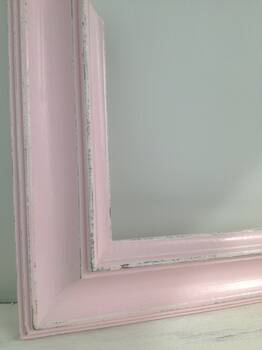
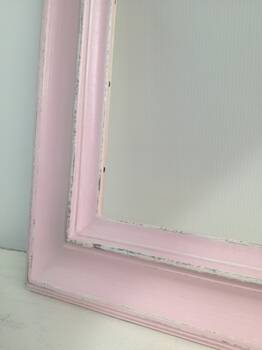
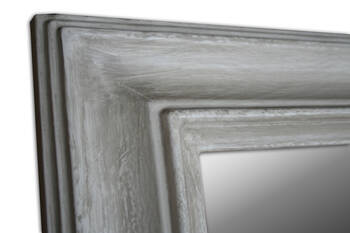
Shabby Chic Picture Frame, Hand-Painted in Four Colours
- Add feedback:
- Code: 290SC
- Manufacturer: Karol Milewski
-
Availability:
 Exists
Delivery time: 20 - 30 working days
- pcs.
- €163.89
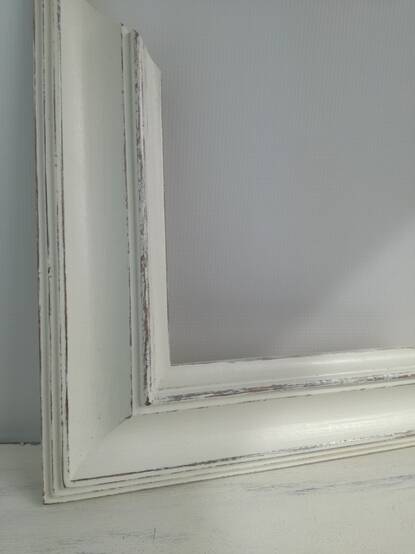
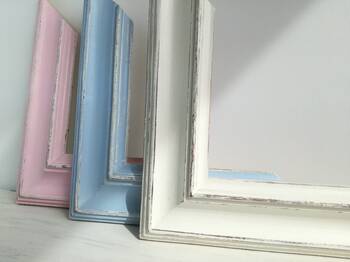
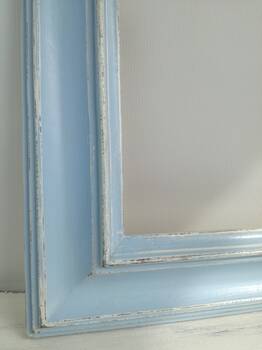
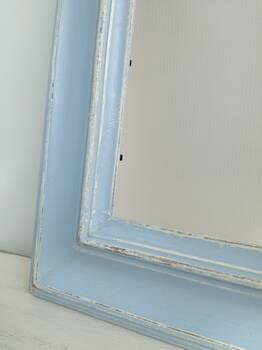
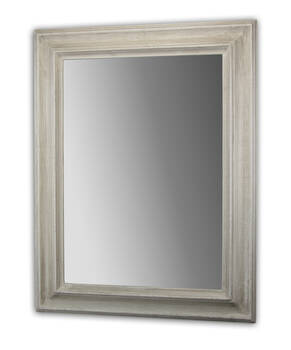
An 80 mm moulding with a rounded bead close to the artwork and a broad half-round hollow across the face, hand-painted and patinated in white, grey, blue or pink. The rabbet takes a stretcher up to 20 mm thick. I cut and finish each frame to the size of one particular work.
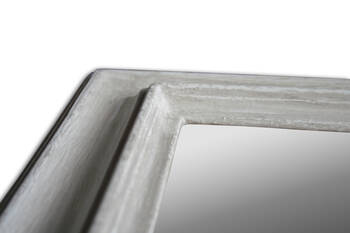
At 80 mm across the face this is the widest painted moulding in my workshop. I hand-paint it in white, grey, blue or pink and patinate the surface by hand, so the colour thins over the raised elements and stays dense in the hollow. That is what gives the frame its shabby chic character: the wear is worked into each length of moulding, so no two come out the same. In the white finish it sits with my white picture frames; the other colours are chosen from the order menu.
Frame profile
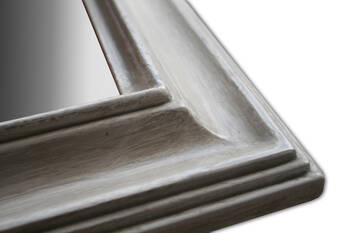
From the artwork side the face rises in a concave approach to a narrow step, and above that step sits a rounded bead, the highest point of the moulding, set close to the edge of the work. Behind the bead the profile falls through a second step onto a narrow fillet and opens into a wide half-round hollow that takes up the largest part of the face. Towards the outside the hollow climbs to a second fillet, and two descending steps close the moulding at the outer edge.
Holding the high point close to the work and laying the broad hollow outside it leads the eye inwards along the curve, and on a face this wide the hollow carries a visible gradation of the patina from the pale fillet down to the base of the curve.
Specification
- Style: rustic, shabby chic, hand-patinated
- Finish: hand-painted in several layers, patinated by hand, buffed with wax to a satin sheen
- Colours: white, grey, blue or pink, selected in the order
- Moulding width: 80 mm
- Moulding thickness, face to back plane: 42 mm
- Rabbet: 7 mm wide, 20 mm deep
- Material: low-tannin wood, the timber used in museum work and art conservation
- Corner joints: cut at 45 degrees, reinforced with wooden splines
- Artwork mounting: spring clips as standard, brass plates with screws on request
- Hanging: portrait or landscape, selected in the order, hanging cord as standard
- Glass, backing and mounts: outside the calculator, individually quoted on request
- Intended for: paintings on canvas and on stretchers up to 20 mm thick, works on paper once glass and spacers are added
- Lead time: 20 to 30 working days
I make the frame to the size of one particular work. The calculator asks for the dimensions of the artwork, not of the frame: the finished frame is 2 to 3 mm larger so the work slides in freely, and the moulding covers about 4 to 5 mm of its edge.
Which paintings and interiors it suits
An 80 mm face makes a wide border, so this frame asks for a work that can hold its own beside it: landscapes, still lifes, loosely painted florals and larger prints on canvas. From roughly 40 x 50 cm upwards the proportion settles; below that a narrower profile serves the work better. I go through those proportions in my guide to types of picture frames for canvas paintings.
The patinated colours belong in rooms that already carry some age in their surfaces: painted timber, natural linen, stripped floors, country and coastal interiors. White and grey are the quiet pair, close to a plainly painted moulding; blue and pink are decorative and look their best against a pale wall.
How it is made and finished
I mill the moulding from low-tannin wood, the timber used in museum work and art conservation. The corners are cut at 45 degrees and reinforced with wooden splines before any colour is applied, so the frame is one rigid structure by the time the surface is built up.
The colour goes on in several layers, mixed in the workshop from a curated, richly pigmented paint range. Once dry, I patinate the surface by hand, working the colour back over the bead, the fillets and the outer steps, the places where a frame in daily use lightens first, and leaving it dense in the hollow. The surface is then buffed with wax to a satin sheen.
How it differs from mass production
A shop-bought frame in this style is usually a moulding wrapped in a printed foil that imitates worn paint, or sprayed and rubbed back by machine to a repeating pattern. Here the layers are real paint and the patina is worked by hand, so the wear follows this particular length of moulding and this particular corner. Cutting each frame to a single set of dimensions is part of the same argument, and it is how I work across all my bespoke picture frames.
Function
The rabbet is 20 mm deep, which is the greatest thickness of stretcher this frame holds as standard. A deeper rabbet can be milled into the same profile, so tell me the stretcher depth when you order.
The frame is supplied without glass, prepared for a stretched canvas. Works on paper, photographs and prints need glass, a backing and spacers, made to order outside the calculator after an individual quote.
The same profile can be made without a rabbet, as a floating frame in which the edge of the stretcher stays visible in the gap between the work and the moulding. I describe that construction on my page about the floating picture frame for canvas art.
Complete framing – additional options
Every frame I make can be completed with full archival and museum-quality framing: anti-reflective UV-filtering glass (four classes to choose from), acid-free museum mat board, spacers wrapped in acid-free paper and a Dibond backing. This kind of mounting protects the work from light, acids and distortion. I set out the full glass and material specification on a separate page: archival and museum framing for paintings and photographs. All components are available at extra cost, as an individual quote on request.
Mounting and hanging
The artwork is held in the rabbet by spring clips, fitted to the back of the frame in the workshop. They rotate aside, so one work can come out and another go in without tools. Brass plates with screws are available on request instead: they are supplied loose with the screws, you fit them yourself once the work is in, and the fixing is permanent. This is not a menu choice, so add a note to the order if you want the brass plates.
Hanging orientation, portrait or landscape, is selected from the order menu, and the frame is prepared for that orientation only. Hanging cord is fitted as standard. A single D-ring hanger is available on request.
Made to measure
The price shown is the price per running metre of moulding. The perimeter of the picture is not the whole length a frame needs: the 45 degree mitres take additional length at each corner, and the wider the moulding, the more they take. The calculator works out the full consumption including corners, along with any add-ons you select.
Measure the artwork itself, width and height, to the nearest millimetre, and type those figures in. For this moulding width the calculator handles artworks up to 180 cm around the perimeter; anything larger is made to individual order, so send me the dimensions and I will price it. Lead time is 20 to 30 working days.