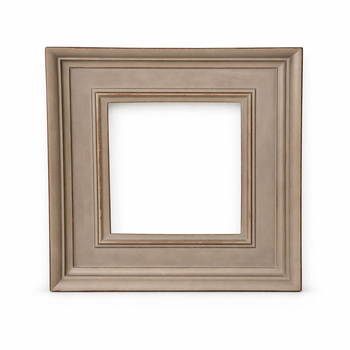
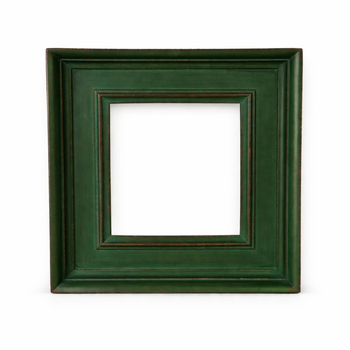
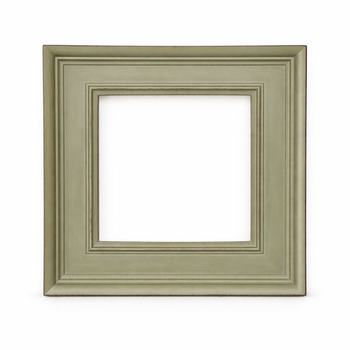
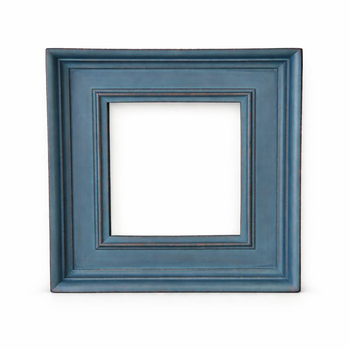
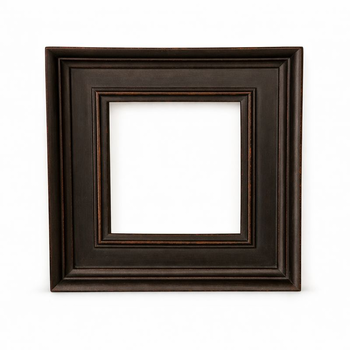
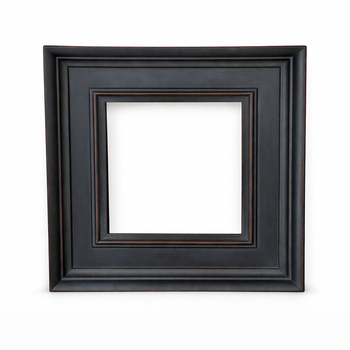
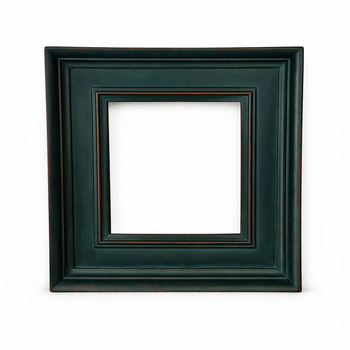
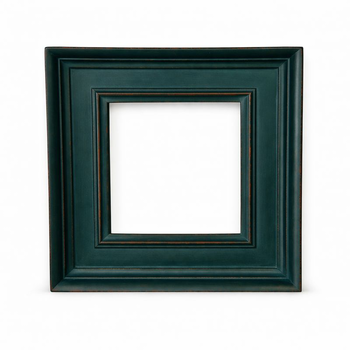
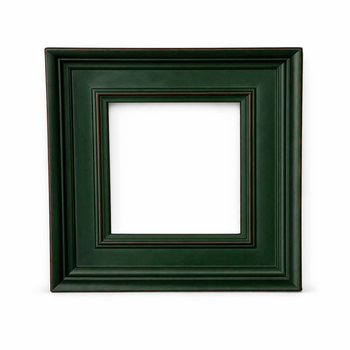
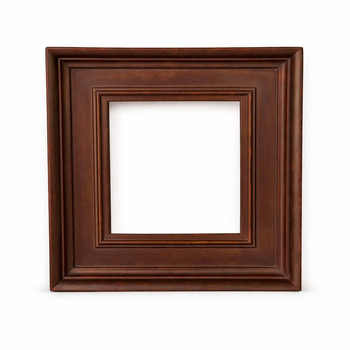
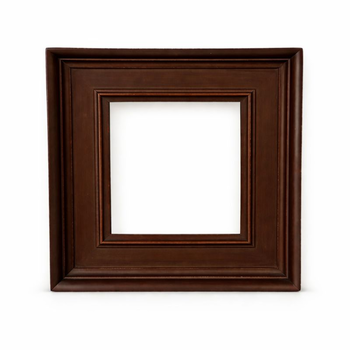
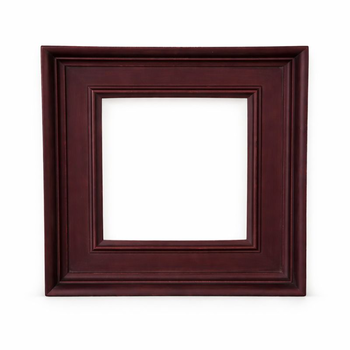
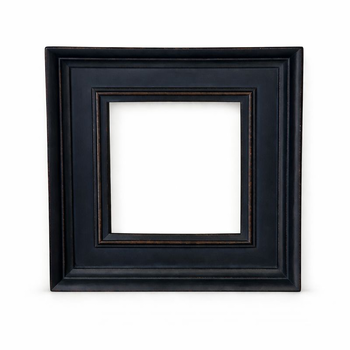
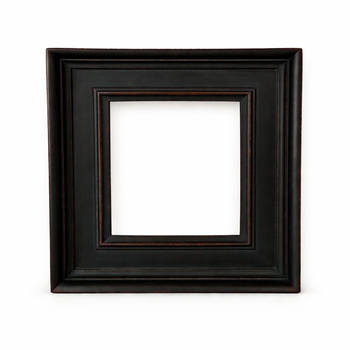
Picture Frame for Canvas, Hand-Rubbed, 18 Finishes
- Add feedback:
- Code: 277
- Manufacturer: Karol Milewski
-
Availability:
 Exists
Delivery time: 20 - 30 working days
Exists
Delivery time: 20 - 30 working days
- pcs.
- €136.11
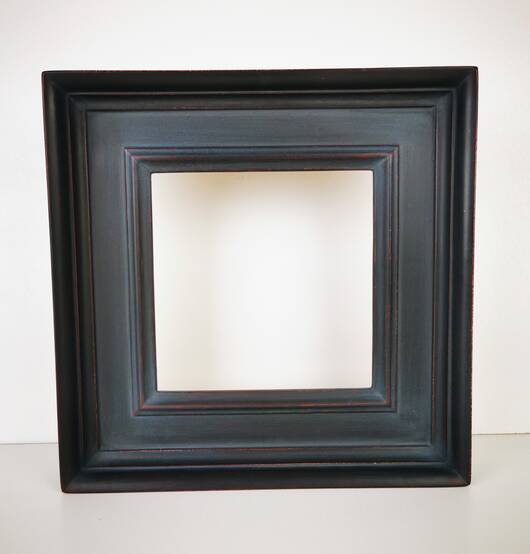
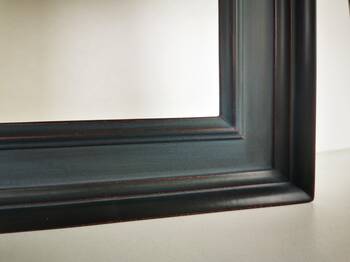
A hand-rubbed picture frame for canvas in solid timber, with a classic 55 mm profile featuring a half-round torus and frieze. Three layers of richly pigmented paint from a curated artisan range, hand-rubbed to bring through the colours beneath. 18 finishes — from blacks and deep greens to greys, navies and earth tones. Made to measure.
Solid timber, hand-painted in successive layers and rubbed back to reveal the colours beneath — this frame is built as a setting for canvas on stretcher. The moulding measures 55 mm wide and at least 36 mm deep; it accepts standard stretcher bars without trimming and without crowding the painted surface. Available in 18 finishes — from matte blacks and deep greens to greys, navies and earth tones — each with its own pattern of rubbed-back marks.
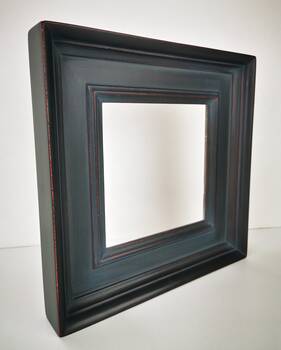
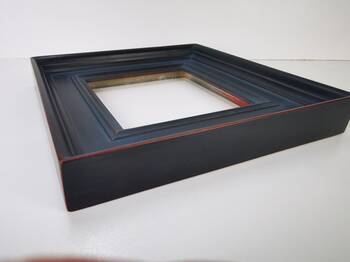
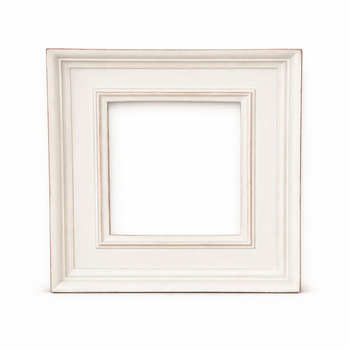
The profile speaks the classical language of architectural moulding with clearly articulated forms. The outer edge is dominated by a half-round torus — the moulding's principal element, which descends through a cyma (S-curve) onto a wide frieze. Nearer the inner edge, a second, smaller cyma rises to a secondary bead marking the transition to the rabbet. Three layers of paint and hand-rubbing settle on each of these planes differently — the beads catch a stronger sheen, the frieze holds an even tone, the cymas pick up a soft rhythm of shadow.
Suited to which artworks and rooms
The 36 mm depth comfortably accepts standard stretchers (typically 18–22 mm) — the artwork sits in a recessed plane, framed cleanly without flattening the composition. Well suited to oil paintings, acrylics, mixed-media works on canvas, canvas reproductions, and deeper printed works. Made without a rabbet, the same moulding becomes a floater frame — leaving the stretcher edges exposed — common in contemporary gallery painting.
On interiors: the rubbed-back finish does not pretend to be antique patina; it is a deliberate, hand-made mark of process. Dark tones — Black, Black-Navy, Deep Dark Grey — sit comfortably in gallery contexts and are the natural home of black picture frames for high-contrast paintings. Navies and deep greens come into their own in rooms with a saturated wall colour: panelled libraries, drawing rooms, period interiors. The earth and coffee tones suit interwar-modern interiors and pared-back gallery hangs.
Specification
- Moulding width: 55 mm
- Moulding depth: 36 mm minimum
- Rabbet width: 7 mm — actual overlap onto the artwork approx. 4–5 mm per side
- Material: solid timber, low in tannins, of the type used in museum and conservation framing
- Corner joinery: wooden splines, with no visible seam at the mitre
- Finish: three-layer hand painting, hand-rubbed back, sealed with shellac and wax
- Available finishes: 18 (selected from the variant menu)
- Artwork retention: spring clips or brass plates with screws (selected from the variant menu)
- Hanging: cord, portrait or landscape (selected from the variant menu); single D-ring on request
- Application: oil and acrylic paintings, mixed-media works on canvas, deeper printed works; floater-frame configuration available without rabbet
The dimensions entered into the price calculator are the artwork (stretcher) dimensions. The frame is made 2–3 mm larger than the artwork as technical clearance, so the moulding overlaps the painted surface by approx. 4–5 mm per side.
Three-layer paint and hand-rubbing
Each frame is built up in three layers from a curated, richly pigmented paint range. Once dry, the layers are rubbed back by hand: the surface is not uniform, but reveals fragments of the colours beneath — the impression is of a piece that grew through stages. The finish is sealed in the traditional way with shellac and wax; the surface has a deep, lightly satin glow that emphasises the rhythm of the rubbed-back marks. Each piece has its own configuration of markings — no two are identical.
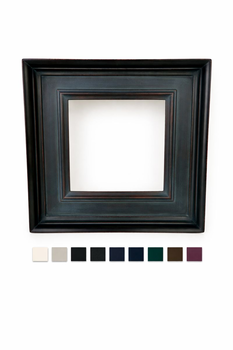
Palette — 18 finishes
The palette is a full cross-section of saturated but tempered tones, with a few accents:
- Blacks and deep graphites: Black, Black-Navy, Deep Dark Grey, Dark Grey.
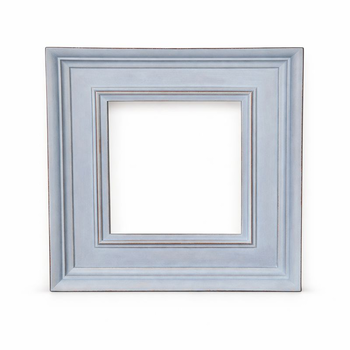
- Navies and blues: Marine Navy, Light Blue, Smoky Grey-Blue.
- Greens: Deep Green, Dark Green, Light Bottle Green.
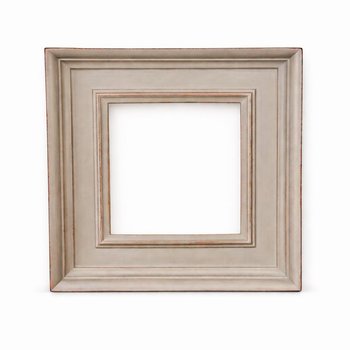
- Browns and earth tones: Chocolate Brown, Dark Brown, Grey-Brown, Brown-Grey, Earth Grey, Light Coffee.
- Accents: Dark Plum, Champagne White.
All finishes share the same rubbed-back surface character — they differ in tone, not in surface effect. A colour sample from the current pigment batch is available on request before the order is confirmed.
How this differs from mass production
Factory-produced frames are painted in a single pass, mechanically, in a standard palette. Here the cycle is performed by hand, in three layers, with a curated pigment range; each piece varies in its rubbed-back pattern. The moulding is solid timber, joined at the corners with wooden splines (not glue and staples), giving a structure that holds for decades. The shellac-and-wax finish belongs to the tradition of the artisan workshop — natural, breathable, and refurbishable in part rather than requiring a full strip-back.
Artwork retention and hanging
The frame is supplied without glass — as a setting for canvas on stretcher. The artwork is held in the rabbet using one of two retention systems, selected from the order menu.
Spring clips — factory-fitted to the back of the frame. Once the artwork is inserted, the clips rotate sideways with a single movement, securing the stretcher in the rabbet. The system allows quick artwork changes at any time, with no tools required.
Brass plates with screws — supplied loose, with screws included. The customer fits the plates after inserting the artwork. The mounting is permanent and discreet, recommended for long-term display.
Hanging: orientation — portrait or landscape — is selected from the order menu; the frame is fitted only in that position. As standard, the frame is supplied with hanging cord. A single D-ring hanger is available on request — please add a note to your order.
Complete framing — additional options
Every frame can be completed with a full archival mounting prepared in the workshop: glass, archival backing and matting. All components are available as a custom add-on — quote on request.
Glass — four classes available
Opti White, 4mm — low-iron glass with a neutral, colourless appearance (no green tint typical of standard float glass). Available up to 90×90 cm — the only option for larger works.
Ultra Vue UV70 (Tru Vue), 2.0mm — anti-reflective glass with 70% UV protection, low-iron. Available up to 60×80 cm.
Art View — premium-class anti-reflective glass: reflection reduced below 1%, up to 75% UV protection, scratch-resistant coating, low-iron, can be cut and mounted from either side. Meets ISO 18916 (Photographic Activity Test) — safe for archival photography. Premium quality at an accessible price. Available up to 60×80 cm.
Optium Museum Acrylic (Tru Vue) — top-tier museum acrylic: over 99% UV protection, museum-grade reflection reduction, anti-static, lightweight, shatter-resistant. The museum standard for conservation work and archival photography. Available up to 60×80 cm.
Archival backing
Dibond 3mm aluminium composite panel — two layers of aluminium with an acid-free polymer core. Rigid, chemically neutral, dimensionally stable. An industry standard in archival photographic framing and art conservation.
Mounting and matting
Acid-free foam board — chemically neutral, will not yellow over time, will not react with paper or photographic emulsions. Archival standard.
Full museum framing
Combining anti-reflective UV-filtering glass, acid-free matting, Dibond backing and conservation hinging tapes provides a museum-grade mounting — protecting the work from light damage, acid migration from typical framing materials, and mechanical distortion. This type of framing is used in museums, galleries and private collections.
To order: all of the above components are available as a frame add-on on request. Please get in touch with the dimensions of your work and your preferred glass class — I will prepare an individual quote.
Made-to-measure ordering
The online price calculator supports orders of made-to-measure frames for artwork sizes up to 120×80 cm. Larger formats are made to individual order — please get in touch with the artwork dimensions and your chosen finish; I will prepare a quote.
The base price shown on the page is the price per linear metre of moulding. The artwork's perimeter is not the full length of moulding the frame requires — corners cut at 45° take additional length, more so as the moulding widens. The calculator accounts for the full moulding consumption, including mitres and any selected add-ons.
Lead time: 20–30 working days from order confirmation.