Luxury gilded picture frame — 23-karat gold leaf, Flemish corners
- Add feedback:
- Code: 344
- Manufacturer: Karol Milewski
-
Availability:
 Exists
Delivery time: 20 - 30 working days
Exists
Delivery time: 20 - 30 working days
- szt.
- €247.22
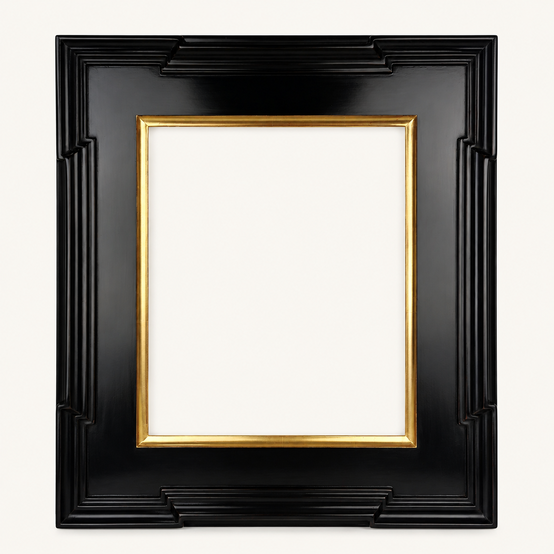
An artisan-made, museum-quality gilded picture frame for canvas — a collector frame in the form of 17th-century Dutch and Flemish workshops. A broad satin-black frieze counterpointed by a narrow edge gilded with 23-karat yellow gold leaf on red bole. A 100 mm profile with the distinctive Flemish corners.
An artisan-made, luxury gilded picture frame made to size — in the classical form of 17th-century Dutch and Flemish workshops. A 100 mm wide profile with a 50 mm depth, with a precisely calibrated distribution of mass: a broad, satin-black frieze and a narrow gilded inner edge. The gilding is carried out in 23-karat yellow gold leaf (an alloy of roughly 96% gold with a small admixture of silver and copper) on red bole — the most intense, classical warm glow of gold, in which the red clay resonates with the depth and gravity of a historical mounting. The narrow, precisely measured gilded edge is set within a substantial black frieze: this is a gilded picture frame that unites the gilder's tradition with the sobriety of black — in the tradition where the frame was treated as an autonomous work of craft, counterpointing the artwork through the gravity of its black and a meticulously measured accent of gold.
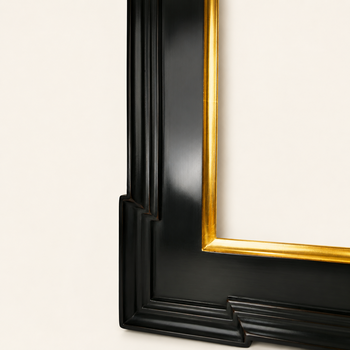
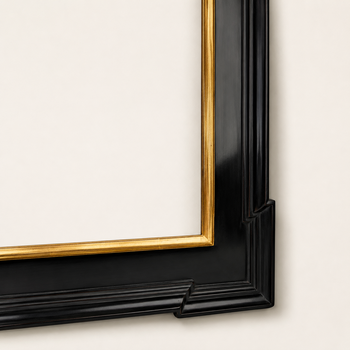
The profile is organised around a broad black frieze, leading the eye from the inner edge outwards. At the artwork side — a narrow, profiled edge gilded in 23-karat yellow gold, with red bole showing through here and there, framing the work without over-ornament. The transition from the frieze towards the outer edge runs through a stepped descent — three subtle steps lifting the edge of the frame upwards. The outer edge is rounded, with a gentle curved transition to the underside of the moulding. At the corners comes the distinctive Flemish element — profiled corners in the form of a three-step decorative protrusion, where the outer part of the frame extends beyond the line of the frieze, producing a rhythmic accent. This is a workshop detail that demands precise mitring and separate assembly — a signature of the Flemish carving tradition, discussed in detail in the article on Dutch picture frames.
For which paintings and interiors
A deep picture frame for canvas of this mass and finish balances paintings of a saturated palette especially well — oils, acrylics, and tempera in the classical manner, the natural territory of fine art framing. The warm, intense glow of 23-karat gold enters into dialogue with the deep reds, browns, ochres and greens of the Old Masters; the black frieze gives the artwork a neutral visual ground, while the narrow gilded inner edge holds the gravity of a historical mounting without the weight of full gilding. The frame performs as a collector's mounting for copies of Old Master works, icons, and archival-quality portrait photography. In luxury interiors — paired with raw surfaces, dark woods, or unbleached linen — it becomes a deliberate accent of historical gravity within a minimal narrative. This is a frame from the family of gold-gilded picture frames, addressed to the collector segment and gallery presentation — with a clear reference to the Dutch and Flemish workshop tradition.
Specification
- Style: Flemish / 17th-century Dutch picture frames
- Side finish: black, satin, hand-waxed
- Inner-edge finish: 23-karat yellow gold leaf on red bole, burnished with an agate stone
- Gilding technique: water gilding on a multi-layered ground
- Moulding width: 100 mm
- Moulding depth: 50 mm
- Rabbet (depth): 7 mm
- Material: solid timber, low in tannins, used in museology and the conservation of works of art
- Corner construction: mitred corners reinforced with wooden splines
- Gold sealing: traditional shellac and wax
- Black sealing: hand-polished wax
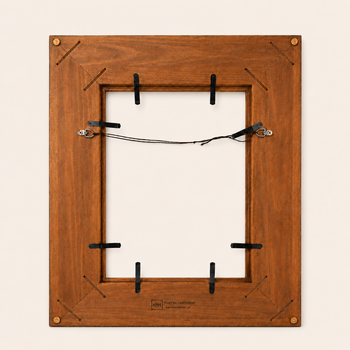
- Artwork retention: spring clips as standard; brass plates with screws on request (permanent fixing, customer-fitted)
- Hanging: cord; portrait / landscape orientation from the menu
- Application: mounting for canvas on stretcher (no glazing as standard)
The dimensions given at order refer to the artwork itself (canvas on stretcher). The frame is made approximately 2–3 mm larger than the stated dimensions — this is a standard technological clearance, ensuring the work seats freely inside the rabbet.
Workmanship
Each frame in this profile (workshop reference: Casina 2) is made entirely by hand. The moulding is mitred at 45° and the corners are joined using the traditional method — wooden splines. A spline is an inner wooden tongue that reinforces the joint, a technique known from conservation workshops, giving the frame dimensional stability at large formats and resistance to the seasonal movement of timber.
The gilding is carried out by the water method — in multiple layers. The first layer is a chalk-glue ground (gesso), followed by a layer of bole clay in a red tone (terra rossa). The bole serves two functions: it provides a warm tonal ground showing through the gold leaf and — crucially — it enables burnishing with an agate stone, the manual smoothing of the gold's surface with a polished agate to achieve the deep, velvety sheen impossible to obtain by any other method. The full process is described in detail on the water gilding page.
The 23-karat yellow gold leaf — an alloy of approximately 96% gold with a small admixture of silver and copper — produces the most intense, warmest tone of gold: a classical, deep glow, in which the warmth of the red bole resonates more openly than with the cooler moon-gold alloy. The leaves, measuring approximately 80 × 80 mm, are cut with a specialist gilder's knife on a gilder's cushion to the width required for the narrow edge of this frame.
After drying and burnishing, the gold is sealed in the traditional way — with shellac and wax — producing depth of colour and a soft matt glow, in contrast to lacquers which give a cooler, more technical reflection. The black side surfaces are finished with hand-polished wax, for an even satin effect.
What sets this frame apart from mass production
Three craft decisions set this frame apart from catalogue products. First — the material: solid timber low in tannins, used in museology and the conservation of works of art, not moulded foam, MDF with imitation carving, or polystyrene. Second — the gilding technique: genuine 23-karat gold leaf, water-gilded and agate-burnished, not metallised foil or aerosol paint with glitter. Third — the corner construction: wooden splines that absorb the stresses of seasonal timber movement, in place of welded tape or glued plastic. These three decisions are what make this frame a work intended to outlast centuries — not a product made for periodic replacement.
Artwork retention and hanging
The frame is offered without glazing — as a mounting for canvas on a stretcher. Artwork retention within the rabbet is achieved by one of two systems, selected from the variant menu. Spring clips are factory-fitted inside the rabbet — they simply turn aside to admit the artwork and rotate back into a holding position; this solution allows quick swapping of works. Brass plates with screws are supplied loose, with screws included — the customer fits the artwork into the rabbet at the back of the frame; this is a permanent solution, suited to works intended for fixed display.
The hanging direction — portrait or landscape — is selected from the variant menu; the frame is physically finished for the chosen orientation. As standard, a hanging cord is supplied, fitted to rear D-rings. On request, a single central D-ring may be supplied in place of the cord.
Complete framing — additional options
Every frame can be completed with a full archival mounting prepared in the workshop: glass, archival backing and matting. All components are available as a custom add-on — quote on request.
Glass — four classes available
Opti White, 4 mm — low-iron glass with a neutral, colourless appearance (no green tint typical of standard float glass). Available up to 90 × 90 cm — the only option for larger works.
Ultra Vue UV70 (Tru Vue), 2.0 mm — anti-reflective glass with 70% UV protection, low-iron. Available up to 60 × 80 cm.
Art View — premium-class anti-reflective glass: reflection reduced below 1%, up to 75% UV protection, scratch-resistant coating, low-iron, can be cut and mounted from either side. Meets ISO 18916 (Photographic Activity Test) — safe for archival photography. Premium quality at an accessible price. Available up to 60 × 80 cm.
Optium Museum Acrylic (Tru Vue) — top-tier museum acrylic: over 99% UV protection, museum-grade reflection reduction, anti-static, lightweight, shatter-resistant. The museum standard for conservation work and archival photography. Available up to 60 × 80 cm.
Archival backing
Dibond 3 mm aluminium composite panel — two layers of aluminium with an acid-free polymer core. Rigid, chemically neutral, dimensionally stable. An industry standard in archival photographic framing and art conservation.
Mounting and matting
Acid-free foam board — chemically neutral, will not yellow over time, will not react with paper or photographic emulsions. Archival standard.
Full museum framing
Combining anti-reflective UV-filtering glass, acid-free matting, Dibond backing and conservation hinging tapes provides a museum-grade mounting — protecting the work from light damage, acid migration from typical framing materials, and mechanical distortion. This type of framing is used in museums, galleries and private collections.
To order: all of the above components are available as a frame add-on on request. Please get in touch with the dimensions of your work and your preferred glass class — I will prepare an individual quote.
Made to order
Each frame is made individually to the dimensions of the artwork. The calculator on the product page accepts the side dimensions and returns the total price of the frame.
The base price is the price per linear metre of moulding. Mitred corners at 45° take additional length — the wider the moulding, the greater the consumption. The calculator accounts for the full consumption with corners and the selected add-ons.
The online price calculator supports artwork sizes up to 120 × 80 cm. Larger formats are made to individual order — please get in touch with the dimensions of the work and a description of the painting support.
Lead time: 20–30 working days from order confirmation.
The range also includes finishing variants of this frame — including the moon-gold (22-karat) version (workshop reference: Casina 2 — moon gold), available as a separate product listing. The classical warm glow of 23-karat yellow gold can be compared with the cooler, more silvery 22K, allowing the finish closest in character to the work being framed to be chosen.