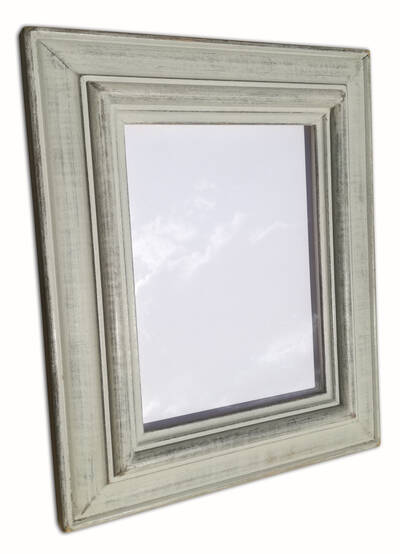
Light Grey Dutch-Style Picture Frame
- Add feedback:
- Code: 116S
- Manufacturer: Karol Milewski
-
Availability:
 Exists
Delivery time: 20 - 30 working days
- pcs.
- €136.11
A light grey picture frame with a Dutch-style reverse profile: the moulding is at its highest beside the painting and slopes down towards the wall. It is 67 mm wide, about 2⅝ inches, painted by hand in layers, patinated and waxed to a satin sheen. I make each frame to measure for paintings on stretchers up to 20 mm (about ¾ inch) thick.
This light grey Dutch-style picture frame is made for paintings on canvas. The reverse profile of Dutch frames is usually pictured in dark, ebonised or stained wood; here I paint it by hand in a pale grey, built up in layers and then patinated, so the surface has the soft tonal variation of a vintage finish. It is one of my custom picture frames, each made to order for a particular painting.
Frame profile
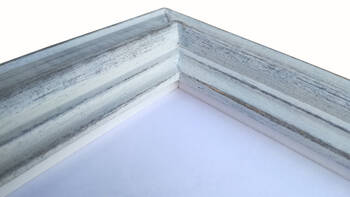
Next to the painting the moulding opens with a hollow, which passes into a flat and rises to a half-round, the highest point of the section. Beyond the half-round lies a second flat, followed by the broad face, gently convex and sloping down towards the outer edge. A small half-round and a flat side close the moulding.
With the high point at the painting and the face falling away behind it, this is a reverse profile: the strongest line of the frame, the half-round, runs right beside the picture, and the moulding loses height towards the wall. I write about where this profile comes from, and how much more varied Dutch framing once was, in my article on Dutch frames and the reverse profile.
Specification
- style: Dutch-style reverse profile, painted vintage finish
- colour: light grey, painted by hand in layers and hand-patinated
- finish: hand-waxed to a satin sheen
- moulding width: 67 mm
- moulding thickness (face to back): 36 mm
- rebate: 7 mm wide, 20 mm deep
- material: low-tannin timber of the kind used in museum work and art conservation
- corner joinery: mitred corners reinforced with wooden splines
- glazing, mat and backing: optional extras, priced individually
- artwork fixing: sprung clips as standard, brass plates with screws on request
- hanging: picture wire as standard, single D-ring on request, portrait or landscape chosen when you order
- suitable for: oil and acrylic paintings on stretched canvas; photographs and prints on a rigid board or with glazing and a mat
- lead time: 20–30 working days
Which paintings and interiors it suits
The frame is intended first of all for oil and acrylic paintings on stretched canvas. The cool, patinated grey sits easily with landscapes, still lifes and work in a muted palette, and around strongly coloured painting it acts as a neutral margin, separating the picture from the wall without competing with it. At 67 mm, about 2⅝ inches, the moulding is in proportion with medium and large formats.
In a room, pale grey belongs with light schemes: Scandinavian and French country interiors, or classical rooms with limed timber. It is also a good answer to a strongly coloured wall, where a white frame would set up too hard a contrast.
Craftsmanship and finish
I begin with the moulding and the corners. Each corner is cut at 45 degrees and reinforced with wooden splines before any paint goes on, so the grey later runs across every corner as one surface. The timber has a low tannin content, of the kind used in museum work and art conservation, so it does not bleed into the paint or react with other framing materials.
With the frame assembled, I prepare the surface and build up the light grey by brush, one coat after another. The patina follows: along the edges and in the recesses of the profile I bring out lighter and darker passages by hand, which gives the frame its gently aged character and makes each one slightly different. Finally I wax the surface by hand and buff it to a satin sheen.
Colour to order
Light grey with a patina is the standard version of this frame. I can paint the same profile in another grey, in white or in a colour matched to a particular painting or room, from a curated, richly pigmented paint range. If you would rather choose a finished colour from the order menu, my reverse profile picture frame comes in nineteen hand-painted shades on a wider, 75 mm moulding.
How it differs from mass production
A factory frame is cut from moulding lacquered on a spray line, in a handful of standard sizes, and joined from behind, so its surface is uniform and each corner is simply where two finished lengths meet. This frame is built the other way round: it is cut for one painting, its corners are splined first, and the grey and the patina are applied afterwards to the frame as a whole.
Hand finishing also means that two frames from the same order resemble each other closely without being identical, because the patina depends on the pressure and path of the hand. I work alone and take on a limited number of commissions at a time, so every frame passes through my hands from the first cut to the final coat of wax.
Functionality
As standard I make the frame without glazing, for a painting fitted straight into the rebate. The rebate is 7 mm wide and 20 mm deep, which matches a typical painting stretcher, so the canvas sits fully inside the frame and finishes flush with its back. For a thicker stretcher I make the rebate deeper; just give me its thickness when you order. The frame is made 2–3 mm larger than the painting as technical clearance and covers about 4–5 mm of its edge.
I can also make this profile without a rebate, as a floating frame: the canvas then sits inside with a narrow gap around it and the sides of the stretcher stay in view. I describe how that construction differs from a classic frame in my article on the floating picture frame for canvas art.
Frequently asked questions
Is a 67 mm frame too wide for a small painting?
Below roughly 30 × 40 cm, about 12 × 16 inches, a moulding of this width starts to dominate the picture. For small formats I usually suggest a narrower profile; send me the size of the work and I will recommend one.
Can I use this frame for a photograph or a print?
Yes, if the work is mounted on a rigid board, or framed with glazing, a mat and a backing panel, for which the 20 mm rebate has ample depth. The standard frame comes without glazing, so tell me what you are framing and I will price the mounting together with the frame.
What should I measure before ordering?
The width and height of the painting itself, to the nearest millimetre; I add the technical clearance myself. Please also tell me the thickness of the stretcher, so that the painting sits correctly in the rebate.
Complete framing – additional options
Every frame I make can be completed with full archival and museum-quality framing: anti-reflective UV-filtering glass (four classes to choose from), acid-free museum mat board, spacers wrapped in acid-free paper and a Dibond backing. This kind of mounting protects the work from light, acids and distortion. I set out the full glass and material specification on a separate page: archival and museum framing for paintings and photographs. All components are available at extra cost, as an individual quote on request.
Mounting and hanging
This frame is intended for paintings on canvas and stretchers, so it does not include glass as standard. To hold the painting, I fit sprung retaining clips as standard; they pivot to the side, so the canvas can be removed and replaced quickly without tools. On request I supply brass plates with screws instead (provided loose, for permanent self-installation). The hanging orientation, portrait or landscape, is chosen at checkout. Picture wire is standard, with a single D-ring available on request.
Ordering made to measure
The base price shown on the site is the price per running metre of moulding. The perimeter of the painting is not the full length of moulding a frame needs: corners cut at 45 degrees take extra length, and the wider the moulding, the more they take. The calculator accounts for the full moulding consumption with corners and for any options you choose, so you only need to enter the dimensions of your painting. The calculator accepts artwork up to a perimeter of 180 cm, the limit set for a moulding of this width; larger formats I make to individual order, so please write to me first. The lead time is 20 to 30 working days.