Gilded Wood Picture Frame with Burr Oak Veneer
- Add feedback:
- Code: 13
- Manufacturer: Karol Milewski
-
Availability:
 Exists
Delivery time: 20 - 30 working days
- pcs.
- €275.00
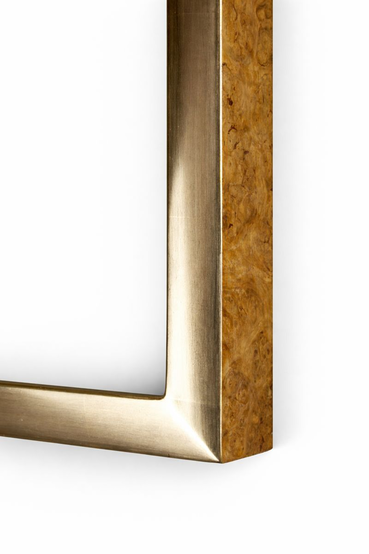
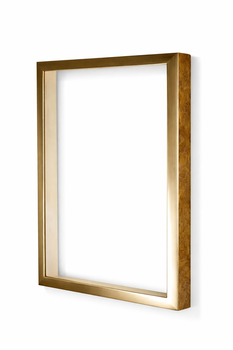
A narrow gilded face and a deep flank of burr oak veneer: two materials that most workshops never put on the same moulding. The 22 mm face is water gilded with 22-karat moon gold leaf over plum bole, then burnished and lightly patinated; the 45 mm side is faced with burr oak, French polished and waxed to a satin sheen. A 40 mm rabbet takes deep stretchers. Made to measure for your painting or photograph.
This is the only moulding in my catalogue that shows gold and bare timber side by side. The face is water gilded with 22-karat moon gold leaf, a paler and cooler gold than the classic yellow; the flank beside it is faced with burr oak veneer, French polished and waxed so the figure of the wood reads clearly from an angle. The result sits somewhere between a gilded frame and a cabinetmaker's frame, and it works where a fully gilded moulding would be too much. Every one is cut and finished to the size of a particular work. You will find the rest of the gilded range in gold gilded picture frames.
The moulding profile
The highest point of the moulding stands at the artwork. From there the face falls away towards the outside in one continuous convex curve, with no steps, hollows or secondary profiling anywhere along its 22 mm of visible width. That reversed arrangement throws the eye inwards rather than outwards, and it is why a moulding this narrow still holds a large canvas. At the outer edge the curve finishes and the side begins: a flat vertical flank 45 mm high, faced with burr oak veneer and finished with French polish and wax. I write about what a reversed profile does to the reading of a painting in reverse and coved frames.
Specification
- Style: reverse profile, contemporary, no ornament
- Moulding width: 22 mm
- Moulding thickness (face to back): 45 mm
- Rabbet: 7 mm wide – up to 40 mm deep
- Material: timber low in tannin content, of the kind used in museum work and art conservation; sides faced with burr oak veneer
- Corner joinery: mitred at 45°, reinforced with wooden splines
- Gilding: water gilding on gesso and plum bole, 22-karat moon gold leaf laid in a single layer, burnished with an agate stone and lightly patinated
- Side finish: burr oak veneer, French polished and waxed to a satin sheen
- Glass, backing and mount: available on request at extra cost
- Mounting and hanging: spring clips as standard, cord fitted, portrait or landscape chosen with the order
- Suits: oil and acrylic on canvas, works on panel, photographs, prints
The frame is made to the size of your particular work, so enter the dimensions of the artwork itself into the calculator. I build to those figures with a technical allowance of 2 to 3 mm, which leaves the moulding covering roughly 4 to 5 mm of the edge of the work all round.
Which artworks and interiors it suits
The 40 mm rabbet is the practical point of this frame. It swallows the deep stretchers that contemporary painters use, including gallery-depth bars that a conventional moulding cannot close over, and it does so without adding visual width at the front. For oil and acrylic on canvas it gives a firm gold boundary and then gets out of the way. On photographs, etchings and drawings under glass, the narrow gilded face reads as a line rather than a border.
In an interior the oak flank is what makes this frame unusual. Against walnut, oak or ash furniture it picks up the same material language instead of fighting it, which is why it settles into rooms where a fully gilded frame would look imported from another century. It suits pale and mid-toned walls, and it earns its place in a room with good joinery in it.
How it is made and finished
I cut the moulding, mitre the corners at 45° and reinforce them with wooden splines before anything else happens, so the frame is mechanically sound before a single coat goes on. Then the gesso ground, built up in layers and cut back, and the plum bole over it, also in layers. The gilding is done with 22-karat moon gold leaf laid leaf beside leaf with an overlap of about a millimetre, a single layer of gold over a multi-layered ground. I burnish it with an agate stone and then patinate it lightly by hand, so the plum bole breaks through along the crown of the curve and takes the hardness out of the gold.
The veneer goes on the flanks separately, chosen for figure, then French polished and waxed. That finish is what gives burr oak its depth: the polish sits in the grain rather than on top of it. If you want the background to the gilding itself, I describe the process on my page about water gilding.
How it differs from mass production
Factory mouldings that look like this one are printed foil or sprayed metallic lacquer on a wrapped profile, cut from stock lengths and joined with staples. Nothing about them changes with the light. Water gilding is a different material fact: real gold leaf laid on a wet bole ground, burnished until it takes on a metallic depth that no coating reproduces, on a frame built to your dimensions rather than to the nearest standard size. The veneer is real oak with real figure, not a printed grain. Small variations between one frame and the next are the evidence of hand work, not a fault in it.
Functionality
The frame is supplied without glass as standard, as a setting for a canvas on a stretcher or a work on a rigid panel. The 40 mm rabbet depth is the widest I offer and takes deep contemporary stretchers comfortably. If you would rather the canvas floated with a shadow gap all round instead of sitting under the moulding, I can make this profile as a floating frame, without a rabbet.
Complete framing – additional options
Every frame I make can be completed with full archival and museum-quality framing: anti-reflective UV-filtering glass (four classes to choose from), acid-free museum mat board, spacers wrapped in acid-free paper and a Dibond backing. This kind of mounting protects the work from light, acids and distortion. I set out the full glass and material specification on a separate page: archival and museum framing for paintings and photographs. All components are available at extra cost, as an individual quote on request.
Mounting and hanging
The artwork is held in the rabbet by spring clips, fitted to the back of the frame in the workshop. They rotate aside, so one work can come out and another go in without tools. Brass plates with screws are available on request instead: they are supplied loose with the screws, you fit them yourself once the work is in, and the fixing is permanent. This is not a menu choice, so add a note to the order if you want the brass plates.
Hanging orientation, portrait or landscape, is selected from the order menu, and the frame is prepared for that orientation only. Hanging cord is fitted as standard. A single D-ring hanger is available on request.
Made to measure
The price shown is the price per running metre of moulding. The perimeter of the picture is not the whole length a frame needs: the 45° mitres take additional length at each corner, and the wider the moulding, the more they take. The calculator works out the full consumption including corners, along with any add-ons you select.
Measure the artwork itself, width and height, to the nearest millimetre, and type those figures in. The calculator handles artworks up to 120 × 80 cm; anything larger is made to individual order, so send me the dimensions and I will price it. Lead time is 20 to 30 working days.