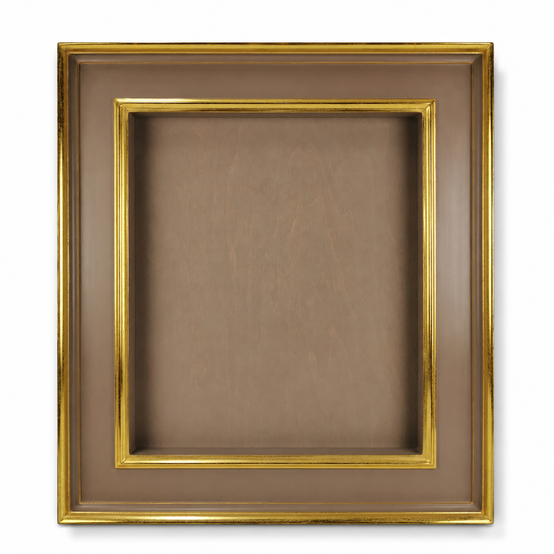
Floater Frame for Oil Paintings on Canvas, 23-Karat Gold Trim
- Add feedback:
- Code: 169GC
- Manufacturer: Karol Milewski
-
Availability:
 Exists
Delivery time: 20 - 30 working days
- pcs.
- €247.22
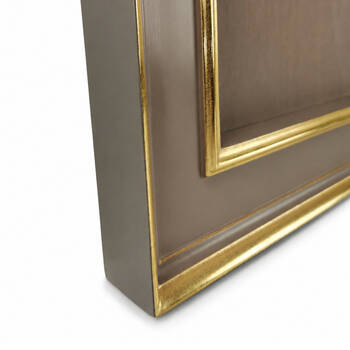
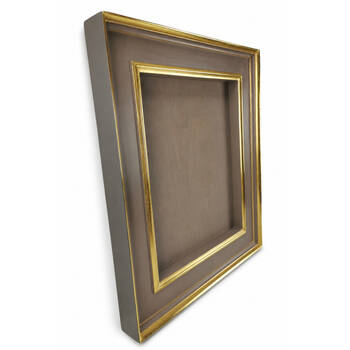
A floater frame for paintings on stretched canvas, built without a rebate so that the canvas hangs free inside a deep chamber. The broad face is hand painted in latte, the outer side in soft grey, and the two raised edges that hold the face between them are water gilded in real 23-karat gold leaf. The moulding is 33 mm from face to back, about 1 5/16 inches, and every frame is built to the size of one particular stretcher.
This is a floater frame for oil and acrylic paintings on stretched canvas, made to measure in my workshop. The gilding is held to a trim rather than spread across the whole moulding: the broad face is hand painted in latte, the outer side in soft grey, and only the two raised edges either side of the face carry real gold leaf, laid by hand in 23-karat yellow gold. Built as a floater, the frame has no rebate at all. In place of an inner lip a painted side wall drops away from the face, opening a chamber in which the canvas stands clear of the moulding on every side. You can see the same construction in other models in my gilded and partially painted picture frames.
Profile
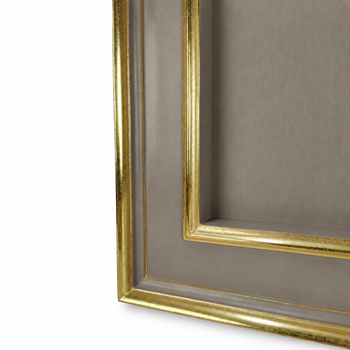
At the artwork the section opens with a shallow hollow carrying a raised bead. The surface then falls into a broad flat face, the widest and quietest run of the whole section. Beyond the face the profile climbs again through a cavetto, passes a small step and closes on an ovolo that stands at the highest point of the section, hard against the outer edge. The outer side is vertical and painted grey. The gold is confined to the two raised elements that hold the face between them: the bead on the artwork side and the ovolo at the outer edge.
Specification
- Style: floater frame, painted face with gilded accents at both edges
- Mounting: floater, built without a rebate; the same profile is also made in a rebated version, with a rebate 7 mm wide overlapping the edge of the painting by about 4 to 5 mm
- Moulding width: 70 mm
- Moulding thickness (face to back): 33 mm, about 1 5/16 inches
- Canvas stretcher thickness: 10 mm or 20 mm, selected from the variant menu
- Colour: face and inner side wall in latte, outer side in soft grey, both hand painted in successive coats
- Gilding: real 23-karat yellow gold leaf, water gilded on a grey bole, on the bead and the ovolo
- Surface finish: traditional shellac and wax, satin sheen
- Frame material: low-tannin timber of the kind used in museum work and art conservation
- Corner joinery: mitred at 45 degrees, reinforced with wooden splines
- Glazing, backing and matting: available as an add-on, priced individually
- Fixing and hanging: spring clips or brass screw plates, cord as standard
- Use: oil and acrylic paintings on stretched canvas, canvas prints
The size you enter in the calculator is the size of the painting itself, that is of the stretcher. The chamber is then built about 1 cm wider on each side, roughly 3/8 of an inch, and that gap is what makes the canvas read as suspended inside the frame rather than pressed against it. If you want a wider or narrower floating gap, or a stretcher thickness outside the menu, tell me before you order.
What it suits
The frame is built around easel painting on canvas, and it does most for work with visible surface: impasto, palette-knife passages, a painted edge that deserves to stay in view. Warm, earth-bound palettes sit particularly well inside the latte face, ochres, siennas, umbers and muted blues among them, and the gold trim reads as a line of light at the boundary rather than a border around the picture. Acrylics behave the same way. Watercolours and works on paper are better served by a rebated frame with a mat and glazing, and I build that version of this profile too.
In a room the two tones do different jobs. Latte gives the painting a warm, quiet surround that does not compete with it, and the grey outer side keeps the frame from reading as heavy against a pale wall. It sits comfortably in modern classic, mid-century and warm neutral interiors, and in a plain contemporary room it is often the only warm object on the wall. If you are weighing this mounting against a traditional one, my guide to the floating picture frame for canvas art sets out the difference.
How it is made and finished
Every frame starts as bare timber. The lengths are cut and the corners mitred at 45 degrees and reinforced with wooden splines before anything else happens, then the whole frame is grounded in several layers of chalk gesso, and the areas that will be gilded are covered with bole. The painted sections are built up in successive coats by hand. The gold goes on last, leaf by leaf with a narrow overlap, laid on water in the traditional way; the leaves arrive at roughly 80 by 80 mm and have to be cut into strips on the gilder's cushion to follow a bead this narrow. The finish is shellac and wax, which gives the painted surfaces their depth and a satin sheen and leaves the gold with a settled, slightly aged surface. There is more on the method on my page about water gilding.
Gold leaf
The standard build is 23-karat yellow gold, the warmest and most saturated of the leaves I work with. The same frame can be gilded in 22-karat moon gold, which is paler and cooler and suits muted palettes; in 12-karat white gold, a cool tone with a discreet sheen; or in 6-karat white gold, which is close to chrome in its reflection. The choice changes the temperature of the whole frame, so it is worth deciding against the actual painting.
Bole
The bole is the coloured clay ground laid under the leaf. It shows through wherever the gold is burnished, and it decides whether the metal reads warm or cool. This frame is built on a grey bole, which holds the yellow gold back and keeps it from turning brassy against the latte. Red warms and deepens the gold in the older manner, black and Victorian grey cool it, and plum, olive and light blue pull an interior colour up into the gilding.
Painted sections
The face, the inner side wall and the outer side are painted from a curated, richly pigmented range put together for framing: warm and cool whites, beiges, greys, earth ochres and terracottas, deep blacks and strong pigments. Two finishes are standard, satin sheen finished by hand with wax and high gloss finished with lacquer. A two-tone scheme like the one on this frame, one colour on the face and another on the outer side, costs nothing extra and is often the thing that makes a frame sit properly in a particular room.
How it differs from a mass-produced frame
A factory frame of this shape is usually a length of MDF or wrapped moulding, and its gold is a sprayed or printed effect that dulls with age and cannot be burnished. What you are looking at here is timber, gesso, bole and real gold leaf, put together in one workshop by one pair of hands. The consequence is visible: the tone of the leaf shifts very slightly along a length, the overlaps catch the light in their own rhythm, and no two frames come out identical. Those are marks of the method, not faults in it.
Functionality
The frame is supplied without glazing, as a setting for a painting that is meant to be seen directly. Because it is built as a floater there is no rebate: the stretcher sits inside the chamber and its edges stay visible, held from behind. If you would rather have the moulding overlap the painting in the traditional way, the same profile is made with a 7 mm rebate, and the depth is set for a 10 mm or 20 mm stretcher from the same menu. Archival glazing, backing and a mat can be added to either version, and the details are below.
Questions I am asked most often
Is the whole frame gilded, or only the edges?
Only the edges. The face and the outer side are painted, and the gold trim runs along the bead at the artwork and the ovolo at the outer edge. If you want the leaf carried across the whole face instead, that is a different build and I will quote it.
Which gold tone should I choose for an oil painting?
For a warm palette, and for anything in a traditional idiom, 23-karat yellow is the safe answer and the standard build here. For cooler or muted painting, 22-karat moon gold holds the light without the yellow. For contemporary work with a cool ground, 12-karat or 6-karat white gold reads almost silver.
Can this frame take conservation-grade low-reflection UV glazing?
Yes, on request. A floater is normally shown open, but if the work needs protection I build the chamber to take glazing with spacers so that nothing touches the paint surface. Tell me the size and I will price it.
Can a gilded frame be made to a tighter budget?
Yes, by simplifying the profile rather than the materials. A narrower moulding with one gilded edge instead of two uses less leaf and less labour, and the gold is still real gold. I would rather do that than move to an imitation finish.
Conservation framing, optional extras
Every frame I make can be completed with a full conservation mounting prepared in the workshop: conservation-grade low-reflection UV glazing, museum-quality matting, spacers and a Dibond backing panel. All of it is made to order and priced for the size of your work. The four glazing classes, the materials and the way a complete museum framing is put together are set out on my page on archival and museum framing.
Fixing and hanging
Two fixing systems are offered and you choose one in the product menu. Spring clips are fitted in the workshop and turn aside under a fingertip, so the painting can be swapped in seconds. Brass screw plates are supplied loose with their screws; you fit them where you want them, and they hold permanently, which is the better answer for a work that will stay in the frame.
Hanging orientation, portrait or landscape, is chosen from the variant menu and the hardware is fitted for that orientation. A cord through fixings in the upper corners is standard; a single D-ring at the centre of the top edge is available on request.
Made to measure
The frame is sized from the painting, so the measurement I need is the stretcher, not the wall. The base price on this page is the price per running metre of moulding. The perimeter of the painting is not the same as the length of moulding a frame needs: corners cut at 45 degrees consume extra length, and the wider the moulding the more they take. The calculator works out the full consumption including corners, together with the options you select.
For this moulding width the calculator handles artworks up to 180 cm around the perimeter; anything larger is made to individual order, so send me the dimensions and I will price it. Lead time is 20 to 30 working days from the moment an order is confirmed. If you are still deciding how to present the work, my page on framing oil paintings covers the choices that come before the frame itself.