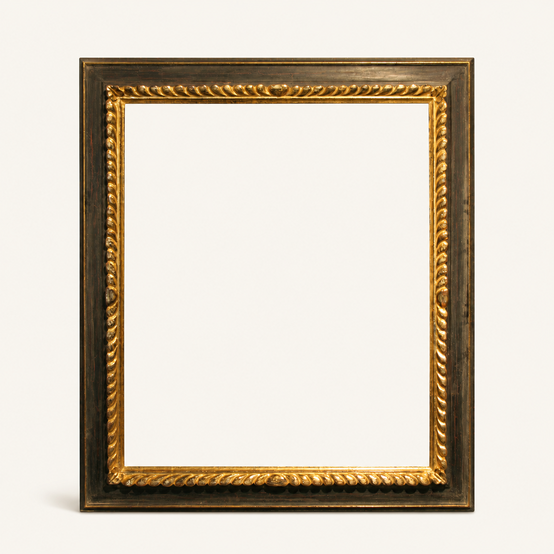
Hand carved gilded frame for paintings, 23 karat gold leaf
- Add feedback:
- Code: 1
- Manufacturer: Karol Milewski
-
Availability:
 Exists
Delivery time: 35 - 55 working days
Exists
Delivery time: 35 - 55 working days
- pcs.
- €413.89
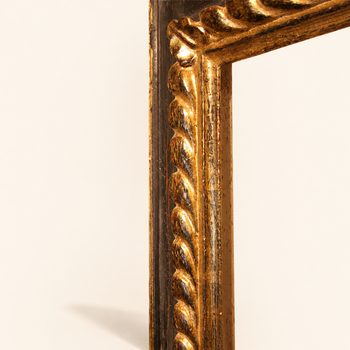
A hand carved gilded frame for paintings. The ornament band is cut by hand into a 110 mm cassetta moulding, then water gilded with 23 karat yellow gold leaf over red bole, with a wide hand patinated frieze running across the centre. Antique style drawn from Italian Renaissance framing, made to the measurements of one particular painting.
A wide, hand carved frame for paintings that carry their own presence: a 110 mm moulding with a band of ornament cut into the timber beside the artwork, a deep patinated frieze across the centre, and 23 karat yellow gold leaf over red bole. The proportions follow sixteenth century Italian cassetta framing, adapted to contemporary picture formats. Each frame is built to order, to the exact dimensions of your work.
Frame profile
The profile opens with a half-round hollow running immediately beside the sight edge. It passes into a hand carved band of ornament, undercut where it ends and carried by a narrow torus into the flat frieze that forms the main field of the moulding. At the outer edge the frieze is closed by a small ovolo, which then falls away in a cove towards the outer side of the frame.
Specification
- Style: cassetta type frame, Italian Renaissance lineage
- Ornament: carved by hand into the routed moulding, not applied composition
- Finish: gesso ground, red bole, 23 karat yellow gold leaf; frieze hand patinated in dark brown; sealed with traditional shellac and wax, giving a satin sheen
- Moulding width: 110 mm
- Moulding thickness, face to back: 44 mm
- Rabbet: 7 mm wide by 24 mm deep
- Material: low tannin timber, the standard used in museum work and art conservation
- Corners: mitred at 45 degrees and reinforced with wooden splines
- Gilding: water gilding, 23 karat yellow gold leaf laid leaf by leaf over red bole
- Glass, backing and mount: available on request, at extra cost
- Artwork retention and hanging: spring clips as standard; portrait or landscape selected from the order menu
- Use: oil paintings on stretcher, historicising and museum grade presentation
The dimensions given describe the moulding itself. The rabbet, the recess that receives the painting, is correspondingly smaller. You order the frame to the dimensions of your painting and it is made 2–3 mm larger, so the work seats without force.
What it suits
This profile is made for paintings with strong colour and compositional weight: oils in full pigment, classical still life, portraits, historicising landscape, copies after the Old Masters. A 110 mm moulding asks for space around it, and it repays the room by setting a clear boundary between the painting and the wall. It sits well over a mantelpiece, in a library, a study, or a formally dressed dining room, and in interiors that take their cue from historical painting traditions: period flats, country houses, rooms with hardwood floors and heavy textiles. In a contemporary setting it works as a deliberate counterpoint, one historicising frame in an otherwise plain room. If you are weighing a new carved frame against reworking an old one, it is worth reading how antique gilded frames are restored and re-gilded before you decide.
How it is made and finished
The moulding is routed to profile first, and the ornament is then carved into it by hand, length by length, with the tools working into the finished section rather than a flat blank. That order matters: the carving has to follow a section that is already fixed, so there is no margin to correct a slip. The mitres are cut at 45 degrees and locked with wooden splines, and the frame is dimensionally settled before any ground goes on it. Then comes the gesso, brushed on in layers and smoothed back, followed by red bole.
The gilding is done with 23 karat yellow gold leaf laid over the bole by the water gilding method, leaf by leaf with an overlap of about a millimetre. Leaves of roughly 80 by 80 mm are cut down on the gilder's cushion with a knife wherever the carving and the narrower members need a smaller piece. The gold is then burnished with an agate stone and worked back by hand, so the red bole reads through as a warm underglow along the raised cuts of the ornament. The frieze is painted and hand patinated in dark brown, and the whole surface is sealed with traditional shellac and wax, which leaves a satin sheen rather than a film.
How it differs from mass production
A factory frame of this type takes its pattern from composition pressed in a mould and glued onto a machine profile, and its gold from metallic paint or imitation leaf. Neither contains gold, and both dull and darken as they oxidise; the applied relief also lifts and chips from its backing over time, because it was never part of the wood. Here the ornament is cut into the timber itself, so it has real depth and real undercuts, the ground is gesso, the bole is clay, and the metal is 23 karat leaf laid by hand on water. Shellac and wax instead of spray lacquer give a surface that improves with age rather than clouding over. Because every length is carved and patinated by hand, the pattern repeats but the rhythm of light across it does not: no two frames in the gilded and partially painted range come out identical.
Functionality
The frame is supplied without glass, as a setting for an oil painting on stretcher. The rabbet is 24 mm deep, which takes a standard stretcher with room to spare, and the painting is held from the back. Every frame in this range can also be made without a rabbet as a floater frame, with the canvas set inside the moulding at a controlled gap, leaving the stretcher edges deliberately exposed.
Frequently asked questions
Is the ornament carved into the wood or applied on top?
Carved. The moulding is routed to profile, then the ornament band is cut into it by hand with carving tools. There is no composition, no cast relief and nothing glued on, which is why the undercuts hold shadow and the gilding follows real depth rather than a shallow moulded impression.
Will it suit an antique or Old Master style painting?
Yes. The proportions come from sixteenth century Italian cassetta frames, the framing tradition most Old Master copies and historicising paintings were composed against. The dark patinated frieze holds the painting away from the gold rather than competing with it.
Can it be made larger than 120 by 80 cm?
Yes. The online calculator covers artwork up to 120 by 80 cm; anything larger is made to individual order. Send me the dimensions and a photograph of the work and I will price it.
Complete framing – additional options
Every frame I make can be completed with full archival and museum-quality framing: anti-reflective UV-filtering glass (four classes to choose from), acid-free museum mat board, spacers wrapped in acid-free paper and a Dibond backing. This kind of mounting protects the work from light, acids and distortion. I set out the full glass and material specification on a separate page: archival and museum framing for paintings and photographs. All components are available at extra cost, as an individual quote on request.
Mounting and hanging
Spring clips are fitted as standard, installed in the workshop and rotated aside to seat or swap the painting without dismantling the frame. Brass plates with screws are available on request, supplied loose with the screws included, for you to fit once the work is in place; this is the permanent retention used in exhibition mounting.
Hanging orientation, portrait or landscape, is selected from the order menu, and the frame is fitted only in the chosen orientation. Picture wire is standard; a single D-ring hanger is available on request.
Ordering to measure
Measure the width and height of the painting to within a millimetre and enter those dimensions into the calculator on this page. The frame is made 2–3 mm larger than the figures you give, so the work seats cleanly. Then select the hanging orientation and add the frame to your basket. The online calculator supports artwork up to 120 by 80 cm; larger formats are made to individual order.
The base price shown is the price per running metre of moulding. The perimeter of the painting is not the whole length the frame needs: corners cut at 45 degrees consume additional length, and the wider the moulding, the more each corner takes. The calculator accounts for the full consumption including corners and any add-ons you select. For guidance on the wider question of framing oil paintings, including rabbet depth and stretcher thickness, see the workshop guide.
Lead time: 20–30 working days.