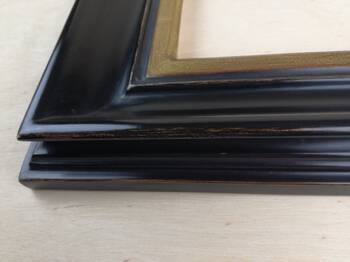
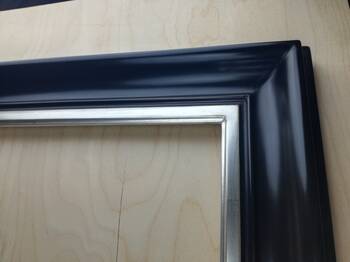
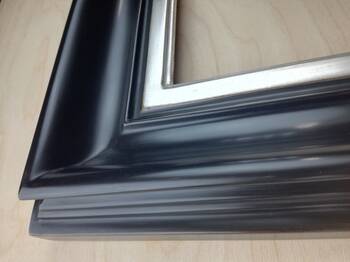
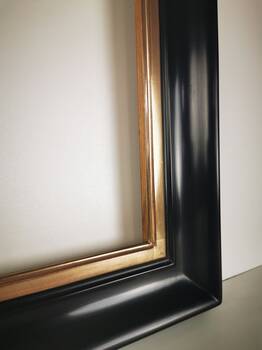
Black scoop picture frame with a gilded inner edge
- Add feedback:
- Code: 122BG
- Manufacturer: Karol Milewski
-
Availability:
 Exists
Delivery time: 20 - 30 working days
- pcs.
- €247.22
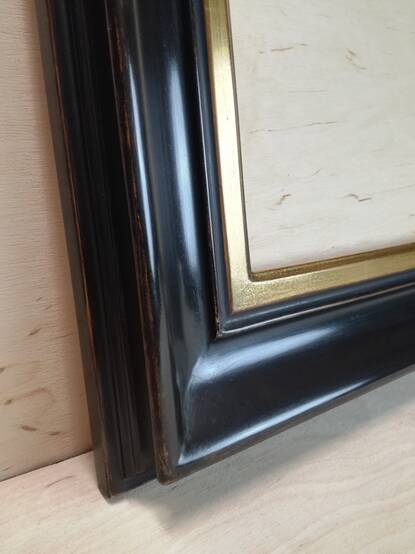
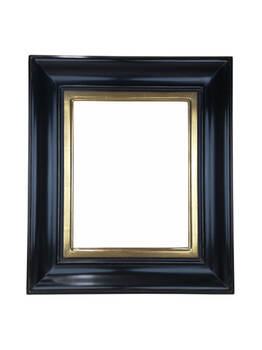
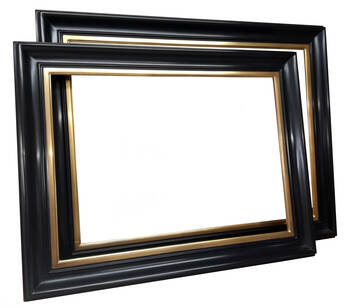
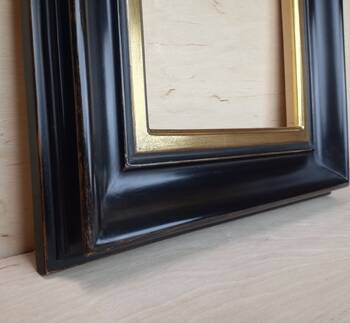
A black scoop picture frame with gilded accents: the face is held by one deep, sweeping hollow that rises to a rolled crest at the outer edge, while a flat band of real gold leaf runs at the sight edge, right around the painting. I hand-paint the 86 mm moulding, about 3 3/8 inches, and water gild that band in 23-karat yellow gold, 22-karat moon gold or 12-karat white gold. Made to measure for paintings on canvas.
Among my black picture frames this one is built on a deep scoop section: a moulding 86 mm wide and 45 mm thick from face to back, whose face falls away from the painting and then climbs to a rolled crest at the outer edge. A flat band of water gilded gold leaf runs at the sight edge, marking the line where the frame meets the canvas, while the black hollow holds the painting forward. I make each frame to measure in the workshop, for collectors, galleries and private clients framing work that deserves more than a length of factory moulding.
Frame profile
At the sight edge runs a narrow flat, and behind it a flat frieze with a shallow hollow worked into it. The gold covers both and stops where the flat ends, at a small half-round bead. From the bead the most distinctive part of the section begins: a broad, deep scoop that first falls gently away and then rises, ever more steeply, towards the outer edge. The highest point of the moulding is a pronounced rolled crest, S-shaped in section. Behind the crest the moulding is undercut, drops through two soft steps and flattens a little at the base.
Specification
- Style: classical, a deep scoop profile with a gilded sight edge
- Finish: hand-painted black with a satin sheen, sealed with traditional shellac and wax; gilded elements in genuine gold leaf
- Gilding: real gold leaf, water gilded on bole: 23-karat yellow gold, 22-karat moon gold or 12-karat white gold, chosen in the order menu
- Bole colour: nine shades to choose from, red as standard (also grey, Victorian grey, plum, black, brown, yellow, olive green, light blue); the bole tunes the tone of the gold
- Moulding width: 86 mm
- Moulding thickness (face to back): 45 mm in the base version, 50 mm in the deeper version
- Rebate: 7 mm wide, 10 mm or 20 mm deep, selected in the order menu; maximum thickness of the work 10 mm or 20 mm accordingly
- Material: solid timber with a low tannin content, of the kind used in museum conservation
- Corner joinery: mitred corners reinforced with wooden splines
- Glazing, backing and mat: available as archival add-ons, quoted individually
- Mounting and hanging: sprung clips as standard, brass plates on request; picture wire, portrait or landscape orientation
- Use: oil and acrylic paintings on canvas and stretchers, made to measure
The frame is made to the dimensions of your painting: you enter the width and height of the artwork in the calculator, the rebate is cut 2 to 3 mm larger than the canvas, and the moulding overlaps the painted surface by about 4 to 5 mm on each side.
Which paintings and interiors it suits
The deep rebate and the sprung-clip mounting make this first of all a frame for framing oil paintings and acrylics on stretched canvas: portraits, landscapes and still lifes. Because the face is broad and the hollow deep, the frame gives a painting presence on the wall without crowding it, and the way a concave face carries the eye inwards is something I set out in the guide to reverse and concave profiles. In a room it sits as comfortably among dark timber and brass as in a plain modern interior.
Craftsmanship and finish
Everything that happens after the timber is cut is handwork. I join the mitred corners first and reinforce them with wooden splines, then build up the ground: layers of gesso and, over the flat at the sight edge and the frieze behind it, a coloured gilding bole in the shade you choose. The gold is laid as water gilding, leaf beside leaf with a slight overlap, cut to the width of the band on the gilder's cushion. Because the leaf lies on bole, the colour underneath keeps working in the finished frame: red warms the gold, grey and black quieten it.
The black is brushed on in thin coats, so a soft texture stays visible across the sweep of the hollow, and I patinate the gilding with translucent glazes so the gold stops behaving like a mirror. The frame is sealed with traditional shellac and wax, which gives the black its satin sheen.
How it differs from mass production
A factory frame in this style is a length of pre-finished moulding, cut and stapled together, with the gold effect printed or foiled on. Here the sequence is reversed: the corners are joined and splined first, and only the assembled frame is primed, gilded and painted, so the finish runs unbroken around the corners. Real gold leaf on bole also ages differently from any imitation, since it can be patinated, repaired and, decades from now, re-gilded.
Functionality
Like all my frames for paintings, it is supplied without glazing: the canvas sits in the rebate, held from the back. The rebate is 7 mm wide, with a depth of 10 mm or 20 mm chosen in the order menu, which sets the maximum thickness of the work at 10 mm or 20 mm; the deeper version adds 5 mm to the thickness of the moulding, 50 mm instead of 45 mm. That depth decides what the frame can enclose, rather than how far the moulding stands off the wall; if your stretcher is thicker, write to me and I will adjust it. The same moulding can also be made without a rebate as a floating frame for canvas art, where the painting appears to hover inside the frame with a shadow gap around its edges.
Frequently asked questions
Is the whole frame gilded, or only the inner edge?
The gold covers the flat at the sight edge and the frieze behind it, and stops at the bead; the scoop and the crest are painted black by hand. It is a painted frame with gilded accents rather than a gilded frame.
Which gold tone should I choose for an oil painting?
23-karat yellow gold gives the warmest, most classical line and works with earths, reds and browns. 22-karat moon gold is paler and cooler, better with greys, blues and muted contemporary palettes. 12-karat white gold is paler again, a cool, silvery tone that keeps a little of the warmth of gold. The bole underneath shifts each of them again, with red as the standard choice.
Can this frame take conservation-grade low-reflection UV glazing?
Yes. It leaves the workshop without glazing, because it is built for canvas on a stretcher, but for a work on paper I can complete it with conservation-grade, low-reflection UV glazing, acid-free mat board and a Dibond backing. A traditional mat border for a frame of this weight runs about 2 to 3 inches, 50 to 75 mm.
Can a gilded frame be made within a tighter budget?
Yes, by changing the profile rather than the gold. A narrower moulding takes less leaf and less handwork per metre, while the band at the sight edge stays real gold leaf.
Complete framing - additional options
Every frame I make can be completed with full archival and museum-quality framing: anti-reflective UV-filtering glass (four classes to choose from), acid-free museum mat board, spacers wrapped in acid-free paper and a Dibond backing. This kind of mounting protects the work from light, acids and distortion. I set out the full glass and material specification on a separate page: archival and museum framing for paintings and photographs. All components are available at extra cost, as an individual quote on request.
Mounting and hanging
This frame is intended for paintings on canvas and stretchers, so it does not include glass as standard. To hold the painting, I fit sprung retaining clips as standard; they pivot to the side, so the canvas can be removed and replaced quickly without tools. On request I supply brass plates with screws instead (provided loose, for permanent self-installation). The hanging orientation, portrait or landscape, is chosen at checkout. Picture wire is standard, with a single D-ring available on request.
Ordering made to measure
The base price shown on the site is the price per running metre of moulding. The perimeter of the painting is not the full length of moulding a frame needs: corners cut at 45 degrees take extra length, and the wider the moulding, the more they take. The calculator accounts for the full moulding consumption with corners and for any options you choose, so you only need to enter the dimensions of your painting. The calculator accepts artwork up to a perimeter of 180 cm, the limit set for a moulding of this width; larger formats I make to individual order, so please write to me first. The lead time is 20 to 30 working days.