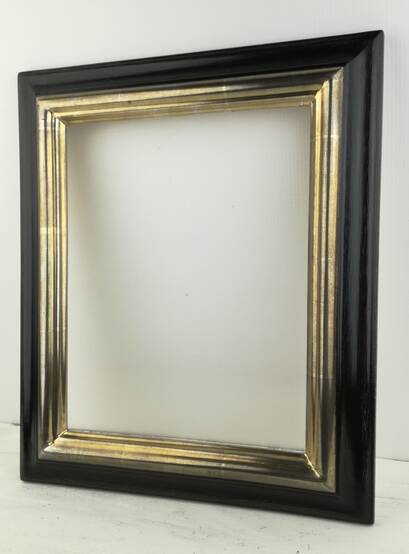
Black Picture Frame with Silver Leaf for Oil Paintings
- Add feedback:
- Code: 118R
- Manufacturer: Karol Milewski
-
Availability:
 Exists
Delivery time: 20 - 30 working days
- pcs.
- €191.67
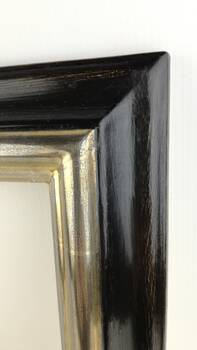
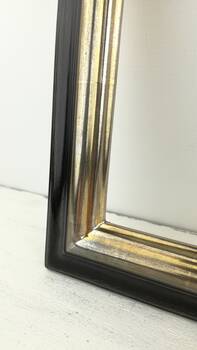
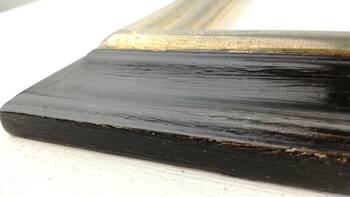
A hand-finished frame for oil paintings: the outer face is painted black shading into dark brown, and the band next to the canvas is covered in genuine silver leaf, water gilded over gesso and grey bole, then patinated. The moulding is 46 mm wide, about 1¾ inches, and the profile is reversed, so the crown of the section sits at the artwork and the face falls away towards the wall.
A black picture frame with silver leaf, made to measure for oil and acrylic paintings on stretchers. The outer face is painted black shading into dark brown, and the band closest to the canvas is covered in genuine silver leaf and patinated, so the metal sits against the painting rather than at the far edge. The section is reversed in the Dutch manner: the highest point lies at the artwork and the face descends towards the wall, closing the painting in and drawing the eye inwards. More on that in my guide to Dutch frames and the reverse profile.
The moulding profile
At the artwork the face opens with a cavetto on a quarter-circle arc, rising to a narrow flat about 5 mm across. From that flat the surface lifts into a half-round torus, the highest point of the section. Beyond the torus the face drops away in a shallow hollow, then rises again near the outside and closes with a narrow cornice. The shape is machine milled; everything after that is hand work.
Specification
- Style: reverse profile
- Finish: genuine silver leaf, chemically patinated, next to the artwork; black shading into dark brown outside it; satin sheen
- Moulding width: 46 mm
- Moulding thickness (face to back): 24 mm with the 10 mm rebate
- Rebate: 7 mm wide, 10 mm or 20 mm deep
- Silvering: genuine silver leaf laid on water over gesso and grey bole
- Sealing: shellac and wax
- Timber: low-tannin wood, as used in art conservation
- Corner joinery: mitred at 45 degrees, wooden splines
- Glazing, backing and mounts: add-ons
- Mounting and hanging: spring clips, cord, vertical or horizontal
- Suitable for: oil and acrylic painting, rigid supports
Ordering dimensions: I build to the size of the painting, not the frame, so the calculator asks for the width and height of the work. I add 2 to 3 mm of clearance to those figures, and the moulding covers about 4 to 5 mm of the edge.
Which artworks and interiors it suits
The frame is drawn for oil painting. The dark outer zone quietens whatever surrounds the picture, and the silver band lifts the cool passages of paint: greys, greens and blues. It suits landscape, still life and portrait in a restrained palette. At 46 mm, about 1¾ inches, it is wide enough not to look provisional and narrow enough not to overwhelm smaller formats. In a room it sits well against dark timber and muted walls, and holds its own in a plain contemporary interior. How I match frame to canvas is on my page about framing oil paintings, and other colour and metal variants are in the category of picture frames gilded and partially painted.
How the frame is made and finished
I cut the moulding at 45 degrees and join the corners with wooden splines first. Only then does the frame receive gesso, built up in layers and sanded smooth, followed by grey bole. The bole matters: showing through in places, it cools the silver rather than warming it. The leaf is laid on water, leaf by leaf, with an overlap of about a millimetre; leaves are roughly 80 by 80 mm, so on a band this narrow I cut them on the gilder's cushion. More on the technique is on my page about water gilding.
The silvered zone is then patinated chemically. The patina is raised on the surface of the metal rather than painted on, so it dims the silver unevenly, more in the hollow and less on the crown, and that unevenness reads as long use. The hollow and the cornice I paint black shading into dark brown; shellac and wax then fix the patina and give a satin sheen.
How it differs from mass production
A ready-made frame of this appearance is normally reached with metallised foil or a print imitating worn metal over a moulding pressed from board. Here the silver is real metal on gesso and bole, and its dimming is a chemical reaction on the leaf, not a pattern repeating every few dozen centimetres.
Practical points
The frame is supplied without glazing. An oil painting on a stretcher usually does not need it, and leaving it out removes weight and breakage risk in transit. The rebate depth is chosen from the order menu. The same moulding can be made without a rebate, as a floater frame with a gap around the canvas.
Frequently asked questions
Is the whole frame silvered, or only part of it?
Only the band beside the artwork, from the cavetto up over the torus; the rest of the face is hand painted. The whole moulding can be covered in metal to order, in silver, palladium or white gold leaf.
Which rebate depth do I need for my canvas?
It follows the stretcher. Bars up to 10 mm, about 3/8 inch, and rigid supports sit in the 10 mm rebate; a standard stretcher up to 20 mm, about 3/4 inch, needs 20 mm. For anything thicker, write to me and I will make it deeper.
Can this frame take conservation-grade low-reflection UV glazing?
Yes. Glazing is not part of the standard build, but I fit it on request with an acid-free mount, spacers and an archival backing panel.
Will the patina on the silver keep darkening?
No. The darker tone is raised chemically at the finishing stage and stopped by the shellac and wax, which seal the metal from the air. A dry cloth is all it needs.
Can a frame like this be made to a tighter budget?
Yes, by simplifying the section rather than the materials. A narrower moulding with a shorter silvered band uses less leaf and less time at the cushion, and the metal stays real.
Complete framing: additional options
Every frame I make can be completed with full archival mounting: conservation-grade low-reflection UV glazing, acid-free museum board mounts, spacers and a Dibond backing panel. Conservation framing of this kind protects the work from light, from the acids in ordinary framing materials and from mechanical distortion. The glazing classes and materials are set out on a separate page about archival and museum framing. Every set is priced individually for the particular work.
Mounting and hanging
The painting sits into the rebate from the back, held by spring clips that turn aside under a fingertip, so it can be taken out and put back without dismantling anything. Brass plates with screws are prepared on request for permanent fixing. Orientation, vertical or horizontal, is chosen from the order menu. Hanging is on cord, with a single D-ring on request.
Made to measure
The base price on this page is the price per linear metre of moulding. The perimeter of the painting is not the whole length a frame needs: corners cut at 45 degrees take up extra length, and the wider the moulding, the more they take. The calculator accounts for that and for any options selected. For this width it handles artworks up to 180 cm around the perimeter, roughly 71 inches; anything larger is made to individual order, so send me the dimensions. Production takes 20 to 30 working days.