Black Ogee Picture Frame with a Hand-Gilded Inner Edge
- Add feedback:
- Code: 178
- Manufacturer: Karol Milewski
-
Availability:
 Exists
Delivery time: 20 - 30 working days
- pcs.
- €247.22
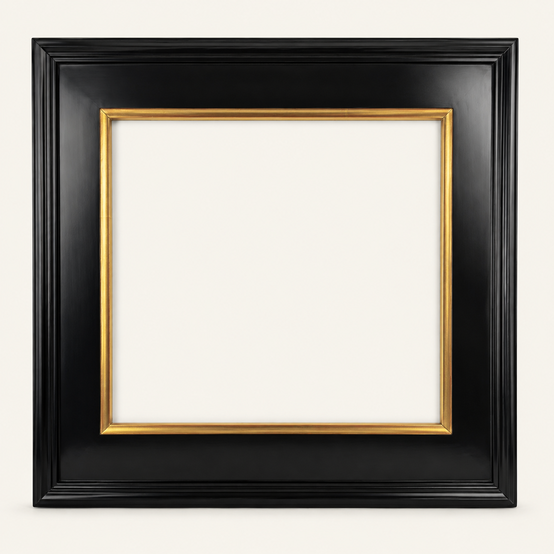
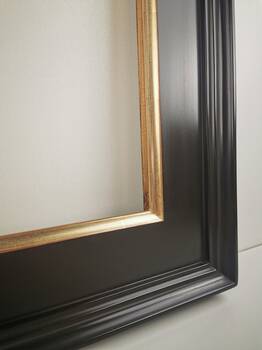
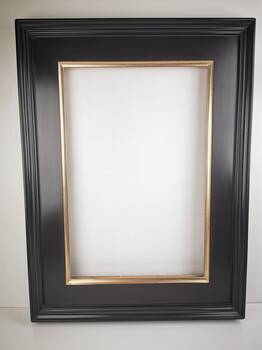
A wide black picture frame made to measure, 100 mm across the face, with a narrow band of gold leaf laid by hand at the inner edge. The flat frieze is painted deep black and finished to a satin sheen, and towards the outside the surface climbs through an ogee to a flat crown. Genuine leaf over red bole, in 23-karat yellow, 22-karat moon gold, 12-karat or 6-karat white gold.
A wide black frame for a work that can carry one: the face measures 100 mm across, most of it a flat frieze painted deep black, and at the inner edge runs a narrow band of genuine gold leaf laid by hand. The black is finished to a satin sheen rather than a gloss, so the frieze holds the light quietly and the gilded band stays the one bright line in the composition. You choose which leaf goes on that band: 23-karat yellow gold, 22-karat moon gold, 12-karat white gold or 6-karat white gold. It belongs to my range of black picture frames.
The moulding profile
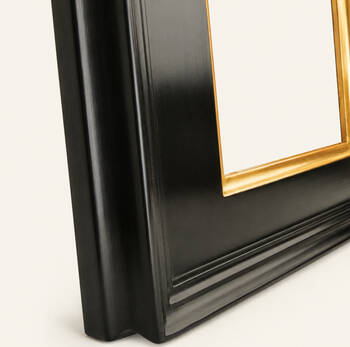
At the artwork side the moulding opens with a concave hollow, a narrow band scooped out of the timber that lifts the surface away from the work. Beyond it lies the flat frieze, close to half the width of the moulding, a smooth plane of black that sets the character of the whole frame. Towards the outside the surface begins to climb: first a quarter-round hollow, then an ogee that carries the profile to its highest point, the flat crowning edge at the outer perimeter. The outer flank is cut by a further recess, so that from the side the frame reads as though built from two parts.
Specification
- Style: classical ogee profile with a wide flat frieze, machine-milled
- Face finish: deep black, hand-sanded, satin sheen, sealed with shellac and wax
- Gilding: genuine gold leaf at the inner edge, water gilded over bole and hand-patinated
- Leaf options: 23-karat yellow gold, 22-karat moon gold, 12-karat white gold, 6-karat white gold
- Bole: red as standard, other colours agreed when you order
- Moulding width: 100 mm
- Moulding thickness (face to back): 50 mm
- Rebate: 7 mm wide × 20 mm deep
- Material: timber with a low tannin content, of the type used in museum and conservation framing
- Joinery: mitred at 45° and reinforced with timber splines, before any ground is applied
- Glass, archival backing and matting: available as an add-on, quoted individually
- Lead time: 20 to 30 working days
- Suitable for: oil and acrylic on canvas, works on paper, photographs and prints
Enter the dimensions of the artwork itself into the calculator, to the millimetre. I build the frame about 2 to 3 mm larger than the size you give me, so the work seats without forcing, and the moulding then covers roughly 4 to 5 mm of the edge on each side.
What it suits
A 100 mm face is a decision about weight. It gives a modestly sized painting the presence of a much larger one, which is why it works around oils with a strong painterly charge, expressive landscape, abstraction and black-and-white photography, and why it is the wrong choice around a delicate study that needs air rather than mass. The gilded inner edge keeps it usable in classical settings too: drawings, watercolours, monochrome prints, archival photographs and diplomas all sit well inside it. In a room it behaves as a single dark rectangle with one line of light in it, which suits contemporary interiors with older pieces in them, private galleries, studies and hallways. My notes on wide wooden painting frames go through how face width changes the reading of a picture, and if the work is an oil on canvas my page on framing oil paintings covers the practical side.
Making and finishing
The mitres are cut at 45° and reinforced with timber splines before any ground goes on, so the corners are locked by the joint rather than by the finish. Several coats of gesso follow, rubbed back between coats, and over the band that will be gilded goes the coloured bole, the clay ground that gives water gilding its depth and lets it be burnished. Leaf arrives in squares of roughly 80 × 80 mm, far wider than this narrow band, so each square is cut down on the gilder's cushion before laying. It goes on one leaf at a time onto wetted bole, each leaf overlapping its neighbour by about a millimetre, and that single laid layer is the gold you see. The band is then hand-patinated, a fine and even softening that lets the bole read through and keeps a new frame from looking raw. The frieze is laid in a richly pigmented paint from a curated range, hand-sanded between coats to an even satin surface, and the whole frame is sealed with shellac and wax. I set the gilding process out on my water gilding page.
How it differs from a mass-produced frame
A factory moulding in this shape arrives already finished, in fixed lengths, its gold a foil or a sprayed lacquer over a synthetic base, and it is cut to whatever standard sizes the run requires. Here the timber is jointed to your measurements first and finished afterwards, so the gesso and the paint run across the mitres as one unbroken surface. The gold is metal rather than colour: it reflects instead of glowing flat, it varies along the hollow as the light moves, and it ages instead of peeling. At this width the difference is easy to see, because a 100 mm face gives a machine finish nowhere to hide.
Functionality
The frame is supplied without glass as standard, as oils and acrylics on canvas are normally framed. What governs how much it holds is the rebate depth rather than the 50 mm thickness of the moulding: 20 mm takes a standard stretcher or a panel. Works on paper are held behind glass with a backing and, where the sheet must not touch the glazing, spacers. It can also be made without a rebate at all, as a floating frame, with a shadow gap running around the canvas.
Complete framing – additional options
Every frame I make can be completed with full archival and museum-quality framing: anti-reflective UV-filtering glass (four classes to choose from), acid-free museum mat board, spacers wrapped in acid-free paper and a Dibond backing. This kind of mounting protects the work from light, acids and distortion. I set out the full glass and material specification on a separate page: archival and museum framing for paintings and photographs. All components are available at extra cost, as an individual quote on request.
Mounting and hanging
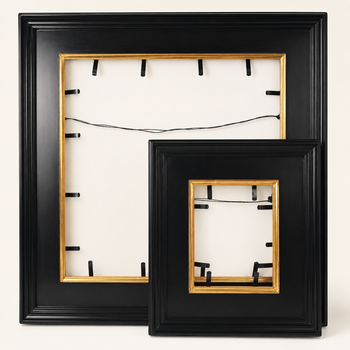
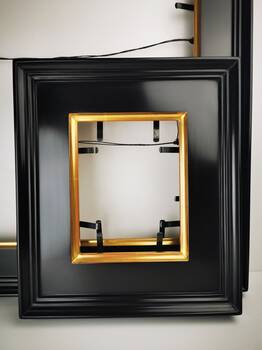
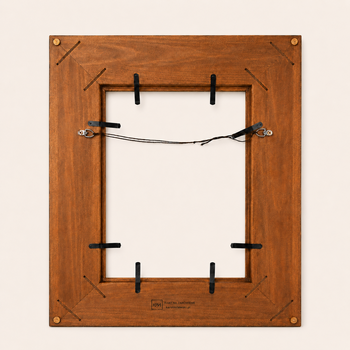
As standard the frame is fitted with sprung clips, which turn to release and make it easy to change the canvas. On request I fit brass plates with screws instead, supplied loose for you to install for a permanent fixing. For hanging, the frame takes picture wire as standard, with a single D-ring hanger available on request; you choose portrait or landscape orientation when you order.
Ordering made to measure
The base price shown on the page is the price per running metre of moulding. The perimeter of the artwork is not the full length of moulding a frame needs: the corners, cut at 45°, take up additional length, and the wider the moulding, the more they consume. The calculator accounts for the full run of moulding including its corners, plus the fittings and options you choose. Glass, archival backing and matting are quoted separately.
For this moulding width the calculator handles artworks up to 180 cm around the perimeter; anything larger is made to individual order, so send me the dimensions and I will price it. Lead time is 20 to 30 working days. If your order is tied to a date or an exhibition, get in touch first and I will tell you what is realistic.